Moist Walnut Bundt Cake Recipe
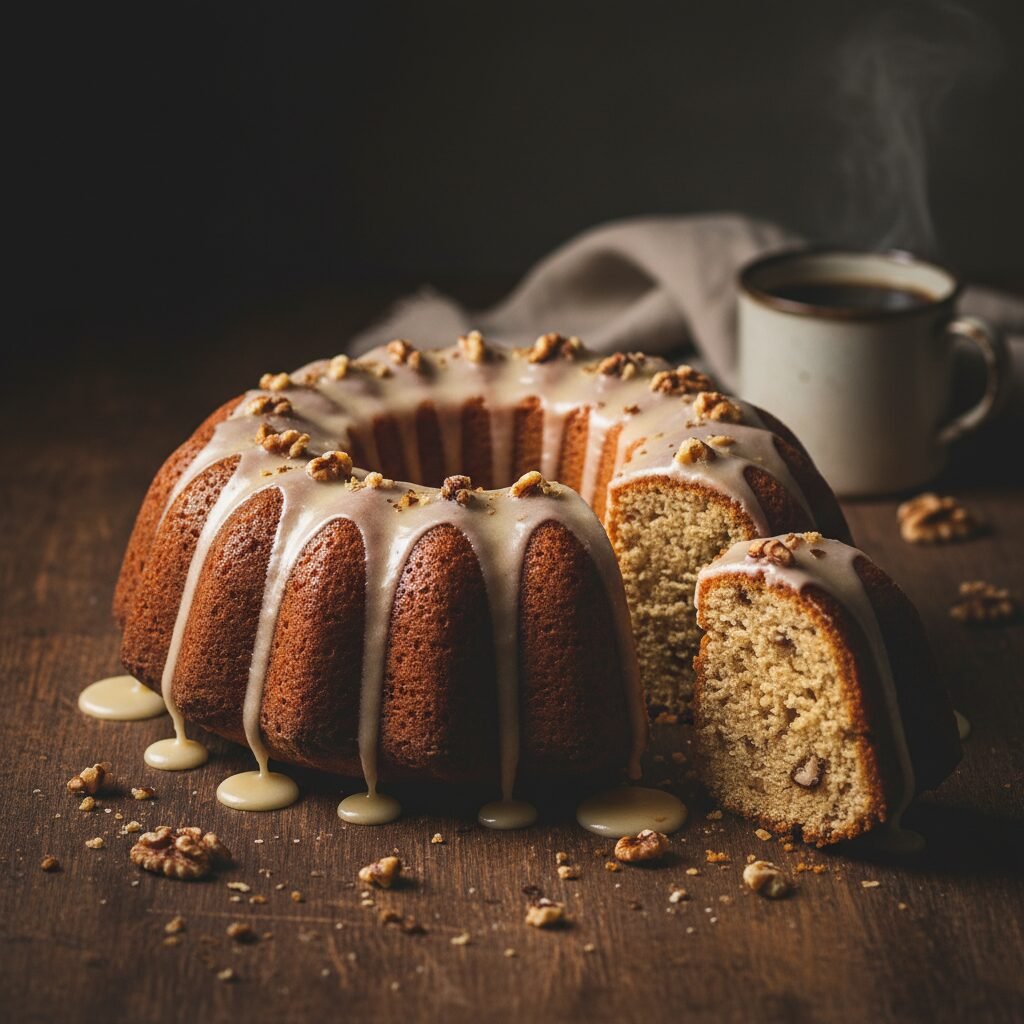
Discover the secret to the most tender, melt-in-your-mouth Walnut Bundt Cake you will ever taste. Infused with toasted walnuts and topped with a rich maple glaze, this recipe is the perfect centerpiece for holiday gatherings or a cozy afternoon coffee break.
20 minutes
55 minutes
1 hour 15 minutes
12-14 servings
Dessert
Baking
American
Vegetarian
There is something undeniably comforting about a Bundt cake. Unlike the precarious layers of a birthday cake or the casual nature of a sheet cake, the Bundt stands in a league of its own—sturdy yet elegant, rustic yet refined. This specific Moist Walnut Bundt Cake recipe is a love letter to classic baking, designed to evoke memories of grandmother’s kitchen while delivering a texture that is scientifically perfected for modern palates. The magic lies in the crumb; it is incredibly dense and moist, avoiding the dry, crumbly fate that befalls so many nut-based cakes.
What sets this recipe apart is the depth of flavor achieved by pre-toasting the walnuts. Many recipes simply fold raw nuts into the batter, but taking the extra ten minutes to roast them releases their natural oils, intensifying the nutty aroma that permeates every slice. Paired with a batter enriched with both butter and sour cream, the result is a cake that stays fresh for days—if it lasts that long. The sour cream provides the acidity needed to tenderize the gluten strands in the flour, ensuring a velvety texture that is soft but holds its shape beautifully when sliced.
Whether you are an experienced baker looking for a reliable showstopper or a novice wanting to try your hand at a classic shape, this recipe is approachable and forgiving. We finish it off with a glossy maple glaze that cascades down the ridges of the cake, pooling slightly at the base, creating a sticky, sweet counterpoint to the earthy, savory notes of the walnuts. It is the quintessential companion to a hot cup of black coffee or a steaming mug of tea, making it an ideal choice for breakfast, brunch, or dessert.
History & Origins
The history of the Bundt cake is a fascinating journey that bridges European tradition with mid-century American innovation. The distinctive ring shape of the cake traces its lineage back hundreds of years to the European ‘Gugelhupf’ or ‘Kugelhopf,’ a brioche-style cake popular in Germany, Austria, and Alsace. These early cakes were yeast-leavened and often studded with fruit and nuts, baked in ceramic or cast-iron pans with a central chimney to help the dense dough bake evenly.
However, the Bundt cake as we know it in America is a relatively recent phenomenon, largely credited to H. David Dalquist, the founder of Nordic Ware. In 1950, at the request of a group of Jewish women from the Hadassah Society in Minneapolis who wanted to recreate the traditional cakes of their heritage, Dalquist cast a lightweight aluminum version of the heavy ceramic pans. He trademarked the name ‘Bundt,’ adding a ‘t’ to the German word ‘Bund’ (meaning an alliance or bond) to aid in pronunciation and trademarking.
Initially, the pan was a commercial failure. It wasn’t until the 1966 Pillsbury Bake-Off, where Ella Helfrich of Houston, Texas, won second place with her ‘Tunnel of Fudge’ cake, that the Bundt pan catapulted to stardom. Overnight, every household in America wanted a Bundt pan. Since then, the Bundt has become a staple of American baking, evolving from the heavy yeast cakes of the Old World to the chemically leavened, moist, and rich pound-cake styles we adore today. This Walnut Bundt Cake pays homage to that history, combining the nutty, dense texture of the original Kugelhopf with the ease and moisture of the modern American kitchen.
Why This Recipe Works
This recipe succeeds where others fail due to a careful balance of fat, acidity, and thermal dynamics. First, the inclusion of sour cream is non-negotiable. Sour cream has a high fat content, which shortens gluten strands, preventing the cake from becoming tough or chewy. Moreover, its acidity reacts with the baking soda to create carbon dioxide gas, which helps lift the heavy batter, resulting in a crumb that is dense but not brick-like.
Secondly, the method of incorporating the walnuts is crucial. By chopping the toasted walnuts finely and tossing them with a small amount of flour before folding them into the batter, we ensure suspension. A common pitfall in nut cakes is that the heavy nuts sink to the bottom of the pan during baking. The flour coating creates friction, holding the nuts in place throughout the rising process, guaranteeing a crunchy bite in every forkful.
Finally, the Bundt pan itself is an engineering marvel utilized here for even cooking. Because this batter is heavy and rich, baking it in a standard round pan would likely result in burnt edges and a raw center. The central tube of the Bundt pan allows heat to penetrate the center of the cake, cooking it from the inside out as well as the outside in. This promotes a uniform bake and creates that beautiful, caramelized crust on all sides, which seals in the moisture effectively.
Why You’ll Love This Recipe
- ✓Incredibly moist crumb thanks to the sour cream and butter combination.
- ✓Rich, toasted walnut flavor in every single bite.
- ✓Keeps fresh for up to 5 days at room temperature.
- ✓Beautiful presentation with a simple maple glaze.
- ✓Freezer-friendly for make-ahead holiday prep.
Equipment You’ll Need
- ✓10-12 cup Bundt pan
- ✓Stand mixer or electric hand mixer
- ✓Large mixing bowl
- ✓Medium mixing bowl
- ✓Wire cooling rack
- ✓Rubber spatula
- ✓Measuring cups and spoons
- ✓Baking sheet (for toasting nuts)
Ingredients
- ✓2 1/2 cups All-Purpose Flour
- ✓1 teaspoon Baking Powder
- ✓1/2 teaspoon Baking Soda
- ✓1/2 teaspoon Salt
- ✓1 cup Unsalted Butter, softened to room temperature
- ✓1 1/2 cups Granulated Sugar
- ✓1/2 cup Light Brown Sugar, packed
- ✓4 large Eggs, room temperature
- ✓1 tablespoon Pure Vanilla Extract
- ✓1 cup Full-Fat Sour Cream, room temperature
- ✓1 1/2 cups Walnuts, toasted and roughly chopped
- ✓1 cup Powdered Sugar (for glaze)
- ✓2-3 tablespoons Pure Maple Syrup (for glaze)
- ✓1 tablespoon Milk or Heavy Cream (for glaze)
Instructions
- Preheat your oven to 350°F (175°C). Spread the walnuts on a baking sheet and toast for 8-10 minutes until fragrant. Let them cool completely, then chop roughly.
- Thoroughly grease your Bundt pan with butter or non-stick baking spray (the kind with flour in it works best). Dust with flour if using butter, tapping out excess.
- In a medium bowl, whisk together the flour, baking powder, baking soda, and salt. Remove 1 tablespoon of this mixture and toss it with the cooled walnuts to prevent sinking.
- In the bowl of a stand mixer fitted with the paddle attachment, cream the softened butter, granulated sugar, and brown sugar on medium-high speed for 5 minutes until pale and fluffy.
- Add the eggs one at a time, beating well after each addition and scraping down the sides of the bowl. Stir in the vanilla extract.
- Reduce the mixer speed to low. Add the flour mixture in three parts, alternating with the sour cream in two parts, starting and ending with the flour. Mix just until combined; do not overmix.
- Gently fold in the flour-coated walnuts using a rubber spatula.
- Pour the batter into the prepared pan and smooth the top. Tap the pan firmly on the counter twice to release air bubbles.
- Bake for 50-60 minutes, or until a wooden skewer inserted into the center comes out clean or with just a few moist crumbs attached.
- Let the cake cool in the pan for exactly 10 minutes. Then, invert it onto a wire rack to cool completely.
- While the cake cools, whisk together powdered sugar, maple syrup, and milk until smooth. Drizzle over the completely cooled cake before serving.
Expert Cooking Tips
- ✓Room temperature ingredients are vital; cold eggs or sour cream can curdle the batter.
- ✓Don’t skimp on greasing the pan; get into every nook and cranny to ensure a clean release.
- ✓Toast the nuts! It makes a massive difference in flavor depth.
- ✓Do not overmix the batter once the flour is added, or the cake will be tough.
- ✓Cool the cake in the pan for exactly 10 minutes—too short and it breaks; too long and it sticks.
- ✓Weigh your flour if possible (approx. 120g per cup) to avoid a dry cake.
Substitutions and Variations
Baking is chemistry, but there is some room for flexibility in this recipe. If you don’t have walnuts, pecans are an excellent 1:1 substitution that offers a slightly sweeter profile. For those with nut allergies, you can omit the nuts entirely or replace them with chocolate chips (tossed in flour) for a different vibe. If you don’t have sour cream, full-fat Greek yogurt is the best alternative; it provides similar acidity and fat content. Buttermilk can also work, though the batter will be slightly thinner. Regarding the flour, you can use cake flour for an even lighter crumb, but all-purpose flour provides the best structure for holding the heavy nuts. For the glaze, if you dislike maple, a simple vanilla glaze using milk and vanilla extract, or a lemon glaze with fresh lemon juice, works beautifully to cut the richness.
Common Mistakes to Avoid
The most heartbreaking mistake with Bundt cakes is the ‘stick.’ This usually happens because the pan wasn’t greased properly or the cake cooled in the pan for too long. The sugar in the crust turns into glue as it cools, so timing the inversion is critical. Another common error is over-baking. Because the pan is dark and deep, it retains heat well. Check the cake 5 minutes before the timer goes off. If the skewer has wet batter, keep baking. If it has dry crumbs, it might be overdone. Aim for moist crumbs. Lastly, using cold butter will prevent proper creaming. The butter must be soft enough to indent with a finger but not melted, or the cake won’t rise properly.
Serving Suggestions
This Moist Walnut Bundt Cake is versatile enough for various settings. For a sophisticated dessert, serve a slice slightly warmed with a dollop of unsweetened whipped cream and a dusting of cinnamon. It pairs exceptionally well with poached pears or fresh berries to cut the sweetness. For a breakfast or brunch setting, it stands alone perfectly next to a strong espresso or a chai latte. You can also serve it ‘naked’ without the glaze, simply dusted with powdered sugar, for a less sweet, more rustic presentation suitable for afternoon tea.
Storage and Reheating Tips
One of the best features of this cake is its shelf life. It can be stored at room temperature in an airtight container (or a cake dome) for up to 5 days. In fact, the flavor often improves on the second day as the moisture redistributes. If you live in a very hot or humid climate, you may want to refrigerate it, but bring it to room temperature before eating for the best texture. For long-term storage, this cake freezes beautifully. Wrap individual slices or the whole unglazed cake tightly in plastic wrap, then foil. It will keep in the freezer for up to 3 months. Thaw on the counter overnight before glazing and serving.
Nutrition Facts (Estimated)
| Serving Size | 1 slice |
| Calories | 480 |
| Fat | 28g |
| Saturated Fat | 12g |
| Unsaturated Fat | 14g |
| Trans Fat | 0g |
| Cholesterol | 85mg |
| Sodium | 210mg |
| Carbohydrates | 54g |
| Fiber | 2g |
| Sugar | 32g |
| Protein | 6g |
Frequently Asked Questions
Why did my walnuts sink to the bottom?
This happens if the batter is too thin or the nuts are too heavy/oily. The key is to toss the chopped nuts in a tablespoon of flour before adding them. This creates friction that holds them in suspension within the batter.
Can I use a different pan if I don’t have a Bundt pan?
Yes, but the baking time will change significantly. You can use two 9×5 inch loaf pans. Start checking for doneness around 40-45 minutes. The texture will be similar, but you lose the signature crust-to-interior ratio of the Bundt.
My cake is stuck in the pan. What do I do?
Don’t panic. If it’s stuck, leave it inverted on the rack and place a kitchen towel soaked in hot water over the Bundt pan for a few minutes. The steam often helps release the sugars gripping the pan. Give it a gentle shake.
Can I make this cake gluten-free?
Yes, you can use a high-quality 1:1 gluten-free all-purpose flour blend (one that contains xanthan gum). The texture might be slightly more dense, but the sour cream helps keep it moist.
Is the maple glaze necessary?
Not at all. The cake is flavorful enough on its own. You can simply dust it with confectioners’ sugar or serve it plain. The glaze just adds an extra layer of sweetness and visual appeal.
Can I use oil instead of butter?
Butter is recommended for the flavor profile of this specific recipe. However, you can substitute half the butter with a neutral vegetable oil if you want an even softer crumb, but you will lose some of that rich, buttery taste.
How do I know when the cake is truly done?
Visual cues include the cake pulling away slightly from the sides of the pan. The truest test is a wooden skewer inserted into the deepest part of the cake coming out with a few moist crumbs, not wet batter.
Can I add chocolate chips?
Absolutely. You can add 1/2 to 1 cup of semi-sweet chocolate chips. Treat them like the walnuts—toss them in a little flour so they don’t sink to the bottom.
Conclusion
Baking this Moist Walnut Bundt Cake is more than just following a recipe; it is about creating a moment of warmth and connection. The aroma of toasted walnuts and vanilla filling your kitchen is a reward in itself, second only to that first bite of tender, maple-glazed goodness. Whether you are baking for a holiday celebration, a family gathering, or simply treating yourself to a delicious weekend project, this cake promises to deliver joy in every slice. We hope this becomes a cherished recipe in your collection, passed down just like the Bundt pans of the past. Happy baking!