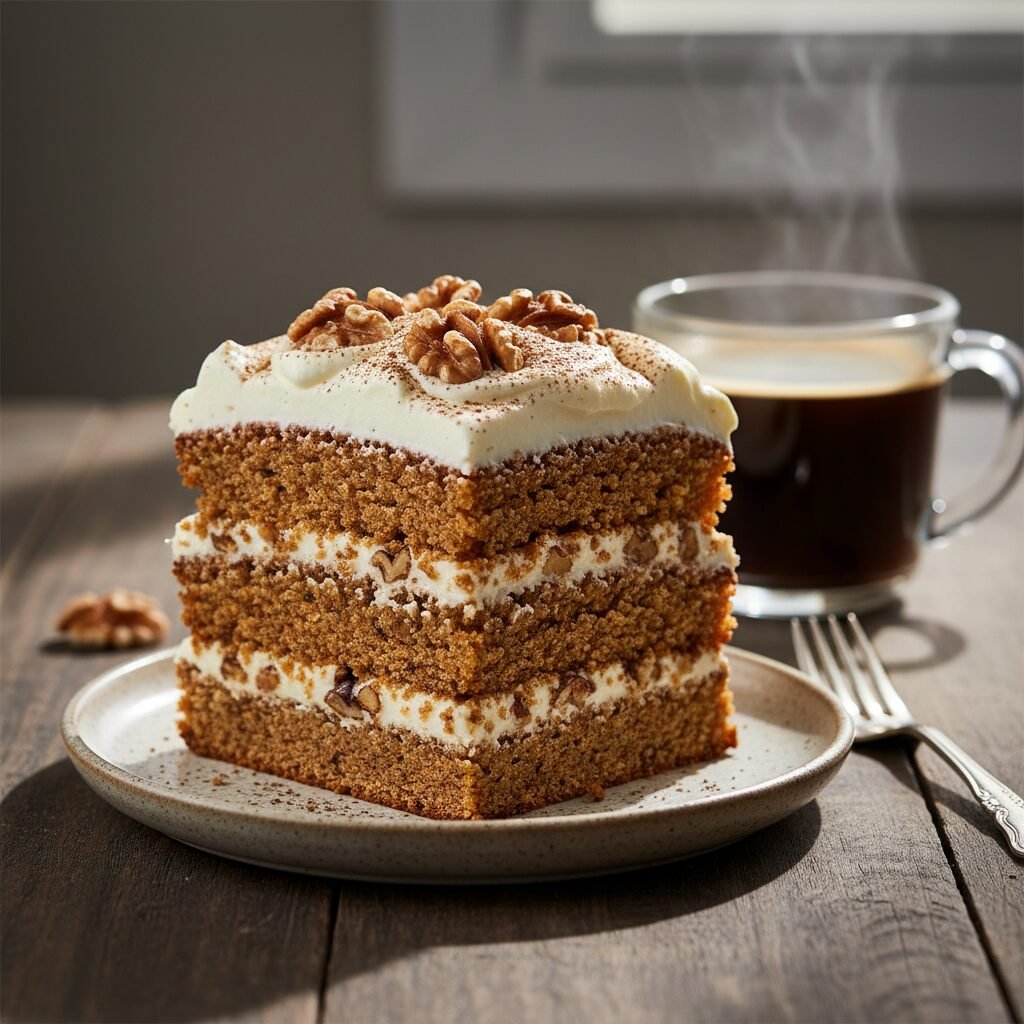
Moist Coffee Walnut Cake With Mascarpone Frosting Recipe
Experience the perfect marriage of robust espresso and earthy walnuts in this incredibly moist layer cake. Topped with a silky, not-too-sweet mascarpone frosting, it’s an elegant dessert that serves as the ultimate afternoon pick-me-up or dinner party showstopper.
30 minutes
35 minutes
1 hour 30 minutes
12 servings
Dessert
Baking
American / British Fusion
Vegetarian
There is something undeniably sophisticated about the combination of coffee and walnuts. It’s a pairing that evokes images of cozy European cafes, rainy afternoons, and the comfort of a warm kitchen. This Moist Coffee Walnut Cake with Mascarpone Frosting is my love letter to that classic flavor profile, elevated with a texture so tender it practically melts in your mouth. Unlike many coffee cakes that are simply intended to be eaten *with* coffee, this cake is infused with the rich, aromatic depth of freshly brewed espresso, ensuring that every bite delivers a caffeine-kissed punch.
The secret to this cake’s allure lies in its balance. Coffee can be bitter, and walnuts can be tannic, but when enveloped in a batter enriched with brown sugar and tangy yogurt, those sharp notes soften into a warm, nutty embrace. The texture is paramount here; we aren’t looking for a dry sponge that requires a drink to wash it down. We want a crumb that is dense enough to hold the walnuts but light enough to feel indulgent rather than heavy.
And then, there is the frosting. While a traditional buttercream is delicious, it can sometimes be overwhelmingly sweet, masking the delicate flavors of the sponge. Enter mascarpone. This Italian cream cheese brings a luxurious, milky richness that pairs beautifully with the coffee. Whipped with just the right amount of heavy cream and powdered sugar, it creates a cloud-like topping that feels sophisticated and light. Whether you are baking for a special birthday, a holiday gathering, or simply because you survived a long week, this cake promises to be the highlight of your table.
History & Origins
The concept of ‘coffee cake’ has a somewhat bifurcated history depending on which side of the Atlantic you find yourself. In the United States, coffee cake traditionally refers to a sweet, cinnamon-infused cake intended to be eaten alongside a cup of coffee, often devoid of any actual coffee in the ingredients list. However, in Britain, ‘Coffee and Walnut Cake’ is a stalwart of the baking canon, a classic tea-time treat that dates back to the early 20th century.
The inclusion of coffee in desserts gained traction as coffee became more accessible and affordable in Europe during the 19th century. Cooks began experimenting with coffee essences and syrups to flavor sponges, custards, and creams. Walnuts, native to the region stretching from the Balkans to the Himalayas, have been a staple in European baking for centuries, prized for their textural crunch and ability to cut through sweetness.
The specific marriage of coffee and walnut likely solidified its popularity in the 1930s with the rise of home baking culture and the availability of instant coffee granules, which made flavoring cakes significantly easier for the home cook. Mascarpone, on the other hand, hails from the Lombardy region of Italy. Traditionally used in Tiramisu, its integration into American and British style layer cakes is a more modern culinary evolution, representing a shift towards lighter, tangier frostings over the sugar-heavy buttercreams of the mid-20th century. This recipe bridges these worlds: the British love for coffee-flavored sponge, the American desire for a moist, tender crumb, and the Italian influence of a creamy, sophisticated frosting.
Why This Recipe Works
This recipe succeeds where others fail primarily due to the careful management of moisture and flavor infusion. Many coffee cakes suffer from dryness because coffee is acidic and can alter the structure of the gluten. To combat this, we utilize a combination of oil and butter. Butter provides that classic dairy flavor, while oil remains liquid at room temperature, ensuring the cake stays moist for days. Furthermore, we incorporate Greek yogurt or sour cream, which adds acidity to tenderize the gluten strands, resulting in a plush, velvety crumb.
Flavor-wise, simply adding ground coffee to dry ingredients often results in a gritty texture and weak flavor. In this recipe, we dissolve instant espresso powder into hot milk before adding it to the batter. This ‘blooming’ process releases the volatile oils in the coffee, amplifying the aroma and ensuring an even distribution of flavor throughout the cake. We also toast the walnuts before folding them into the batter. Raw walnuts can be waxy and slightly bitter; toasting them releases their natural oils, making them crunchier and nuttier.
Finally, the mascarpone frosting is the structural and flavor counterpoint. Mascarpone has a higher fat content than cream cheese and is less acidic, providing a stable yet creamy texture that doesn’t overpower the coffee notes. By whipping it with heavy cream, we aerate the frosting, making it light enough to complement the dense nuttiness of the cake without weighing it down.
Why You’ll Love This Recipe
- ✓Intense coffee flavor achieved by blooming espresso in hot milk.
- ✓Incredibly moist crumb thanks to a blend of oil, butter, and yogurt.
- ✓Crunchy toasted walnuts in every bite provide texture contrast.
- ✓Silky, sophisticated mascarpone frosting that isn’t overly sweet.
- ✓Beautiful rustic presentation perfect for holidays or dinner parties.
- ✓Stays moist for days, making it an excellent make-ahead dessert.
Equipment You’ll Need
- ✓Two 8-inch round cake pans
- ✓Stand mixer or electric hand mixer
- ✓Large mixing bowls
- ✓Wire cooling rack
- ✓Parchment paper
- ✓Offset spatula
- ✓Rubber spatula
- ✓Measuring cups and spoons
Ingredients
- ✓2 1/2 cups All-purpose flour
- ✓1 tsp Baking powder
- ✓1/2 tsp Baking soda
- ✓1/2 tsp Salt
- ✓1 cup Unsalted butter, softened
- ✓1/2 cup Vegetable oil
- ✓1 1/2 cups Granulated sugar
- ✓1/2 cup Light brown sugar, packed
- ✓4 Large eggs, room temperature
- ✓2 tsp Vanilla extract
- ✓1 tbsp Instant espresso powder (dissolved in 1 tbsp hot water)
- ✓1 cup Greek yogurt or sour cream, room temperature
- ✓1 1/2 cups Walnuts, chopped and toasted
- ✓FOR THE FROSTING:
- ✓16 oz Mascarpone cheese, cold
- ✓1 cup Heavy whipping cream, cold
- ✓1 1/2 cups Powdered sugar, sifted
- ✓1 tsp Vanilla extract
- ✓Pinch of salt
- ✓Whole walnuts and espresso beans for garnish
Instructions
- 1. Preheat your oven to 350°F (175°C). Grease two 8-inch round cake pans with butter and line the bottoms with parchment paper. Dust the sides with flour and tap out the excess.
- 2. Spread the chopped walnuts on a baking sheet and toast in the oven for 5-7 minutes until fragrant. Let them cool completely before using.
- 3. In a medium bowl, whisk together the flour, baking powder, baking soda, and salt. Set aside.
- 4. In the bowl of a stand mixer fitted with the paddle attachment, beat the softened butter, vegetable oil, granulated sugar, and brown sugar on medium-high speed for about 3-4 minutes until light and fluffy.
- 5. Add the eggs one at a time, beating well after each addition and scraping down the sides of the bowl as needed. Stir in the vanilla extract and the dissolved espresso mixture.
- 6. Reduce the mixer speed to low. Add the flour mixture in three parts, alternating with the Greek yogurt, beginning and ending with the flour. Mix only until just combined—do not overmix.
- 7. Gently fold in the cooled, toasted walnuts using a rubber spatula.
- 8. Divide the batter evenly between the prepared cake pans. Smooth the tops with an offset spatula.
- 9. Bake for 30-35 minutes, or until a toothpick inserted into the center comes out clean or with just a few moist crumbs attached.
- 10. Remove the cakes from the oven and let them cool in the pans for 10 minutes. Then, turn them out onto a wire rack to cool completely before frosting.
- 11. To make the frosting: In a large chilled bowl, whip the cold heavy cream until stiff peaks form. Transfer to a separate bowl.
- 12. In the mixer bowl (no need to clean), beat the mascarpone cheese, powdered sugar, vanilla, and salt on medium speed until smooth and creamy (about 1-2 minutes). Do not overbeat or the mascarpone may curdle.
- 13. Gently fold the whipped cream into the mascarpone mixture until fully incorporated and smooth.
- 14. Assemble the cake: Place one cake layer on a serving plate. Spread a generous layer of frosting over the top. Place the second cake layer on top. Frost the top and sides of the cake with the remaining frosting.
- 15. Decorate with whole walnuts and a dusting of cocoa powder or espresso powder if desired. Chill for 30 minutes before slicing to set the frosting.
Expert Cooking Tips
- ✓Room Temperature Ingredients: Ensure your butter, eggs, and yogurt are at room temperature. This allows them to emulsify properly, creating a uniform batter structure.
- ✓Don’t Skip Toasting: Toasting the walnuts is crucial. It revitalizes the oils in the nuts, making them crunchier and significantly more flavorful.
- ✓Blooming Coffee: Dissolving the espresso powder in a tiny bit of hot water or milk ensures you don’t get bitter granules in your cake and distributes the flavor evenly.
- ✓Mascarpone Care: Mascarpone can curdle if overbeaten or if it gets too warm. Beat it just until smooth and fold the cream in gently.
- ✓Weigh Your Flour: For the most accurate results, use a kitchen scale. If using cups, spoon the flour into the cup and level it off; don’t scoop directly.
- ✓Cool Completely: Never try to frost a warm cake, especially with mascarpone frosting, as it will melt and slide right off.
Substitutions and Variations
This recipe is quite versatile if you need to make swaps. If you don’t have mascarpone, you can substitute full-fat block cream cheese, though the flavor will be tangier and more like a traditional carrot cake frosting. For the nuts, pecans are an excellent 1:1 substitute for walnuts if you prefer a sweeter, milder nut flavor. If you are sensitive to caffeine, feel free to use decaffeinated instant coffee or espresso powder; the flavor profile will remain largely the same. For the yogurt, full-fat sour cream or buttermilk can be used interchangeably. If you need to make this gluten-free, a high-quality 1:1 gluten-free baking flour blend works reasonably well, though the texture may be slightly denser.
Common Mistakes to Avoid
The most common mistake with this cake is overmixing the batter after adding the flour. Overmixing develops the gluten too much, resulting in a tough, rubbery cake rather than a tender one. Another pitfall is neglecting the temperature of the frosting ingredients. Mascarpone is sensitive; if the heavy cream isn’t cold, it won’t whip, and if the mascarpone is beaten too vigorously, it can separate and become grainy. Lastly, failing to line the cake pans with parchment paper often leads to the heartbreak of the cake sticking to the bottom, ruining your layers. Always take the extra minute to line your pans.
Serving Suggestions
This cake is rich, so it pairs beautifully with beverages that can cut through the creaminess. A shot of hot espresso, a dark roast coffee, or a cup of Earl Grey tea are perfect companions. For an elegant dessert course, serve thin slices with a side of fresh berries—raspberries or blackberries work particularly well as their tartness balances the sweet frosting. If serving at a dinner party, a small glass of coffee liqueur or an Amaretto on the rocks makes for a delightful pairing.
Storage and Reheating Tips
Because of the mascarpone and cream in the frosting, this cake must be stored in the refrigerator. It can be left out for about an hour before serving to take the chill off, but should not be left at room temperature for extended periods, especially in warm weather. Store the cake in an airtight cake carrier or wrap slices individually in plastic wrap to prevent them from absorbing fridge odors. The cake will keep well in the refrigerator for up to 4 days. For longer storage, you can freeze the unfrosted cake layers for up to 2 months, wrapped tightly in plastic and foil.
Nutrition Facts (Estimated)
| Serving Size | 1 slice |
| Calories | 580 |
| Fat | 38g |
| Saturated Fat | 14g |
| Unsaturated Fat | 22g |
| Trans Fat | 0g |
| Cholesterol | 85mg |
| Sodium | 210mg |
| Carbohydrates | 52g |
| Fiber | 2g |
| Sugar | 38g |
| Protein | 8g |
Frequently Asked Questions
Can I use brewed coffee instead of espresso powder?
It is not recommended to use liquid brewed coffee as the primary flavoring because adding enough liquid to get a strong coffee taste will throw off the wet-to-dry ratio of the batter. Instant espresso powder provides intense flavor without adding excess liquid.
Why did my mascarpone frosting turn runny?
Mascarpone frosting can turn runny if the cheese was overbeaten or if the mixture got too warm. Mascarpone has a high fat content and can separate easily. Stop mixing as soon as it is combined and keep it chilled.
Can I make this cake as cupcakes?
Absolutely! This batter works well for cupcakes. Fill muffin liners about 2/3 full and bake for 18-22 minutes at 350°F. The yield will be approximately 24 cupcakes.
Is the coffee flavor very strong?
The coffee flavor is distinct but not overpowering. It balances with the brown sugar and walnuts. If you want a very subtle flavor, reduce the espresso powder to 1 teaspoon. For a stronger kick, increase to 1.5 tablespoons.
Can I make the cake layers ahead of time?
Yes. You can bake the layers, let them cool completely, wrap them tightly in plastic wrap, and store them at room temperature overnight or freeze them for up to a month before frosting.
What if I don’t have a stand mixer?
An electric hand mixer works perfectly fine for both the cake batter and the frosting. You can even mix the cake batter by hand if you have a strong arm for creaming the butter and sugar!
Can I use oil only instead of butter?
You can, but you will lose the rich, buttery flavor. If you use only oil, the cake will be very moist but might lack depth. The combination of both gives the best of both worlds.
How do I keep the walnuts from sinking to the bottom?
The batter for this cake is thick enough that sinking shouldn’t be a major issue. However, chopping the nuts finely rather than leaving them in large chunks helps keep them suspended.
Conclusion
This Moist Coffee Walnut Cake with Mascarpone Frosting is more than just a dessert; it’s a comforting ritual on a plate. The interplay of textures—from the soft, tender crumb to the crunch of toasted walnuts and the velvety smoothness of the frosting—creates a sensory experience that store-bought cakes simply cannot replicate. Whether you are an experienced baker or a novice looking to impress, this recipe offers a reliable path to a bakery-quality result. So brew a fresh pot of coffee, gather your ingredients, and treat yourself to a slice of homemade happiness. You deserve it!