Moist Orange Cake With Cream Cheese Frosting Recipe
Experience a burst of sunshine with this incredibly moist orange cake, infused with fresh citrus zest and topped with a tangy, velvety cream cheese frosting. It is the perfect balance of sweet and tart, guaranteed to stay soft for days.
20 minutes
35 minutes
55 minutes
12 servings
Dessert
Baking
American
Vegetarian
There is something undeniably cheerful about an orange cake. In the dead of winter, it brings a promise of sunshine, and in the heat of summer, it offers a refreshing, zesty bite that feels light yet indulgent. But let’s be honest: finding a fruit-flavored cake that doesn’t end up dry or dense is a challenge. That is exactly why this Moist Orange Cake with Cream Cheese Frosting was developed. We aren’t just talking about a subtle hint of orange; we are talking about a bold, aromatic citrus explosion that permeates every single crumb.
The secret lies in the triple-threat of orange usage: fresh zest rubbed into the sugar to release essential oils, freshly squeezed juice in the batter, and a garnish of zest on top. Paired with the richness of sour cream or Greek yogurt in the batter, the texture transforms into something akin to a velvet pound cake but lighter. And then, there is the frosting. While vanilla buttercream is a standard choice, it simply cannot compete with the tangy sophistication of cream cheese frosting on a citrus cake. The slight tang of the cream cheese cuts through the sweetness of the cake, creating a flavor profile that dances on the tongue. This isn’t just a dessert; it’s a sensory experience that evokes memories of orange groves and afternoon tea. Whether you are baking for a holiday brunch, a birthday, or just a Tuesday pick-me-up, this recipe is your new gold standard for fruit cakes.
History & Origins
The concept of baking with citrus is as old as the trade routes that brought these vibrant fruits from Southeast Asia to the Mediterranean and eventually to the Americas. Oranges were once considered a luxury item, a symbol of wealth and prosperity, often gifted during the holidays (a tradition that persists in Christmas stockings today). In medieval Europe, candied orange peel was a common addition to fruitcakes and heavy breads. However, the light, fluffy orange cake we know today has its roots in the evolution of chemical leaveners in the 19th century.
Specifically, the ‘Sunshine Cake’ or ‘Orange Chiffon Cake’ became incredibly popular in mid-20th century America, particularly in the 1950s when convenience cooking and distinct, bright flavors were in vogue. Housewives would often use orange juice concentrate to flavor their cakes. However, the shift back to ‘scratch baking’ in recent decades has revived the use of fresh zest and juice. The pairing with cream cheese frosting is a distinctly American innovation. While cream cheese frosting is most famous for its marriage with carrot cake (popularized in the 1960s), adventurous bakers soon realized that its creamy, slightly savory tang was the perfect foil for the acidity of lemon and orange cakes, creating a modern classic that bridges the gap between a breakfast coffee cake and an elegant dinner party dessert.
Why This Recipe Works
This recipe succeeds where others fail due to the precise balance of fat, acid, and sugar. First, we prioritize **oil over butter** for the cake base. While butter adds flavor, it contains water and solidifies at room temperature. Oil remains liquid, ensuring the cake stays incredibly moist and tender for days, not just hours. We compensate for the buttery flavor by using a high-fat dairy element—specifically sour cream or full-fat Greek yogurt. The acidity in these dairy products interacts with the baking soda to create a robust rise and a tender crumb structure by breaking down gluten strands.
Furthermore, the method of **rubbing the orange zest into the granulated sugar** before mixing is a game-changer. Sugar crystals act as an abrasive, tearing open the zest’s cells and releasing potent essential oils that would otherwise be lost if just stirred in. This infuses the entire batter with a deep, floral orange aroma that artificial extracts cannot replicate. Finally, the cream cheese frosting provides a necessary textural and flavor contrast. A purely sweet buttercream would make the cake cloying; the lactic acid in the cream cheese mirrors the citric acid in the orange, creating a harmonious bridge between the frosting and the sponge.
Why You’ll Love This Recipe
- ✓Stays moist for up to 4 days due to the oil-based batter.
- ✓Uses fresh orange zest and juice for natural, vibrant flavor.
- ✓Tangy cream cheese frosting balances the sweetness perfectly.
- ✓No mixer required for the cake batter—just two bowls and a whisk.
- ✓Versatile: Can be made as a layer cake, bundt, or sheet cake.
- ✓Freezes beautifully for make-ahead convenience.
Equipment You’ll Need
- ✓Two 8-inch or 9-inch round cake pans
- ✓Large mixing bowl
- ✓Medium mixing bowl
- ✓Whisk
- ✓Rubber spatula
- ✓Microplane or fine zester
- ✓Electric hand mixer or stand mixer (for frosting)
- ✓Wire cooling rack
Ingredients
- ✓2 cups (250g) All-purpose flour
- ✓1 1/2 cups (300g) Granulated sugar
- ✓2 tbsp Fresh orange zest (approx. 2 large oranges)
- ✓1 tsp Baking powder
- ✓1/2 tsp Baking soda
- ✓1/2 tsp Salt
- ✓3 Large eggs, room temperature
- ✓1/2 cup (120ml) Vegetable oil or canola oil
- ✓1/2 cup (120ml) Sour cream or plain Greek yogurt, room temperature
- ✓1/2 cup (120ml) Freshly squeezed orange juice
- ✓1 tsp Vanilla extract
- ✓FOR THE FROSTING:
- ✓8 oz (225g) Full-fat cream cheese, softened block style
- ✓1/2 cup (115g) Unsalted butter, softened
- ✓3 cups (360g) Powdered sugar, sifted
- ✓1 tsp Fresh orange juice or vanilla extract
- ✓Pinch of salt
Instructions
- Preheat your oven to 350°F (175°C). Grease two 8-inch or 9-inch round cake pans with butter or baking spray and line the bottoms with parchment paper.
- In a large mixing bowl, combine the granulated sugar and fresh orange zest. Use your fingers to rub the zest into the sugar until the mixture resembles wet sand and is very fragrant. This releases the essential oils.
- Add the all-purpose flour, baking powder, baking soda, and salt to the sugar mixture. Whisk until well combined.
- In a separate medium bowl, whisk together the eggs, vegetable oil, sour cream (or yogurt), fresh orange juice, and vanilla extract until smooth and emulsified.
- Pour the wet ingredients into the dry ingredients. Use a whisk or rubber spatula to mix gently. Stop mixing as soon as the flour streaks disappear. Do not overmix.
- Divide the batter evenly between the prepared cake pans. Tap the pans gently on the counter to release any large air bubbles.
- Bake for 30-35 minutes, or until a toothpick inserted into the center comes out clean or with just a few moist crumbs attached. The tops should be golden brown.
- Remove from the oven and let the cakes cool in the pans for 10 minutes. Then, carefully invert them onto a wire rack to cool completely before frosting.
- To make the frosting: In a large bowl using a handheld or stand mixer, beat the softened cream cheese and butter together on medium-high speed until smooth and creamy (about 2-3 minutes).
- Reduce the mixer speed to low and gradually add the powdered sugar, one cup at a time. Once incorporated, add the orange juice (or vanilla) and salt. Increase speed to high and whip for 2 minutes until fluffy.
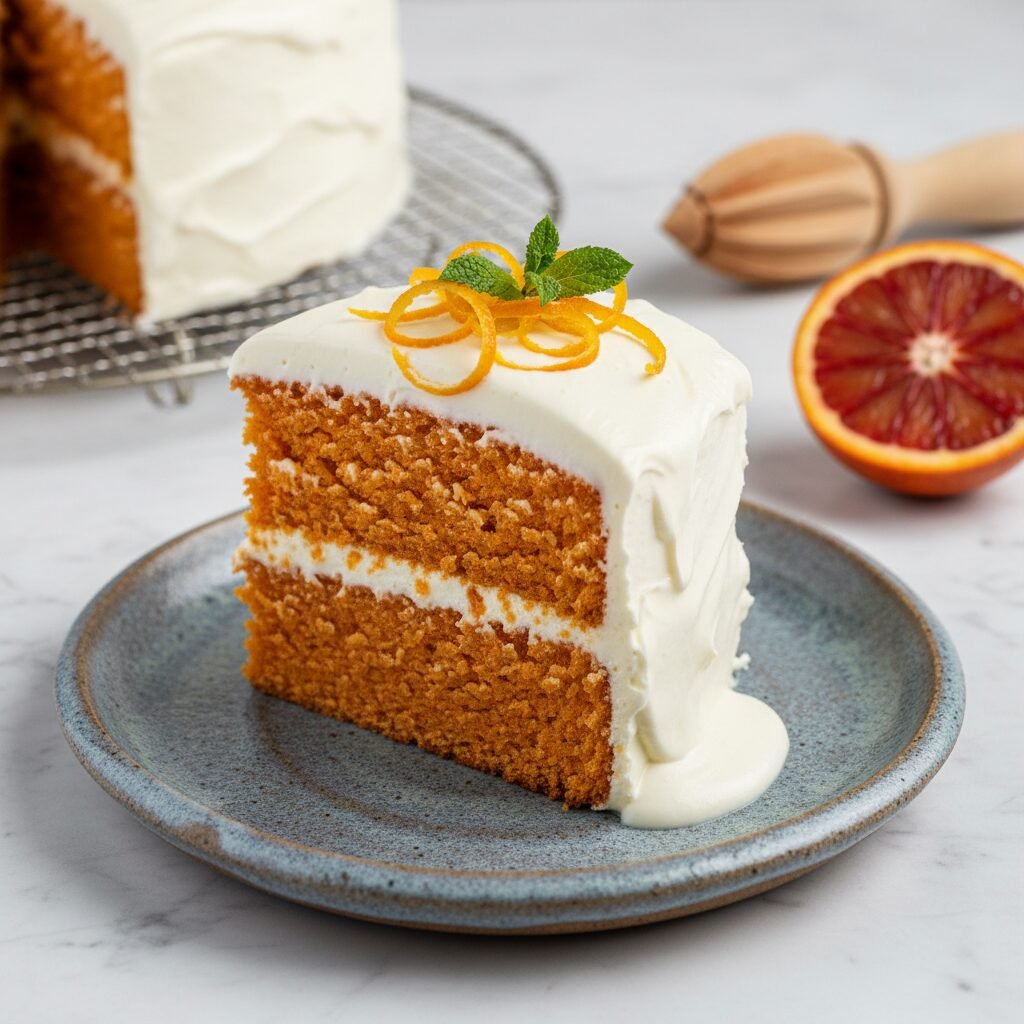
- Once the cakes are completely cool, spread a layer of frosting on top of one cake layer. Place the second layer on top and frost the top and sides. Garnish with extra orange zest or slices if desired.
Expert Cooking Tips
- ✓Room Temperature Ingredients: Ensure your eggs, sour cream, butter, and cream cheese are at room temperature. This prevents the batter from curdling and ensures a smooth, lump-free frosting.
- ✓Don’t Skimp on Zest: The zest is where the flavor lives. Use a microplane to get just the bright orange part, avoiding the bitter white pith.
- ✓Measure Flour Correctly: Use the spoon-and-level method or a kitchen scale. Scooping the cup directly into the flour bag packs it down and leads to a dry cake.
- ✓Cool Completely: Never frost a warm cake. The butter in the cream cheese frosting will melt, causing the layers to slide apart.
- ✓Block Cream Cheese: Use full-fat, block-style cream cheese for the frosting. Tub cream cheese has too much water content and will result in runny frosting.
- ✓Paper Towel Trick: If your cakes have a dome, gently press down on them with a paper towel while they are still warm to flatten the top.
- ✓Infuse the Sugar: Do not skip the step of rubbing zest into the sugar; it makes a massive difference in the aroma.
Substitutions and Variations
This recipe is quite forgiving with thoughtful substitutions. **Flour:** You can use a 1:1 Gluten-Free All-Purpose baking flour blend (like Bob’s Red Mill or King Arthur) to make this gluten-free. **Oil:** While vegetable or canola oil is neutral, you can use melted coconut oil or light olive oil for a slightly different flavor profile. **Sour Cream:** Full-fat plain Greek yogurt is an excellent 1:1 substitute for sour cream. Even buttermilk can work, though the batter will be thinner. **Citrus:** This base works beautifully with lemons, blood oranges, or grapefruits. If using lemons, reduce the juice to 1/3 cup and add 2 tablespoons of milk to balance the acidity. **Sugar:** Do not reduce the sugar significantly as it provides moisture, but you can swap 1/2 cup of white sugar for light brown sugar for a deeper, caramel-like undertone.
Common Mistakes to Avoid
The most common mistake is **overmixing the batter**. Once the wet and dry ingredients meet, gluten begins to form. If you mix too vigorously, the cake will be tough and rubbery instead of tender. Stop as soon as the flour disappears. Another issue is **overbaking**. Check the cake at the 30-minute mark; if it stays in too long, even the oil won’t save it from dryness. Regarding the frosting, **using cold cream cheese or butter** creates lumps that are impossible to whip out later. Finally, **zesting too deep** creates a bitter flavor. You only want the bright orange outer layer, not the white spongy pith underneath.
Serving Suggestions
This cake is stunning on its own, but you can elevate it for special occasions. Serve it on a white ceramic pedestal to let the pale orange frosting pop. Garnish with **candied orange slices**, fresh edible flowers (like nasturtiums or pansies), or a sprig of fresh mint for color contrast. For a dessert course, serve a slice alongside a scoop of vanilla bean ice cream or a dollop of unsweetened whipped cream to cut the sweetness. It pairs beautifully with Earl Grey tea, which has bergamot (citrus) notes, or a strong black coffee.
Storage and Reheating Tips
Because of the cream cheese frosting, this cake should ideally be stored in the refrigerator, especially in warm climates. It can sit out for a few hours during a party, but for long-term storage, place it in an airtight cake carrier in the fridge for up to 5 days. **Important:** Cold cake can taste dry and mute the flavors. Remove the cake (or slices) from the fridge 30 to 60 minutes before serving to bring it back to room temperature. **Freezing:** The unfrosted cake layers freeze exceptionally well for up to 3 months wrapped in plastic wrap. You can also freeze individual slices of the frosted cake; flash freeze them on a tray first, then wrap tightly in cling film and foil.
Nutrition Facts (Estimated)
| Serving Size | 1 slice |
| Calories | 480 |
| Fat | 24g |
| Saturated Fat | 9g |
| Unsaturated Fat | 14g |
| Trans Fat | 0g |
| Cholesterol | 65mg |
| Sodium | 290mg |
| Carbohydrates | 62g |
| Fiber | 1g |
| Sugar | 38g |
| Protein | 5g |
Frequently Asked Questions
Can I bake this in a bundt pan?
Yes! This recipe fits a standard 10-12 cup bundt pan. You will need to increase the baking time to approximately 45-55 minutes. Make sure to grease the pan very thoroughly.
Why did my cake sink in the middle?
Sinking usually happens if the oven door was opened too early (releasing heat), if the cake was underbaked, or if there was too much leavening (baking powder/soda). Ensure your oven temperature is accurate using an oven thermometer.
Can I use bottled orange juice?
Technically yes, but I highly recommend fresh squeezed. Bottled juice often contains added sugar and lacks the bright, acidic ‘zing’ of fresh fruit. Since you need oranges for the zest anyway, use the juice from those.
Can I make these into cupcakes?
Absolutely. This recipe makes about 20-24 standard cupcakes. Bake them at 350°F for 18-22 minutes.
My frosting is too runny, how do I fix it?
This usually happens if the cream cheese was melted rather than softened, or if ‘tub’ cream cheese was used. Try chilling the frosting for 20 minutes to stiffen it up. If it’s still runny, add more powdered sugar, 1/4 cup at a time.
Can I reduce the sugar in the cake?
I don’t recommend reducing it by more than 1/4 cup. Sugar is not just for sweetness; it provides structure and moisture (hygroscopy). Reducing it too much will result in a dry, rubbery cake.
Is the zest really necessary?
Yes, it is the most critical ingredient for flavor. Orange juice alone gives a very mild flavor that bakes out. The oils in the zest provide the distinct orange taste.
Can I use butter instead of oil for the cake?
You can, but the texture will change. Butter cakes are denser and dry out faster. If you prefer the butter flavor, try using half butter and half oil.
Conclusion
This Moist Orange Cake with Cream Cheese Frosting is more than just a recipe; it is a reliable companion for any celebration or quiet afternoon craving. The combination of the tender, oil-based crumb and the bright, floral citrus notes creates a dessert that feels both comforting and refreshing. It is one of those rare cakes that tastes even better the next day, making it perfect for preparing in advance. We hope this cake brings a little slice of sunshine into your kitchen. Don’t forget to pin this recipe for later and tag us in your baking adventures on Instagram!