Moist Peach Layer Cake Recipe
Celebrate the peak of summer with this incredibly moist peach layer cake. Featuring tender, vanilla-infused cake layers, a luscious homemade fresh peach filling, and a silky cream cheese buttercream, this dessert is the perfect balance of sweet and tangy flavors.
45 minutes
35 minutes
1 hour 20 minutes (plus cooling)
12 servings
Dessert
Baking
American / Southern
Vegetarian
There is something undeniably magical about the arrival of peach season. The moment you spot those blushing, fuzzy orbs at the farmer’s market or grocery store, you know that summer has truly arrived. This Moist Peach Layer Cake is my love letter to that fleeting, golden time of year. Unlike many fruit-flavored cakes that rely on artificial extracts or gelatin packets, this recipe is a celebration of the real fruit. We are talking about ripe, juicy peaches reduced down to a concentrated puree to infuse every single crumb with authentic flavor, paired with chunks of fresh fruit nestled between soft layers of cake.
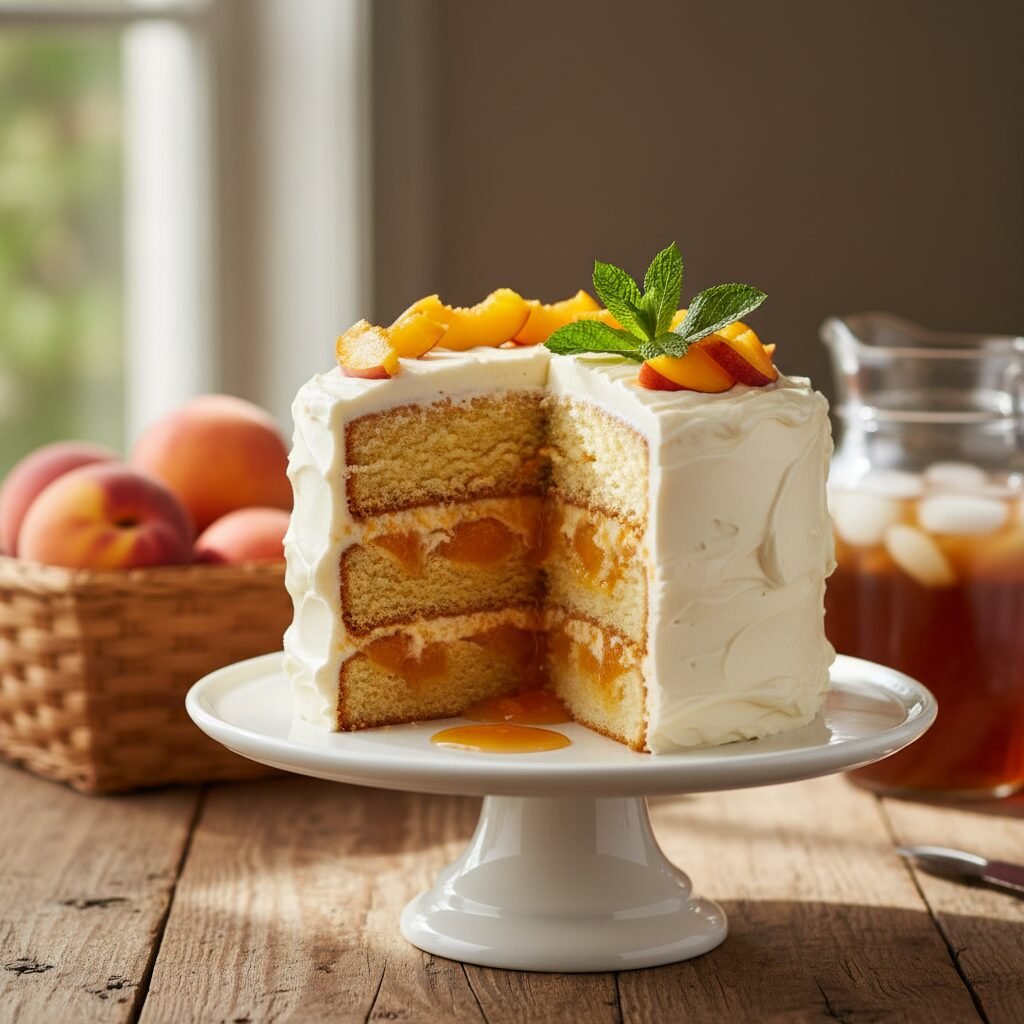
The texture of this cake is what truly sets it apart. It is not dense or heavy; rather, it boasts a plush, velvety crumb that melts in your mouth, thanks to a careful balance of buttermilk and a blend of butter and oil. The oil ensures the cake stays moist for days, while the butter provides that classic, rich flavor we all crave. When you slice into this masterpiece, you are met with beautiful golden layers stacked high with a filling that tastes like the best peach jam you have ever had, but fresher and brighter.
To finish it off, we coat the entire confection in a whipped cream cheese buttercream. The slight tang of the cream cheese cuts through the sweetness of the cake and the fruit filling, creating a harmonious bite that is not cloyingly sweet. Whether you are baking for a summer barbecue, a birthday celebration, or just because you found a basket of perfect peaches, this cake is guaranteed to be the showstopper of your table. It is comfort food elevated to elegance, bringing a slice of Southern hospitality right to your kitchen.
History & Origins
The history of the peach layer cake is deeply intertwined with the agricultural and culinary history of the American South, though the story of the peach itself begins much further away. Peaches (Prunus persica) originated in Northwest China, where they were first cultivated as early as 2000 BC. They were revered not just for their flavor but as symbols of immortality and longevity. From China, they traveled along the Silk Road to Persia (modern-day Iran), eventually reaching Europe and, later, the Americas via Spanish explorers in the 16th century.
However, it was in the humid, warm climate of the Southeastern United States—particularly Georgia and South Carolina—that the peach tree found a new, thriving home. By the 19th century, commercial peach production was booming, and the fruit became synonymous with Southern identity. As access to refined sugar and flour became more common in the late 1800s and early 1900s, the ‘layer cake’ emerged as a status symbol and a staple of church picnics and community gatherings. Southern bakers were renowned for their ‘high cakes,’ often consisting of many thin layers stacked with boiled icings or fresh fruit fillings.
The specific iteration of a fresh peach cake likely evolved from simple sponge cakes served with macerated fruit. As chemical leaveners like baking powder improved, home cooks began incorporating the fruit directly into the batter or creating elaborate fillings to sandwich between layers. This recipe pays homage to that tradition, combining the old-world appreciation for the fruit’s natural sweetness with modern baking techniques that ensure a stable, moist crumb capable of supporting the heavy fruit filling. It is a dessert that carries centuries of agricultural migration and generations of Southern baking heritage in every bite.
Why This Recipe Works
This recipe succeeds where many fruit cakes fail because it addresses the two main enemies of baking with fresh fruit: excess water content and lack of concentrated flavor. Fresh peaches are mostly water. If you simply chop them up and throw them into a batter, they will release that water during baking, resulting in a soggy, dense cake or pockets of raw dough. To solve this, we use a reduction technique. By pureeing the peaches and simmering them down on the stove before adding them to the batter, we evaporate the excess water while concentrating the peach flavor. This ensures the cake tastes distinctly of peaches without compromising its structural integrity.
Furthermore, the ‘moist’ factor is scientifically guaranteed through the fat selection. We use a hybrid method employing both unsalted butter and neutral oil. Butter contains water and milk solids, which contribute to flavor and a fluffy texture when creamed with sugar (aeration). However, butter solidifies at room temperature, which can sometimes lead to a dry mouthfeel. Oil, on the other hand, remains liquid at room temperature, coating the flour proteins and preventing gluten formation, which keeps the cake tender and moist for days.
Finally, the inclusion of buttermilk is crucial. The acidity in the buttermilk reacts with the baking soda to create carbon dioxide gas, giving the cake a supreme lift and a tender crumb. It also helps to break down the gluten strands, ensuring the cake is soft rather than chewy. Combined with the reverse creaming method—or a modified mixing method where dry ingredients are well-blended before wet are added—we minimize gluten development, resulting in a plush, velvety texture that perfectly supports the weight of the peach filling.
Why You’ll Love This Recipe
- ✓Uses fresh peach reduction for intense, natural fruit flavor.
- ✓Hybrid butter-oil method creates a cake that stays moist for days.
- ✓Tangy cream cheese frosting perfectly balances the sweet fruit filling.
- ✓Sturdy enough for stacking but tender enough to melt in your mouth.
- ✓A stunning centerpiece perfect for summer gatherings.
Equipment You’ll Need
- ✓Three 8-inch round cake pans
- ✓Stand mixer with paddle attachment
- ✓Food processor or blender
- ✓Medium saucepan
- ✓Offset spatula
- ✓Wire cooling racks
- ✓Parchment paper
- ✓Cake turntable (optional)
Ingredients
- ✓3 cups Cake flour, sifted
- ✓2 1/2 tsp Baking powder
- ✓1/2 tsp Baking soda
- ✓1 tsp Salt
- ✓1 cup Unsalted butter, softened
- ✓1/2 cup Vegetable oil or Canola oil
- ✓1 3/4 cups Granulated sugar
- ✓4 large Eggs, room temperature
- ✓1 tbsp Vanilla bean paste or pure vanilla extract
- ✓1 cup Buttermilk, room temperature
- ✓1 1/2 cups Fresh peaches, peeled and pureed (reduced to 3/4 cup)
- ✓For the Filling: 2 cups Fresh peaches, peeled and diced
- ✓For the Filling: 1/4 cup Granulated sugar
- ✓For the Filling: 1 tbsp Cornstarch
- ✓For the Frosting: 16 oz Cream cheese, slightly softened
- ✓For the Frosting: 1 cup Unsalted butter, softened
- ✓For the Frosting: 5 cups Powdered sugar, sifted
- ✓For the Frosting: 1 tsp Vanilla extract
Instructions
- 1. Prepare the Peach Reduction: Peel and slice about 3-4 peaches. Puree them in a blender until smooth. Transfer to a saucepan over medium heat. Simmer, stirring occasionally, until the liquid reduces by half (you need 3/4 cup of reduced puree). Set aside to cool completely.
- 2. Preheat and Prep: Preheat your oven to 350°F (175°C). Grease three 8-inch round cake pans with butter, line the bottoms with parchment paper, and grease the paper. Dust with flour and tap out excess.
- 3. Mix Dry Ingredients: In a medium bowl, whisk together the sifted cake flour, baking powder, baking soda, and salt. Set aside.
- 4. Cream Butter and Sugar: In the bowl of a stand mixer fitted with the paddle attachment, beat the softened butter, oil, and granulated sugar on medium-high speed for about 5 minutes until pale and fluffy.
- 5. Add Eggs: Add the eggs one at a time, beating well after each addition and scraping down the sides of the bowl as needed. Mix in the vanilla bean paste.
- 6. Combine Wet and Dry: Lower the mixer speed to low. Add the flour mixture in three parts, alternating with the buttermilk and the cooled peach puree (begin and end with the flour). Mix only until just combined; do not overmix.
- 7. Bake: Divide the batter evenly among the three prepared pans. Bake for 30-35 minutes, or until a toothpick inserted into the center comes out clean or with just a few moist crumbs. The cakes should spring back when lightly touched.
- 8. Cool: Allow cakes to cool in the pans for 10 minutes, then turn them out onto wire racks to cool completely before assembling.
- 9. Make the Peach Filling: While cakes bake, combine the diced peaches, 1/4 cup sugar, and cornstarch in a small saucepan. Cook over medium heat, stirring constantly, until the peaches release their juices and the mixture thickens into a jam-like consistency (about 5-7 minutes). Remove from heat and let cool completely.
- 10. Make the Frosting: Beat the cream cheese and butter together on medium-high speed until smooth and creamy (no lumps). Gradually add the powdered sugar, one cup at a time, mixing on low speed. Add vanilla and whip on high for 2-3 minutes until light and airy.
- 11. Assembly: Place one cake layer on a serving plate. Pipe a dam of frosting around the outer edge. Fill the center with half of the cooled peach filling. Top with the second cake layer and repeat. Place the final cake layer on top (bottom side up for a flat top).
- 12. Finish: Frost the outside and top of the cake with the remaining cream cheese frosting. Garnish with fresh peach slices or mint leaves if desired.
Expert Cooking Tips
- ✓Room Temperature Ingredients: Ensure your butter, eggs, and buttermilk are at room temperature. This creates an emulsion that traps air, resulting in a lighter cake.
- ✓Don’t Skip the Reduction: Using raw puree without reducing it adds too much water, which can make the cake gummy. The reduction concentrates flavor.
- ✓Weigh Your Flour: If possible, use a kitchen scale (1 cup cake flour = approx 115g). If using cups, spoon and level to avoid packing the flour.
- ✓Cool Completely: Never try to frost a warm cake. The butter in the frosting will melt, and the layers will slide apart.
- ✓Peeling Peaches: To peel peaches easily, score an X on the bottom, blanch in boiling water for 30 seconds, then transfer to an ice bath. The skins will slip right off.
- ✓The Crumb Coat: Apply a thin layer of frosting first to trap crumbs, chill for 20 minutes, then apply the final layer for a professional look.
Substitutions and Variations
If you cannot find cake flour, you can make a substitute by measuring 1 cup of all-purpose flour, removing 2 tablespoons, and replacing them with 2 tablespoons of cornstarch. Sift this mixture twice to aerate it. For the buttermilk, you can make a ‘sour milk’ substitute by adding 1 tablespoon of lemon juice or white vinegar to a cup of whole milk and letting it sit for 5 minutes until curdled.
While fresh peaches are the star here, you can use frozen peaches if they are out of season. Thaw them completely and drain the excess liquid before pureeing or dicing. Avoid canned peaches in syrup for the filling as they are too soft and sweet, though they can work for the puree if rinsed thoroughly and reduced significantly. If you prefer a less sweet frosting, you can swap the cream cheese buttercream for a Swiss Meringue Buttercream or a stabilized whipped cream frosting, though the structure will be less stable in heat.
Common Mistakes to Avoid
The most common mistake with this recipe is under-baking the cake due to the moisture content of the fruit. Even if the top looks done, the center might still be wet. Always trust the toothpick test. Another frequent error is over-mixing the batter after adding the flour. Once the flour hits the liquid, gluten begins to form. If you mix too vigorously, you will end up with a tough, bread-like texture instead of a tender cake.
Regarding the frosting, a common issue is runny cream cheese frosting. This happens if the cream cheese or butter is too warm, or if you use low-fat cream cheese (which has higher water content). Always use full-fat block cream cheese and ensure it is cool room temperature, not meltingly soft. Lastly, assembling the cake before the filling is completely cool will cause the filling to seep out and the layers to slide. Patience is key; the filling must be room temperature or chilled.
Serving Suggestions
This cake is best served at a cool room temperature. If it has been in the fridge, take it out about 30 to 60 minutes before serving to allow the butter in the cake and frosting to soften, which maximizes flavor and texture. Serve generous slices on dessert plates, perhaps accompanied by a scoop of vanilla bean ice cream or a dollop of unsweetened whipped cream to cut the sweetness.
For a beverage pairing, this cake goes beautifully with a glass of cold sweet tea, a sparkling peach bellini, or a warm cup of Earl Grey tea, which has bergamot notes that complement the stone fruit. If you are serving this for a brunch, a light prosecco is also a fantastic choice.
Storage and Reheating Tips
Because of the cream cheese frosting and fresh fruit filling, this cake should be stored in the refrigerator. It can be left out for a few hours during a party, but for overnight storage, place it in an airtight cake carrier or cover the cut sections with plastic wrap to prevent drying out. The cake will keep well in the fridge for up to 4 days.
To freeze, you can freeze individual slices wrapped tightly in plastic wrap and then foil for up to 3 months. Thaw in the refrigerator overnight before eating. You can also bake the cake layers in advance, wrap them tightly in plastic wrap, and freeze them for up to a month before assembling. This actually makes them easier to frost as they are firmer when chilled.
Nutrition Facts (Estimated)
| Serving Size | 1 slice |
| Calories | 580 |
| Fat | 28g |
| Saturated Fat | 14g |
| Unsaturated Fat | 12g |
| Trans Fat | 0g |
| Cholesterol | 85mg |
| Sodium | 310mg |
| Carbohydrates | 76g |
| Fiber | 2g |
| Sugar | 42g |
| Protein | 6g |
Frequently Asked Questions
Can I use canned peaches instead of fresh?
Yes, but fresh is best. If using canned, drain them very well, rinse off the syrup, and pat them dry. You will still need to puree and reduce them for the batter to control the moisture content.
Why did my cake sink in the middle?
This usually happens if the oven door was opened too early, causing a drop in temperature, or if the cake was under-baked. It can also happen if there was too much leavening (baking powder/soda) or not enough structure (flour/eggs).
Can I make this as cupcakes?
Absolutely. This batter will make approximately 24-30 cupcakes. Bake them at 350°F for 18-22 minutes. You can core the center of the cupcakes to add the peach filling.
My frosting is too runny, how do I fix it?
If the frosting is too soft, put the bowl in the refrigerator for 20 minutes to firm up the butter and cream cheese, then whip again. You can also add a bit more powdered sugar, but chilling is usually the best first step.
Can I use white whole wheat flour?
It is not recommended for this specific recipe. Whole wheat flour absorbs liquid differently and has a coarser texture, which fights against the delicate, moist crumb we are aiming for. Stick to cake flour or all-purpose flour.
Do I have to peel the peaches?
For the cake batter puree and the filling, yes. Peach skins can become tough and stringy when cooked and interfere with the smooth texture of the cake and frosting.
Can I make the cake layers ahead of time?
Yes! In fact, chilled cake layers are easier to assemble. Bake them, let them cool completely, wrap them tightly in plastic wrap, and store in the fridge for up to 2 days or freeze for up to a month.
What other fruits work with this base recipe?
This base works well with other stone fruits like nectarines or apricots. You could also adapt it for strawberries, but you must ensure you reduce the puree sufficiently to remove excess water.
Conclusion
There is truly no better way to honor the abundance of summer than with this Moist Peach Layer Cake. It is a labor of love that rewards you with a dessert that is as visually stunning as it is delicious. From the golden, tender crumb infused with peach essence to the pockets of jammy fruit and the tangy cream cheese finish, every element works in harmony to create a bite of pure joy. Whether you are an experienced baker or trying your hand at a layer cake for the first time, this recipe is designed to guide you to success. So, grab those ripe peaches, preheat your oven, and get ready to slice into a little piece of sunshine. Happy baking!