Moist Espresso Chocolate Cake For Brunch Recipe
Start your weekend brunch with a slice of pure indulgence! This Moist Espresso Chocolate Cake combines the richness of dark cocoa with the bold kick of freshly brewed espresso, creating a tender, melt-in-your-mouth dessert that pairs perfectly with your morning coffee.
20 minutes
35 minutes
55 minutes
12 servings
Dessert
Baking
American
Vegetarian
When we think of brunch, our minds often wander to savory staples like eggs benedict, crispy bacon, and avocado toast, or perhaps sweet breakfast classics like waffles and pancakes. But let’s be honest: the best brunches always end with something truly decadent. Enter the Moist Espresso Chocolate Cake, a recipe designed specifically to bridge the gap between a morning pick-me-up and a dessert lover’s dream. This isn’t just another chocolate cake; it is a sophisticated, deeply flavorful masterpiece that utilizes the chemistry of hot espresso to bloom the cocoa powder, resulting in a depth of flavor that is unparalleled. Imagine a crumb so tender it almost resembles a pudding, yet holds its shape perfectly on a fork. The addition of espresso doesn’t overpower the chocolate; rather, it amplifies the cocoa notes, making them sing with a complexity that plain water or milk simply cannot achieve. This cake is perfect for those slow Sunday mornings when you want to impress guests or simply treat yourself to a slice of luxury. Whether served naked with a dusting of powdered sugar or smothered in a silky ganache, this cake commands attention on any brunch spread. It challenges the norm that cake is only for after dinner, proving that dark chocolate and coffee are, in fact, the ultimate breakfast power couple.
History & Origins
The history of chocolate cake is a journey from a drink to a solid confection. Until the mid-19th century, chocolate was primarily consumed as a beverage. It wasn’t until 1828, when Coenraad van Houten discovered a way to treat cocoa beans with alkaline salts and extract the cocoa butter, that we got ‘Dutch cocoa’ and the potential for baking. The first chocolate cakes were actually yellow cakes with chocolate frosting. It wasn’t until the late 1800s and early 1900s, specifically with the introduction of Devil’s Food Cake, that chocolate became the star ingredient of the batter itself. The concept of adding coffee to chocolate cake is a more modern culinary evolution, rooted in the understanding of flavor synergism. Professional bakers and chocolatiers have long known that coffee enhances the flavor profile of chocolate without necessarily imparting a distinct coffee taste. This technique became particularly popular in the mid-20th century American baking scene, where ‘mocha’ flavors began to rise in popularity. The specific iteration of an ‘Espresso Chocolate Cake’ for brunch likely stems from the cafe culture boom of the 1990s, where the line between breakfast pastry and dessert began to blur, and the pairing of a strong espresso with a dense chocolate treat became a staple of coffee shop menus worldwide. Today, it stands as a testament to the enduring marriage of two of the world’s most beloved beans: cocoa and coffee.
Why This Recipe Works
This recipe succeeds where many dry chocolate cakes fail due to three critical scientific factors: the blooming of the cocoa, the fat source, and the acidity. First, the instructions call for mixing boiling hot espresso directly with the cocoa powder. This process, known as ‘blooming,’ dissolves the cocoa solids and releases flavor compounds that are otherwise trapped, ensuring a robust chocolate taste rather than a dusty one. Second, we use vegetable oil instead of butter. While butter adds flavor, it is solid at room temperature, which can lead to a denser, drier crumb once the cake cools. Oil remains liquid at room temperature, coating the flour proteins and preventing gluten formation, which guarantees a sensation of moistness that lasts for days. Finally, the reaction between the acidic buttermilk and the baking soda creates carbon dioxide gas bubbles. This provides the necessary lift to the heavy batter, resulting in a texture that is airy and fluffy despite its rich ingredients. The acidity of the buttermilk and brown sugar also helps to tenderize the gluten, ensuring that every bite is soft and velvety. The espresso acts as a flavor enhancer, masking the bitterness of the cocoa just enough to let the sweet, roasted notes shine through.
Why You’ll Love This Recipe
- ✓Intense chocolate flavor amplified by fresh espresso.
- ✓Stays incredibly moist for days thanks to oil-based batter.
- ✓Simple one-bowl mixing method requires no mixer.
- ✓Perfect balance of sweetness and deep roasted notes.
- ✓Versatile enough for brunch or an elegant dinner dessert.
Equipment You’ll Need
- ✓Two 9-inch round cake pans
- ✓Large mixing bowl
- ✓Whisk
- ✓Measuring cups and spoons
- ✓Parchment paper
- ✓Wire cooling rack
- ✓Espresso machine or coffee maker
Ingredients
- ✓2 cups granulated sugar
- ✓1 3/4 cups all-purpose flour
- ✓3/4 cup unsweetened cocoa powder (high quality)
- ✓1 1/2 teaspoons baking powder
- ✓1 1/2 teaspoons baking soda
- ✓1 teaspoon salt
- ✓2 large eggs, room temperature
- ✓1 cup whole milk
- ✓1/2 cup vegetable oil
- ✓2 teaspoons pure vanilla extract
- ✓1 cup boiling hot strong espresso (or very strong coffee)
Instructions
- Preheat your oven to 350°F (175°C). Grease and flour two 9-inch round baking pans, or line the bottoms with parchment paper for easy removal.
- In a large mixing bowl, whisk together the sugar, flour, cocoa, baking powder, baking soda, and salt until well combined and no lumps remain.
- Add the eggs, milk, oil, and vanilla extract to the dry ingredients. Beat with a whisk or electric mixer on medium speed for about 2 minutes. The batter should be smooth and glossy.
- Carefully stir in the boiling hot espresso by hand. The batter will become very thin and watery; this is completely normal and essential for the moisture of the cake.
- Pour the batter evenly into the prepared pans.
- Bake for 30 to 35 minutes. Test for doneness by inserting a wooden toothpick into the center of the cake; it should come out clean or with just a few moist crumbs attached.
- Remove the cakes from the oven and let them cool in the pans for 10 minutes. This allows the structure to set before moving.
- Run a knife around the edges to loosen, then invert the cakes onto a wire rack to cool completely before frosting or serving.
Expert Cooking Tips
- ✓Do not overmix the batter once the flour is added to keep the cake tender.
- ✓Use freshly brewed, high-quality espresso for the best depth of flavor.
- ✓Ensure your baking soda and powder are fresh; expired leaveners will cause the cake to fall.
- ✓The batter will be very liquid, so ensure your springform pans (if using) seal tightly to prevent leaks.
- ✓Room temperature eggs and milk emulsify better, creating a more uniform crumb structure.
- ✓If you don’t have an espresso machine, instant espresso powder dissolved in boiling water works well.
Substitutions and Variations
This recipe is quite forgiving with substitutions if you have dietary restrictions or missing ingredients. For a gluten-free version, substitute the all-purpose flour with a high-quality 1:1 gluten-free baking flour blend that includes xanthan gum. If you are out of buttermilk (or the milk required), you can make a sour milk substitute by adding one tablespoon of white vinegar or lemon juice to a cup of regular milk and letting it sit for 5 minutes. For the oil, melted coconut oil or canola oil are excellent alternatives to vegetable oil. If you want to reduce the caffeine content, decaffeinated espresso works perfectly without compromising the flavor enhancement. For a vegan version, use flax eggs (1 tbsp ground flaxseed meal + 3 tbsp water per egg) and a plant-based milk like almond or oat milk.
Common Mistakes to Avoid
The most common mistake with this cake is over-baking. Because the batter is dark, it is hard to see when it is browning too much. Trust the toothpick test and check it at the 30-minute mark. Another frequent error is using cold ingredients. Cold eggs and milk can shock the batter and prevent proper emulsification, leading to a dense or greasy texture. Do not skip the boiling water/espresso step; some bakers try to use lukewarm coffee, but the heat is necessary to ‘bloom’ the cocoa powder and dissolve the sugar properly. Lastly, avoid opening the oven door frequently during the first 20 minutes of baking, as the fluctuation in temperature can cause the cake to sink in the middle.
Serving Suggestions
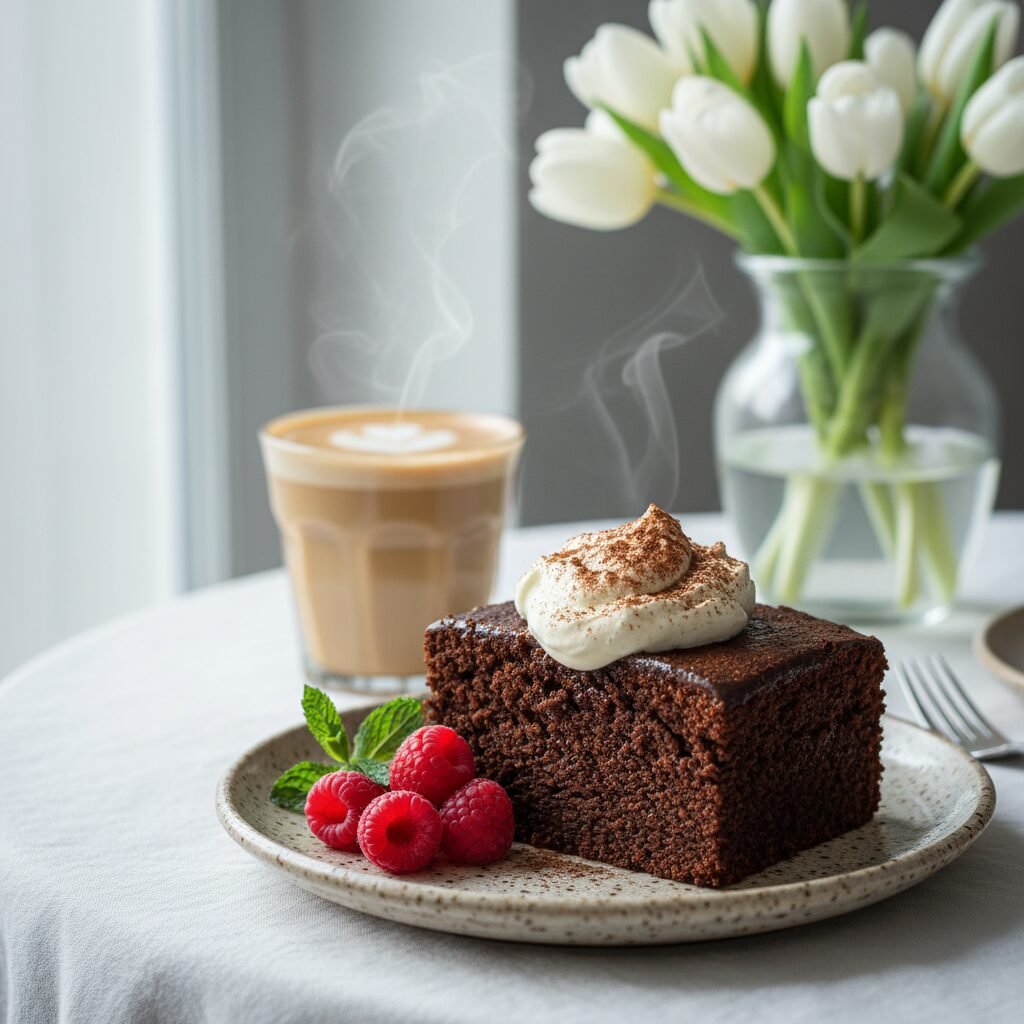
Since this is a brunch cake, presentation can be kept rustic yet elegant. Dust the top generously with powdered sugar and serve with a side of fresh berries—raspberries and strawberries work particularly well to cut through the richness. A dollop of lightly sweetened mascarpone cream or Greek yogurt makes for a sophisticated, breakfast-appropriate topping compared to heavy buttercream. If you are leaning towards a more dessert-style brunch, a drizzle of warm salted caramel sauce or a ganache glaze pairs beautifully with the espresso notes. Serve alongside a cappuccino or a tall glass of cold brew to echo the coffee flavors in the cake.
Storage and Reheating Tips
This cake stores exceptionally well due to its oil content. It can be kept at room temperature in an airtight container for up to 3 days without drying out. For longer storage, wrap the cake layers tightly in plastic wrap and store them in the refrigerator for up to 1 week. If you wish to freeze the cake, wrap the cooled layers individually in plastic wrap and then in aluminum foil. They can be frozen for up to 3 months. Thaw overnight in the refrigerator or on the counter for a few hours before serving. Reheating is generally not necessary, but a 10-second zap in the microwave can restore that ‘fresh out of the oven’ warmth.
Nutrition Facts (Estimated)
| Serving Size | 1 slice |
| Calories | 450 |
| Fat | 24g |
| Saturated Fat | 6g |
| Unsaturated Fat | 17g |
| Trans Fat | 0g |
| Cholesterol | 45mg |
| Sodium | 320mg |
| Carbohydrates | 58g |
| Fiber | 4g |
| Sugar | 35g |
| Protein | 6g |
Frequently Asked Questions
Can I use instant coffee instead of espresso?
Yes, absolutely. Dissolve 1 tablespoon of instant espresso powder or 2 tablespoons of regular instant coffee granules into 1 cup of boiling water.
Will this cake taste strongly of coffee?
No, it will not taste like a coffee cake. The espresso primarily serves to deepen the chocolate flavor, making it richer and more intense.
Can I make this recipe as cupcakes?
Yes, this batter makes excellent cupcakes. Fill muffin liners 2/3 full and bake for 18-22 minutes at 350°F.
Why is my batter so runny?
The batter is supposed to be very thin and liquid due to the cup of boiling liquid. Do not add more flour; it will bake up perfectly.
Can I use Dutch-processed cocoa?
Yes, Dutch-processed cocoa will give a darker color and a smoother, more mellow flavor, while natural cocoa provides a bit more acidity.
Can I reduce the sugar in this recipe?
You can reduce the sugar by about 1/4 cup without ruining the structure, but reducing it further may affect the moisture and texture.
What frosting goes best with this cake?
For brunch, a cream cheese frosting, mascarpone whipped cream, or a simple chocolate ganache are the best options.
Can I bake this in a Bundt pan?
Yes, but ensure you grease and flour the pan thoroughly. Bake for 45-55 minutes and check with a long skewer for doneness.
Conclusion
This Moist Espresso Chocolate Cake is more than just a recipe; it’s a secret weapon for hosting unforgettable brunches. It defies the dry, lackluster reputation of many homemade cakes and delivers a professional-bakery quality texture right from your own oven. The harmonious blend of dark chocolate and aromatic espresso creates a flavor profile that is sophisticated enough for adults but delicious enough for everyone to enjoy. Whether you are celebrating a special occasion or just want to elevate your weekend morning routine, this cake promises to deliver comfort and luxury in every bite. So brew a fresh pot of coffee, gather your ingredients, and get ready to bake the best chocolate cake of your life.