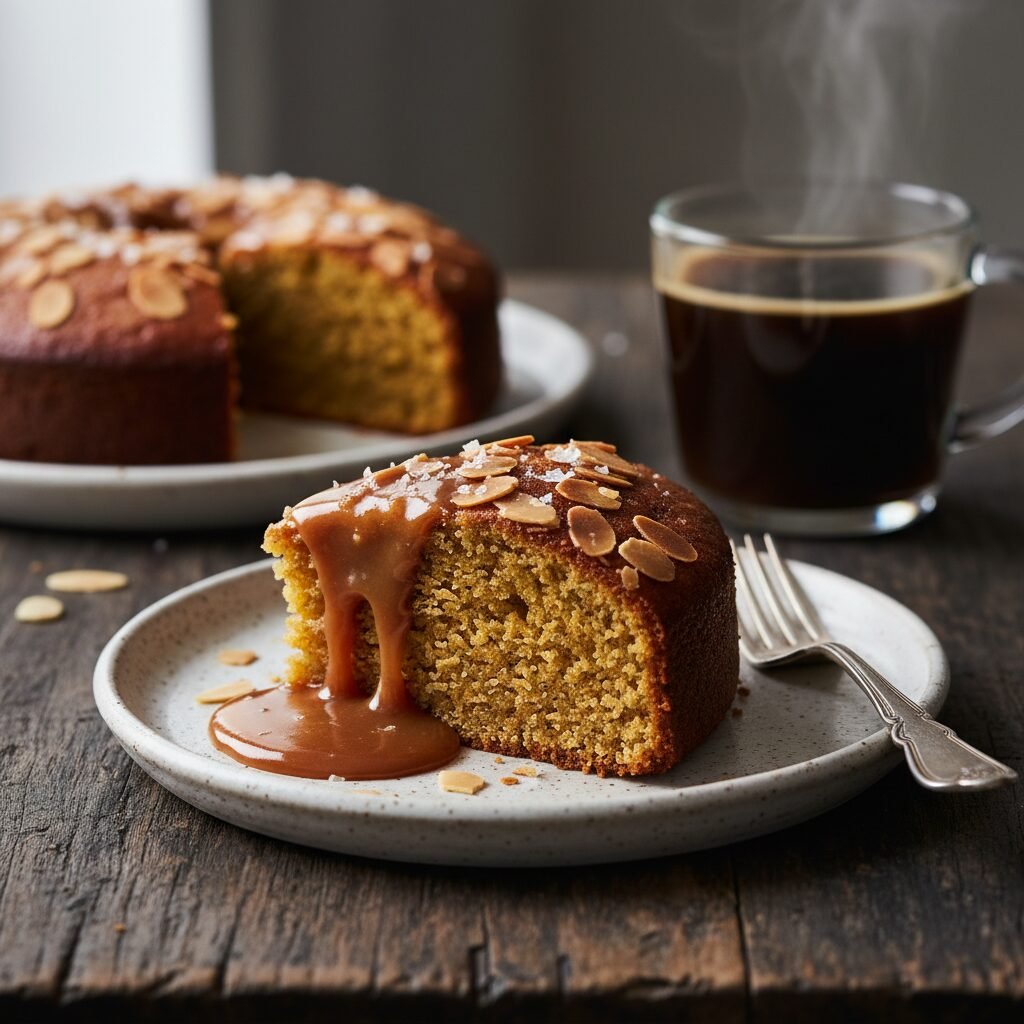
Moist Almond Cake With Caramel Glaze Recipe
This incredibly moist almond cake features a dense, tender crumb infused with pure almond extract and vanilla, topped with a rich, buttery salted caramel glaze that sets to a perfect glossy finish. It is a sophisticated yet simple dessert that pairs perfectly with afternoon coffee or tea.
20 minutes
40 minutes
1 hour 15 minutes (includes cooling)
8-10 servings
Dessert
Baking
American / European Fusion
Vegetarian
There is something profoundly comforting about the aroma of toasted almonds and caramelized sugar wafting through the kitchen on a quiet afternoon. This Moist Almond Cake with Caramel Glaze is not just a dessert; it is an experience in texture and flavor balance that rivals the finest European bakeries. Unlike traditional sponge cakes that rely heavily on wheat flour and aeration, this recipe leans into the rich, natural oils found in almond flour to create a crumb that is undeniably moist, almost reminiscent of a dense blondie or a classic French financier, but with the sliceable elegance of a tea cake. The magic begins with the batter, where butter and sugar are creamed to airy perfection before being folded with a generous amount of almond meal, ensuring that every bite melts in your mouth. But the true showstopper is the glaze. While the cake bakes to a golden brown, you prepare a quick stovetop caramel that walks the fine line between sweet and salty. When poured over the cooled cake, this amber liquid hugs every curve and crevice, setting into a sticky, decadent shell that provides a marvelous contrast to the tender interior. This cake is designed for those who appreciate the subtleties of nut flavors amplified by the warmth of brown sugar. It is rustic enough for a casual brunch yet elegant enough to end a dinner party on a high note. Whether you are a seasoned baker or a novice looking for a foolproof recipe that delivers high-impact results, this almond cake is guaranteed to become a staple in your repertoire. It is the kind of recipe that improves with time, tasting even better the next day as the flavors meld and the moisture redistributes, making it the ultimate make-ahead treat for any occasion.
History & Origins
The history of almond cakes is deeply rooted in Mediterranean and European baking traditions, tracing back to the Middle Ages when almonds were a staple crop in warm climates like Spain, Italy, and Southern France. During this era, refined wheat flour was often a luxury or scarce, leading bakers to grind nuts into meal to create the base for their confections. One of the most famous ancestors of this style of cake is the ‘Tarta de Santiago’ from Galicia, Spain, a flourless almond cake dating back to the Middle Ages, traditionally adorned with the cross of Saint James. Similarly, in France, the ‘Financier’—a small almond cake shaped like a gold bar—became popular in the 19th century in the financial district of Paris. These cakes were prized not only for their rich flavor but also for their ability to stay fresh longer than wheat-based cakes, thanks to the high oil content of the nuts. The addition of caramel glaze is a more modern, Western European twist, likely evolving from the 18th and 19th-century fascination with sugar work and confectionery. Caramel itself, simply burnt sugar, has been used for centuries to coat nuts and fruits, but creating a pourable dairy-based caramel glaze to enrobe a cake became popular in American and British baking in the mid-20th century as home baking ingredients became more accessible. This specific recipe marries the Old World density of a European nut torte with the New World love for rich, buttery toppings, creating a trans-Atlantic fusion that honors the historical significance of the humble almond while embracing modern indulgence.
Why This Recipe Works
This recipe succeeds where many others fail because it scientifically balances fat, sugar, and structure to prevent dryness—the enemy of all cakes. The primary reason this cake remains so moist is the high ratio of almond flour to all-purpose flour. Almond flour is essentially ground nuts, which are composed largely of fats. Unlike the gluten in wheat flour which can become tough and dry if overmixed or overbaked, the fats in the almond flour coat the proteins and starches, inhibiting gluten formation and locking in moisture. This results in a tender, velvety crumb that is virtually impossible to make tough. Furthermore, the use of both butter and eggs provides emulsification that traps air and moisture within the batter structure. We use a specific technique called the ‘creaming method’ for the cake base, which aerates the butter and sugar to provide lift, countering the heaviness of the nut meal. For the glaze, the combination of brown sugar, butter, and heavy cream creates a stable emulsion that thickens as it cools. The brown sugar contains molasses, which adds depth and hygroscopic properties (attracting moisture from the air), keeping the glaze soft and sticky rather than crystallizing into a hard shell. The salt in the glaze is crucial; it cuts through the intense sweetness of the sugar and the richness of the almond cake, activating the salivary glands and making the flavors pop on the palate. This interplay of textures—soft, dense cake meeting sticky, smooth glaze—creates a sensory experience that is scientifically designed to be pleasurable.
Why You’ll Love This Recipe
- ✓Stays moist for days thanks to high almond content
- ✓Rich, buttery caramel glaze sets perfectly without becoming hard
- ✓Simple preparation with no fancy equipment required
- ✓Perfect balance of sweet and salty flavors
- ✓Elegant presentation suitable for holidays or casual coffee breaks
- ✓Can be made gluten-free easily with a simple flour swap
Equipment You’ll Need
- ✓9-inch round cake pan or springform pan
- ✓Electric hand mixer or stand mixer
- ✓Medium mixing bowl
- ✓Small saucepan for glaze
- ✓Whisk
- ✓Wire cooling rack
- ✓Parchment paper
- ✓Measuring cups and spoons
Ingredients
- ✓1 1/2 cups Superfine Almond Flour
- ✓1/2 cup All-Purpose Flour (or 1:1 GF blend)
- ✓1 tsp Baking Powder
- ✓1/2 tsp Fine Sea Salt
- ✓3/4 cup Unsalted Butter, softened
- ✓3/4 cup Granulated Sugar
- ✓3 Large Eggs, room temperature
- ✓1 tsp Pure Almond Extract
- ✓1/2 tsp Vanilla Extract
- ✓1/3 cup Whole Milk, room temperature
- ✓FOR THE GLAZE:
- ✓1/4 cup Unsalted Butter
- ✓1/2 cup Dark Brown Sugar, packed
- ✓3 tbsp Heavy Cream
- ✓1/4 tsp Flaky Sea Salt
- ✓1/4 cup Sliced Almonds, toasted (for garnish)
Instructions
- Preheat your oven to 350°F (175°C). Grease a 9-inch round cake pan liberally with butter and line the bottom with a circle of parchment paper to ensure easy release.
- In a medium bowl, whisk together the almond flour, all-purpose flour, baking powder, and salt until well combined and free of lumps. Set aside.
- In a large mixing bowl or the bowl of a stand mixer fitted with the paddle attachment, beat the softened butter and granulated sugar on medium-high speed for 3-4 minutes until pale, light, and fluffy.
- Add the eggs one at a time, beating well after each addition and scraping down the sides of the bowl to ensure the mixture is homogeneous. Beat in the almond extract and vanilla extract.
- Reduce the mixer speed to low. Add half of the dry flour mixture to the wet ingredients, mixing just until combined. Pour in the milk and mix gently. Finally, add the remaining flour mixture and mix until just incorporated. Do not overmix.
- Pour the batter into the prepared cake pan and smooth the top with a spatula. Bake in the center of the oven for 35-40 minutes, or until the edges are golden brown and a toothpick inserted into the center comes out clean or with just a few moist crumbs.
- Remove the cake from the oven and let it cool in the pan for 10 minutes. Run a knife around the edges to loosen it, then carefully invert it onto a wire rack to cool completely before glazing.
- While the cake cools, prepare the caramel glaze. In a small saucepan over medium heat, melt the 1/4 cup butter. Add the brown sugar and heavy cream, whisking constantly.
- Bring the mixture to a gentle boil and let it bubble for 2 minutes while whisking. Remove from heat and stir in the flaky sea salt. Let the glaze cool for about 5-8 minutes until it thickens slightly but is still pourable.
- Pour the warm caramel glaze over the center of the cooled cake, using a spatula to gently push it towards the edges so it drips down the sides artistically. Immediately sprinkle with toasted sliced almonds. Allow the glaze to set for at least 20 minutes before slicing.
Expert Cooking Tips
- ✓Ensure all refrigerated ingredients like eggs, butter, and milk are at room temperature before starting to prevent the batter from curdling.
- ✓Toast the sliced almonds for the garnish in a dry skillet for 2-3 minutes to release their essential oils and add a crunchier texture.
- ✓Do not skip the cooling time for the glaze; if you pour it immediately while boiling hot, it will be too thin and run right off the cake.
- ✓Use superfine almond flour rather than coarse almond meal for a lighter, more cake-like texture.
- ✓If the top of the cake is browning too quickly in the oven, tent it loosely with aluminum foil for the last 10 minutes of baking.
- ✓Weigh your flour ingredients for the most accurate results; too much flour can dry out even an almond cake.
Substitutions and Variations
This recipe is quite versatile regarding dietary needs and pantry staples. If you need to make this gluten-free, simply replace the 1/2 cup of all-purpose flour with a high-quality 1:1 gluten-free flour blend that contains xanthan gum; the almond flour naturally supports the structure well. For a dairy-free version, use a plant-based butter stick alternative and replace the whole milk with unsweetened almond milk or oat milk. The caramel glaze can be made with full-fat coconut milk instead of heavy cream and vegan butter, though the flavor profile will shift slightly towards coconut. If you do not have almond extract, you can double the vanilla extract, but the cake will lose its distinct ‘marzipan’ flavor profile. For the sugar, you can use light brown sugar in the glaze instead of dark, resulting in a milder caramel flavor. Honey or maple syrup are not recommended substitutions for the sugar in the cake batter as they alter the moisture balance.
Common Mistakes to Avoid
The most common mistake with this recipe is overmixing the batter once the flour is added. Overmixing develops the gluten in the all-purpose flour, leading to a tough, rubbery cake rather than a tender one. Another frequent error is baking at the wrong temperature; oven thermometers are essential as many ovens run hot or cold. If the oven is too hot, the outside will burn before the center is cooked. Regarding the glaze, a common pitfall is overheating the sugar mixture, causing it to seize or become hard candy upon cooling. Keep the boil gentle and only for the specified time. Also, attempting to glaze a hot cake is a recipe for disaster; the cake releases steam which will melt the glaze and cause it to slide off entirely. Finally, using cold butter for the creaming step will prevent proper aeration, resulting in a dense, flat cake.
Serving Suggestions
This cake is visually stunning on its own, but it shines when served with complementary accompaniments. A dollop of unsweetened crème fraîche or slightly sweetened whipped cream cuts through the richness of the caramel. For a warm contrast, serve a slice with a scoop of vanilla bean ice cream or salted caramel gelato. Fresh berries, particularly raspberries or blackberries, add a tart brightness that balances the sweet glaze. Beverage-wise, this cake pairs exceptionally well with a dark roast coffee, an espresso, or a cup of Earl Grey tea. For an evening dessert, consider pairing it with a glass of tawny port or a dessert wine like Sauternes.
Storage and Reheating Tips
Because of the high moisture content from the almonds, this cake stores beautifully. It can be kept at room temperature in an airtight container or under a cake dome for up to 3 days. In fact, the flavors often meld and improve on the second day. If you live in a very hot or humid climate, it is safer to store it in the refrigerator for up to 5 days; just be sure to bring it back to room temperature before serving to soften the butter and glaze. For long-term storage, you can freeze the unglazed cake wrapped tightly in plastic wrap and foil for up to 3 months. Thaw overnight in the fridge and glaze fresh before serving. Individual slices of glazed cake can also be frozen if separated by parchment paper.
Nutrition Facts (Estimated)
| Serving Size | 1 slice |
| Calories | 420 |
| Fat | 26g |
| Saturated Fat | 10g |
| Unsaturated Fat | 14g |
| Trans Fat | 0g |
| Cholesterol | 85mg |
| Sodium | 180mg |
| Carbohydrates | 38g |
| Fiber | 3g |
| Sugar | 28g |
| Protein | 8g |
Frequently Asked Questions
Can I use almond meal instead of almond flour?
Yes, but the texture will be coarser and slightly denser. Almond flour is blanched (skins removed) and ground finely, while almond meal often contains the skins. The flavor will be more rustic with meal.
Why did my cake sink in the middle?
Sinking usually happens if the oven door was opened too early, releasing heat, or if the cake was underbaked. It can also result from over-creaming the butter and sugar, incorporating too much air that collapses.
Can I make this cake in a loaf pan?
Absolutely. A 9×5 inch loaf pan works well. You will likely need to increase the baking time by 10-15 minutes as the batter is deeper. Check for doneness with a toothpick.
Is the almond extract necessary?
It is not strictly necessary for the structural integrity of the cake, but it is highly recommended for that signature nutty, bakery-style flavor. Without it, the cake will taste more like a vanilla butter cake.
My glaze is too thick to pour. What do I do?
If the glaze cooled too much, simply return the saucepan to low heat for a few seconds and whisk vigorously until it loosens up again. Add a teaspoon of cream if it remains stubborn.
Can I use salted butter instead of unsalted?
Yes, if you only have salted butter, reduce the added salt in the cake batter to 1/4 teaspoon. For the glaze, salted butter is fine, but taste before adding the extra flaky sea salt.
How do I know when the cake is perfectly done?
The cake should be golden brown, pull away slightly from the sides of the pan, and a tester inserted in the center should come out clean or with a few damp crumbs attached, but no wet batter.
Can I add fruit to the batter?
Yes! Pears, apricots, or raspberries work wonderfully. Fold about 1 cup of fresh fruit into the batter just before baking. Note that this may increase baking time slightly due to added moisture.
Why is my glaze grainy?
Grainy glaze is caused by undissolved sugar. Ensure you whisk constantly while heating and do not let the mixture boil too vigorously. The sugar needs to fully dissolve into the fat.
Is this cake suitable for shipping?
Yes, the dense, moist texture travels well. However, it is best to ship the cake unglazed and include the glaze ingredients or a jar of caramel sauce separately, or glaze it and freeze it before shipping with ice packs.
Conclusion
In a world of complex desserts and multi-step pastries, this Moist Almond Cake with Caramel Glaze stands out for its beautiful simplicity and profound flavor. It honors the timeless combination of nuts and sugar, elevating humble ingredients into a centerpiece worthy of any gathering. Whether you are baking for a special holiday, a birthday, or simply to bring a bit of warmth into your home on a rainy day, this recipe delivers comfort in every crumb. The lingering taste of buttery caramel and sweet almonds will have your family and friends asking for the recipe before the last crumb is gone. Happy baking!