
Moist Yellow Sheet Cake For Beginners Recipe
Ditch the box mix forever with this foolproof, incredibly moist yellow sheet cake recipe. Featuring a tender, buttery crumb and topped with a rich, homemade chocolate buttercream, this classic dessert is perfect for birthdays, potlucks, and beginner bakers looking for a guaranteed win.
20 minutes
30 minutes
1 hour 15 minutes (includes cooling)
15-20 Servings
Dessert
Baking
American
Vegetarian
There is something profoundly nostalgic about a classic yellow sheet cake. It is the centerpiece of childhood birthday parties, the reliable comfort found at church potlucks, and the sweet ending to Sunday family dinners. While the convenience of a box mix is undeniable, the flavor and texture of a homemade yellow cake are simply incomparable. A true yellow cake should not just be a vehicle for frosting; it should stand on its own with a distinct buttery richness, a hint of vanilla custard flavor, and a crumb that is soft, plush, and undeniably moist. This recipe for Moist Yellow Sheet Cake for Beginners was designed specifically to bridge the gap between the ease of a mix and the superior quality of scratch baking. We have stripped away the complicated techniques often found in professional pastry kitchens, such as separating eggs or using boiled milk, and focused instead on a straightforward method that yields consistent results every time. The secret lies in the balance of ingredients. Many yellow cakes suffer from being too dry or too dense, but this recipe utilizes a combination of butter and vegetable oil. The butter provides that essential, nostalgic flavor that we crave, while the oil ensures the cake stays moist for days, rather than drying out the moment it cools. Paired with the tang of buttermilk, which breaks down the gluten for a tender bite, this cake offers a sensory experience that is both comforting and luxurious. Whether you are a seasoned baker looking for a reliable standard or a complete novice attempting your first scratch cake, this guide will walk you through every step to ensure your sheet cake comes out of the oven golden, fragrant, and perfect ready to be slathered in a thick layer of chocolate fudge frosting.
History & Origins
The history of the ‘yellow cake’ is deeply intertwined with the evolution of baking powder and the availability of refined ingredients in American culinary history. Before the mid-19th century, cakes were primarily leavened using yeast, much like bread, or by the laborious mechanical action of beating eggs for extended periods to incorporate air. These early cakes were denser and more bread-like than the confections we know today. The distinction between ‘white’ and ‘yellow’ cakes emerged more prominently in the late 1800s. In historical cookbooks, you will often find recipes for ‘Gold Cake’ and ‘Silver Cake.’ These were often companion recipes designed to use up the separated parts of the egg; Silver Cake used only egg whites to achieve a pristine, snow-white appearance, while Gold Cake utilized the leftover yolks, resulting in a rich, golden-hued crumb. This usage of yolks is what gives yellow cake its signature color and custard-like richness. As chemical leaveners like baking soda and baking powder became commercially available and reliable around the 1850s and 1860s, the modern butter cake was born. The ‘sheet cake’ format gained massive popularity in the mid-20th century, particularly with the rise of suburban living and the need for desserts that could easily feed a crowd at neighborhood gatherings and school functions. The 9×13 pan became a standard fixture in American kitchens, and the yellow sheet cake cemented its status as the quintessential American birthday cake. Unlike the intricate layer cakes of European patisseries, the American sheet cake represents a democratic, accessible, and communal approach to dessert, prioritizing flavor and abundance over architectural complexity.
Why This Recipe Works
This recipe succeeds where many others fail because it scientifically addresses the two biggest complaints about homemade yellow cake: dryness and lack of flavor. To tackle dryness, we employ a ‘dual-fat’ strategy. Butter is essential for flavor; its milk solids brown slightly during baking, creating nutty, caramelized notes that oil simply cannot replicate. However, butter is about 18-20% water, which evaporates during baking, potentially leading to a drier crumb. Vegetable oil, on the other hand, is 100% fat and remains liquid at room temperature. By replacing a portion of the butter with oil, we coat the flour proteins more effectively, inhibiting gluten formation and ensuring the cake remains sensationally moist and soft even days after baking. Furthermore, we utilize buttermilk rather than regular milk. The acidity in buttermilk reacts with the baking soda and baking powder, creating a robust lift that keeps the cake fluffy rather than dense. This acidity also tenderizes the gluten strands in the flour, contributing to a ‘melt-in-your-mouth’ texture. Finally, the use of both whole eggs and additional egg yolks mimics the ‘Gold Cakes’ of the past. The extra yolks act as an emulsifier, binding the fats and liquids together into a smooth, cohesive batter while adding a richness and golden color that implies luxury. This recipe is also designed to be mixed in a specific order that minimizes the risk of over-mixing, which is the leading cause of tough cakes for beginners.
Why You’ll Love This Recipe
- ✓Uses a mix of butter and oil for the ultimate moist texture.
- ✓Beginner-friendly method with no complex egg separation required.
- ✓Ideally sized for a standard 9×13 pan to feed a crowd.
- ✓Stays soft and fresh for up to 4 days at room temperature.
- ✓Includes a rich, foolproof chocolate buttercream frosting recipe.
- ✓Perfect balance of vanilla and buttery flavors.
Equipment You’ll Need
- ✓9×13 inch baking pan
- ✓Stand mixer or electric hand mixer
- ✓Large mixing bowl
- ✓Medium mixing bowl
- ✓Whisk
- ✓Rubber spatula
- ✓Wire cooling rack
- ✓Measuring cups and spoons
- ✓Offset spatula (for frosting)
Ingredients
- ✓2 1/2 cups All-Purpose Flour (spooned and leveled)
- ✓2 cups Granulated Sugar
- ✓1 1/2 teaspoons Baking Powder
- ✓1/2 teaspoon Baking Soda
- ✓1/2 teaspoon Salt
- ✓3/4 cup Unsalted Butter, softened to room temperature
- ✓1/4 cup Vegetable Oil (or Canola Oil)
- ✓3 Large Eggs, room temperature
- ✓2 Large Egg Yolks, room temperature
- ✓1 tablespoon Pure Vanilla Extract
- ✓1 cup Buttermilk, room temperature
- ✓FOR THE FROSTING: 1 cup Unsalted Butter, softened
- ✓3 1/2 cups Powdered Sugar
- ✓1/2 cup Unsweetened Cocoa Powder
- ✓1/4 cup Heavy Cream or Whole Milk
- ✓1 teaspoon Vanilla Extract
- ✓1/4 teaspoon Salt
Instructions
- 1. Preheat your oven to 350°F (175°C). Grease a 9×13 inch baking pan generously with butter or non-stick baking spray. For extra security, you can line the bottom with parchment paper.
- 2. In a medium bowl, whisk together the flour, baking powder, baking soda, and salt until well combined. Set this dry mixture aside.
- 3. In the bowl of a stand mixer fitted with the paddle attachment (or a large bowl using a hand mixer), beat the softened butter, vegetable oil, and granulated sugar on medium-high speed for about 3-4 minutes. The mixture should look pale, fluffy, and aerated.
- 4. Add the eggs and egg yolks one at a time, beating well after each addition. Scrape down the sides and bottom of the bowl with a rubber spatula to ensure everything is incorporated. Stir in the vanilla extract.
- 5. Reduce the mixer speed to low. Add the flour mixture in three parts, alternating with the buttermilk in two parts, starting and ending with the flour (Flour -> Buttermilk -> Flour -> Buttermilk -> Flour). Mix just until the flour streaks disappear. Do not overmix.
- 6. Pour the batter into the prepared baking pan and smooth the top with an offset spatula or the back of a spoon.
- 7. Bake for 28-32 minutes, or until a toothpick inserted into the center comes out clean or with just a few moist crumbs attached. The top should be golden brown and spring back lightly when touched.
- 8. Remove the cake from the oven and place the pan on a wire rack. Allow the cake to cool completely in the pan before frosting. This usually takes about 45 minutes to an hour.
- 9. While the cake cools, make the frosting. Beat the 1 cup of softened butter in a large bowl until creamy (about 2 minutes). Add the cocoa powder and mix until combined.
- 10. Gradually add the powdered sugar, about one cup at a time, alternating with the heavy cream. Add the vanilla and salt. Whip on high speed for 2-3 minutes until the frosting is fluffy and creamy.
- 11. Once the cake is fully cool, spread the frosting evenly over the top. Slice into squares and serve.
Expert Cooking Tips
- ✓Room temperature ingredients are non-negotiable. Cold eggs or buttermilk can cause the batter to curdle and result in a dense cake.
- ✓Measure flour correctly by spooning it into the measuring cup and leveling it off with a knife. Scooping directly packs the flour and leads to a dry cake.
- ✓Do not overmix the batter once the flour is added. Overmixing develops gluten, which makes the cake tough instead of tender.
- ✓If you don’t have buttermilk, you can make a substitute by adding 1 tablespoon of lemon juice or white vinegar to a measuring cup and filling it to the 1-cup line with whole milk. Let it sit for 5 minutes before using.
- ✓Check the cake at the 28-minute mark. All ovens run differently, and you want to catch it the moment it is done to prevent drying out.
- ✓Tap the pan on the counter once or twice before baking to release any large air bubbles.
- ✓For ultra-smooth frosting, sift your cocoa powder and powdered sugar before mixing to remove any lumps.
Substitutions and Variations
Baking is chemistry, so substitutions should be made with care, but there is flexibility. If you do not have buttermilk, the ‘sour milk’ hack (milk + vinegar) works well, or you can mix sour cream with milk in a 1:1 ratio. For the vegetable oil, you can use melted coconut oil or canola oil; avoid strong-flavored oils like olive oil unless you want that specific flavor profile. If you only have salted butter, omit the additional salt called for in the recipe. For the flour, Cake Flour can be used for an even lighter crumb; if using cake flour, increase the amount to 2 3/4 cups as it is less dense than All-Purpose. In the frosting, you can swap heavy cream for whole milk or half-and-half, though the frosting will be slightly less rich. If you prefer a vanilla frosting, simply omit the cocoa powder and increase the powdered sugar by roughly 1/2 cup to maintain the consistency.
Common Mistakes to Avoid
The most common mistake beginners make is not measuring flour correctly. Dipping the cup into the bag compacts the flour, meaning you might accidentally add up to 30% more flour than required, resulting in a dry, hard brick. Another error is rushing the cooling process. If you try to frost the cake while it is even slightly warm, the butter in the frosting will melt, causing it to slide off or soak into the cake, ruining the texture. Opening the oven door too frequently during baking can cause the temperature to fluctuate and the cake to sink in the middle. Finally, using cold butter will prevent proper aeration during the creaming stage; the butter must be soft enough to indent with your finger but not melted.
Serving Suggestions
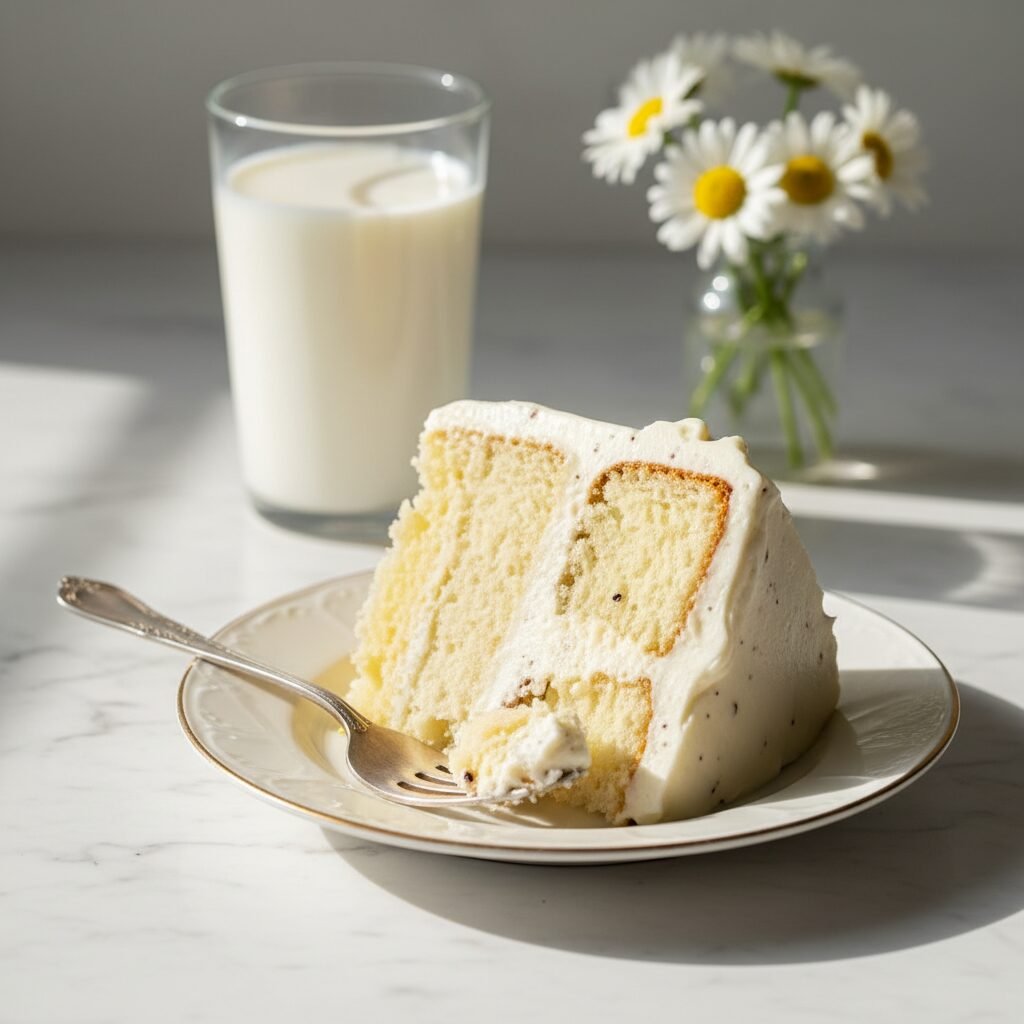
This moist yellow sheet cake is a crowd-pleaser that shines on its own, but it can be dressed up for special occasions. Serve it with a scoop of vanilla bean ice cream on the side to create a ‘cake and cream’ contrast. Fresh berries, such as raspberries or strawberries, add a tart freshness that cuts through the richness of the chocolate frosting. For a birthday party flair, cover the wet frosting immediately with rainbow sprinkles or confetti quins. A hot cup of black coffee or a cold glass of milk are the traditional beverage pairings that highlight the vanilla and chocolate flavors perfectly.
Storage and Reheating Tips
Because this cake uses oil, it stays moist longer than all-butter cakes. It can be stored at room temperature, covered tightly with plastic wrap or in an airtight cake carrier, for up to 4 days. If your kitchen is particularly hot or humid, you may want to store it in the refrigerator, where it will keep for up to 1 week; however, let it come to room temperature before serving for the best texture and flavor. To freeze, you can freeze the entire cake (unfrosted is best, but frosted works too) or individual slices. Wrap the cake or slices tightly in plastic wrap, then a layer of aluminum foil. It will keep in the freezer for up to 3 months. Thaw on the counter for a few hours before eating.
Nutrition Facts (Estimated)
| Serving Size | 1 slice (1/20th of cake) |
| Calories | 380 |
| Fat | 18g |
| Saturated Fat | 10g |
| Unsaturated Fat | 7g |
| Trans Fat | 0g |
| Cholesterol | 65mg |
| Sodium | 210mg |
| Carbohydrates | 52g |
| Fiber | 1g |
| Sugar | 32g |
| Protein | 4g |
Frequently Asked Questions
Can I bake this in two round pans instead of a sheet pan?
Yes, absolutely. This recipe will fit into two 8-inch or 9-inch round cake pans. You will need to adjust the baking time down slightly, checking them around 22-25 minutes.
Why did my cake sink in the middle?
Sinking usually happens if the oven door was opened too early (releasing heat), if the cake was underbaked, or if there was too much leavening (baking powder/soda) or liquid. Ensure your oven temperature is accurate using an oven thermometer.
Can I make this recipe into cupcakes?
Yes, this batter makes excellent cupcakes. It will yield approximately 24 cupcakes. Bake them at 350°F for 15-18 minutes.
Is it necessary to use both butter and oil?
Technically no, but we highly recommend it. Using all butter gives great flavor but a drier texture. Using all oil gives a moist texture but lacks flavor. The combination gives you the best of both worlds.
Can I reduce the sugar in this recipe?
Sugar does more than just sweeten; it provides structure and moisture. Reducing it significantly will alter the texture, making the cake more bread-like and less tender. We recommend sticking to the listed amount for the best crumb.
Do I have to use a stand mixer?
No, a hand mixer works perfectly fine. You can even mix it by hand with a whisk and a strong arm, though creaming the butter and sugar properly will take some physical effort.
What if I don’t have vanilla extract?
Vanilla is key for the flavor profile of a yellow cake. In a pinch, you can use maple syrup or almond extract, though the flavor will be different. Vanilla bean paste is an excellent upgrade if you have it.
How do I know when the butter is creamed enough?
The butter and sugar mixture should turn pale yellow (almost white) and increase in volume. When you rub a little bit of the mixture between your fingers, the sugar granules should feel smaller and less gritty.
Conclusion
Mastering a classic Moist Yellow Sheet Cake is a rite of passage for any home baker, and with this recipe, success is practically guaranteed. By understanding the simple science behind the ingredients and following the tips for room temperature preparation, you can create a dessert that rivals any bakery. Whether you are celebrating a milestone birthday or just need a pick-me-up on a Tuesday night, this cake delivers comfort in every bite. So preheat your oven, grab that 9×13 pan, and get ready to enjoy the best yellow cake you have ever tasted.