Moist Almond Bundt Cake Recipe
This incredibly moist almond Bundt cake is a showstopper dessert featuring a tender, dense crumb and a sweet almond glaze. Perfect for brunches or holidays, it combines the richness of almond paste with a hint of vanilla for an unforgettable treat that stays fresh for days.
25 minutes
55 minutes
1 hour 35 minutes
12-14 servings
Dessert
Baking
American / European
Vegetarian
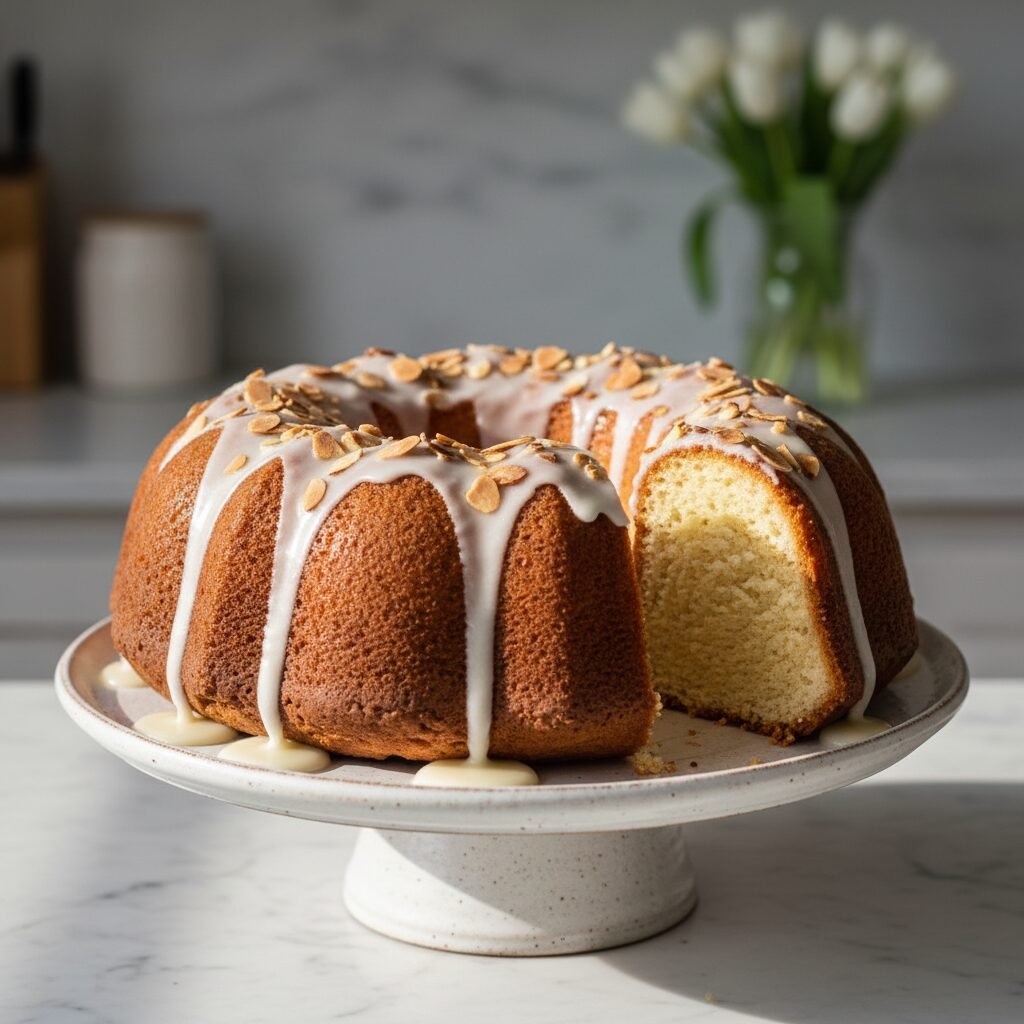
If there is one cake that defines the concept of ‘comfort baking’ while retaining an air of sophisticated elegance, it is the Bundt. But not just any Bundt—this Moist Almond Bundt Cake is a revelation in texture and flavor that stands head and shoulders above standard sponge cakes. At the heart of this recipe is the luxurious use of almond paste, not just almond extract. This key ingredient infuses the batter with a deep, nutty sweetness and a chewy, dense moisture that mimics the finest European pastries. Unlike airy chiffon cakes that can dry out quickly, this almond Bundt possesses a velvety, pound-cake-like crumb that actually improves with time, making it the perfect make-ahead dessert for busy hosts. The golden, caramelized crust formed by the heavy-gauge Bundt pan offers a delightful textural contrast to the soft interior, while the glossy white glaze, scented with a whisper of Amaretto, adds a final touch of sweetness that looks as beautiful as it tastes. Whether you are serving this alongside a strong cup of dark roast coffee for breakfast or presenting it as the centerpiece of a festive holiday table, this cake promises to deliver a ‘wow’ factor with surprisingly minimal effort. It captures the nostalgic essence of bakery-style almond treats but elevates them with the freshness of home baking.
History & Origins
The history of this almond Bundt cake is a fascinating blend of European tradition and American mid-century innovation. The Bundt pan itself is a distinctly American adaptation of the European ceramic ‘Gugelhupf’ or ‘Kugelhopf’ mold, which has been used in Germany, Austria, and Alsace for centuries to bake yeast-risen cakes. In 1950, H. David Dalquist, the founder of Nordic Ware, cast the first aluminum Bundt pan in Minneapolis at the request of a local Jewish women’s society who wanted to recreate their traditional cakes. However, the pan remained a slow seller until the 1966 Pillsbury Bake-Off, where the ‘Tunnel of Fudge’ cake took second place and catapulted the Bundt pan into stardom. This specific almond recipe draws its lineage from the rich tradition of ‘Mandelkuchen’ (almond cake) found across Scandinavia and Germany. In these regions, almonds were considered a luxury ingredient, often ground into marzipan or paste to create dense, festive treats for Christmas and weddings. By adapting these heavy, nut-laden European batters for the American Bundt pan, bakers discovered that the central tube allowed for even heat distribution, permitting the dense batter to bake through perfectly without drying out the edges. Today, the almond Bundt represents the perfect marriage of Old World flavor profiles and New World baking technology.
Why This Recipe Works
Achieving a cake that is both dense and moist is a delicate balancing act, and this recipe succeeds where others fail due to the specific chemistry of its ingredients. The secret weapon is commercial almond paste. Unlike pure sugar, the almond paste contains nut oils and pulverized almonds that hold onto moisture aggressively. When beaten properly with the butter and sugar, the almond paste creates an emulsion that traps fat within the batter, ensuring the cake remains tender for days after baking. Furthermore, the inclusion of full-fat sour cream is critical; the acidity in the sour cream tenderizes the gluten strands in the flour, preventing the cake from becoming tough or rubbery, while its high fat content adds richness. We also use a ‘reverse creaming’ inspired technique where the almond paste is broken down with sugar first; this prevents the common pitfall of finding hard, unappealing lumps of almond paste in the finished product. Finally, the ratio of eggs to flour provides structure. Since almond paste adds weight, the eggs are essential for leavening, working in tandem with the baking powder to lift the heavy batter just enough to fill the intricate designs of the Bundt pan without overflowing or collapsing.
Why You’ll Love This Recipe
- ✓Stays incredibly moist for up to 5 days at room temperature
- ✓Features deep, authentic almond flavor from real almond paste
- ✓Elegant, bakery-style presentation with minimal decorating skills required
- ✓Freezer-friendly slices make for perfect meal prep treats
- ✓The dense crumb holds up well to dunking in coffee or tea
- ✓Can be made gluten-free easily with a 1:1 flour substitute
Equipment You’ll Need
- ✓10-12 cup Bundt pan
- ✓Stand mixer with paddle attachment
- ✓Rubber spatula
- ✓Cooling rack
- ✓Measuring cups and spoons
- ✓Sifter
- ✓Pastry brush for greasing
Ingredients
- ✓1 cup (226g) unsalted butter, softened to room temperature
- ✓8 oz (225g) almond paste, broken into small pieces (NOT marzipan)
- ✓1 3/4 cups (350g) granulated sugar
- ✓4 large eggs, room temperature
- ✓1 teaspoon pure almond extract
- ✓1 teaspoon pure vanilla extract
- ✓3 cups (360g) all-purpose flour
- ✓1/2 teaspoon salt
- ✓1/2 teaspoon baking soda
- ✓1/2 teaspoon baking powder
- ✓1 cup (240g) full-fat sour cream
- ✓For the Glaze: 1 1/2 cups powdered sugar, sifted
- ✓For the Glaze: 2-3 tablespoons milk or Amaretto liqueur
- ✓For the Glaze: 1/2 cup sliced almonds, lightly toasted
Instructions
- 1. Preheat your oven to 325°F (165°C). Thoroughly grease your Bundt pan with softened butter and dust with flour, or use a baking spray specifically designed for baking (containing flour). Use a pastry brush to ensure every nook and cranny of the design is coated to prevent sticking.
- 2. In the bowl of a stand mixer fitted with the paddle attachment, place the broken-up almond paste and 1/4 cup of the granulated sugar. Beat on low speed for 2-3 minutes until the almond paste breaks apart into fine, sand-like crumbs. This step is crucial to avoid lumps.
- 3. Add the softened butter and the remaining granulated sugar to the mixer. Increase the speed to medium-high and beat for 4-5 minutes until the mixture is pale, light, and fluffy. Scrape down the sides of the bowl with a rubber spatula halfway through.
- 4. Add the eggs one at a time, beating well after each addition. Scrape the bowl again. Stir in the almond extract and vanilla extract.
- 5. In a medium bowl, whisk together the flour, baking powder, baking soda, and salt to aerate the dry ingredients.
- 6. Reduce the mixer speed to low. Add the flour mixture in three parts, alternating with the sour cream in two parts, beginning and ending with the dry ingredients. Mix only until the flour is just disappeared. Do not overmix, or the cake will be tough.
- 7. Pour the thick batter into the prepared Bundt pan. Smooth the top with a spatula. Gently tap the pan on the counter 3-4 times to release any large air bubbles trapped in the design.
- 8. Bake for 50 to 60 minutes. The cake is done when it is golden brown and a wooden skewer inserted into the deepest part of the cake comes out clean or with just a few moist crumbs attached.
- 9. Remove from the oven and let the cake cool in the pan for exactly 10 minutes. This allows the structure to set. Then, place a wire cooling rack over the pan and invert the cake onto the rack. Lift the pan off carefully. Let the cake cool completely before glazing.
- 10. To make the glaze, whisk the powdered sugar with the milk (or Amaretto) until you reach a thick but pourable consistency. Drizzle over the cooled cake and immediately sprinkle with the toasted sliced almonds.
Expert Cooking Tips
- ✓Room temperature ingredients are non-negotiable; cold eggs or sour cream can cause the buttery batter to curdle.
- ✓If using a dark-colored non-stick Bundt pan, check the cake at 45 minutes as dark pans conduct heat faster.
- ✓To toast almonds, place them in a dry skillet over medium heat for 3-4 minutes, stirring constantly until fragrant.
- ✓Do not substitute almond paste with marzipan; marzipan has a much higher sugar content and will alter the chemistry of the cake.
- ✓If the top of the cake is browning too quickly before the center is cooked, loosely tent the pan with aluminum foil.
Substitutions and Variations
Baking is a science, so substitutions should be made with care. If you cannot find sour cream, full-fat plain Greek yogurt is an excellent 1:1 substitute that provides similar acidity and moisture. For a gluten-free version, use a high-quality 1:1 gluten-free all-purpose flour blend that contains xanthan gum; the texture will be slightly different but still delicious. If you prefer a milder almond flavor, reduce the almond extract to 1/2 teaspoon or omit it entirely, relying solely on the almond paste. For the glaze, you can use orange juice instead of milk for a citrusy twist that pairs beautifully with almond. Do not substitute the butter for oil or margarine, as the aeration of the butter is essential for the cake’s structure.
Common Mistakes to Avoid
The most common mistake with Bundt cakes is the cake sticking to the pan. This usually happens for two reasons: either the pan wasn’t greased thoroughly enough (pay attention to the center tube!), or the cake was left to cool in the pan for too long. Cooling it for more than 10-15 minutes creates a vacuum effect and causes the sugars to harden, gluing the cake to the metal. Another mistake is overmixing the batter after adding the flour; this develops gluten and results in a tough, rubbery cake rather than a tender one. Finally, ensure you are buying ‘Almond Paste’ and not ‘Marzipan’ or ‘Almond Filling’—check the box carefully, as they are sold in similar packaging.
Serving Suggestions
This cake is versatile enough for breakfast or dessert. Serve a thick slice with a dollop of unsweetened whipped cream and fresh raspberries to cut through the sweetness. It pairs exceptionally well with strong beverages like espresso, Earl Grey tea, or a dessert wine like Moscato. For a warm dessert, microwave a slice for 15 seconds and serve with a scoop of vanilla bean ice cream.
Storage and Reheating Tips
This almond cake has excellent keeping qualities. Store it at room temperature in an airtight cake dome or wrapped tightly in plastic wrap for up to 5 days. The flavor often matures and improves on the second day. For longer storage, wrap individual slices in plastic wrap and then foil, and freeze for up to 3 months. Thaw frozen slices on the counter for 30 minutes before eating. Do not refrigerate the whole cake, as the cold air will dry out the crumb faster than room temperature storage.
Nutrition Facts (Estimated)
| Serving Size | 1 slice |
| Calories | 445 |
| Fat | 24g |
| Saturated Fat | 12g |
| Unsaturated Fat | 10g |
| Trans Fat | 0g |
| Cholesterol | 95mg |
| Sodium | 190mg |
| Carbohydrates | 52g |
| Fiber | 3g |
| Sugar | 32g |
| Protein | 7g |
Frequently Asked Questions
What is the difference between almond paste and marzipan?
Almond paste is made of roughly equal parts ground almonds and sugar, used as a baking ingredient. Marzipan has a much higher ratio of sugar to almonds and is smoother, often used for molding candies or covering cakes. They are not interchangeable in this recipe.
Why did my cake sink in the middle?
Sinking usually happens if the cake was underbaked (the internal structure hadn’t set), if the oven door was opened too early, or if there was too much leavening (baking powder/soda) causing it to rise rapidly and then collapse.
Can I make this cake ahead of time?
Yes! In fact, this cake tastes even better the next day as the moisture from the almond paste redistributes. It’s perfect for baking a day before an event.
My almond paste is very hard, how do I use it?
If your almond paste is rock hard, you can soften it by microwaving it for 10-15 seconds. However, breaking it down with the sugar in the mixer as directed should handle even firm paste.
Can I use a regular tube pan instead of a Bundt pan?
Yes, a standard tube pan (angel food cake pan) works, but ensure it is well-greased. The baking time should remain roughly the same.
Why is my cake dry?
Dryness is usually caused by overbaking or overmeasuring the flour. Always spoon and level your flour or use a scale. Also, ensure you used full-fat sour cream.
Can I add fruit to the batter?
You can add about 1 cup of fresh berries (tossed in flour) or dried fruit (cranberries work well), but be aware this may lengthen the baking time slightly.
How do I know which size Bundt pan I have?
Use a measuring cup to pour water into your pan until it’s full. This recipe requires a 10-12 cup capacity pan to avoid overflowing.
Conclusion
There are few things in the culinary world as satisfying as turning a Bundt pan upside down and lifting it away to reveal a perfect, golden fluted cake. This Moist Almond Bundt Cake is a testament to the power of quality ingredients and simple techniques coming together to create something truly special. Whether you are a seasoned baker or a novice, this recipe is forgiving, reliable, and guaranteed to impress. The intoxicating aroma of toasted almonds filling your kitchen is just the prelude to the joy of sharing this delicious treat with friends and family. Bake it once, and it is sure to become a permanent fixture in your recipe collection.