Moist Almond Layer Cake Recipe
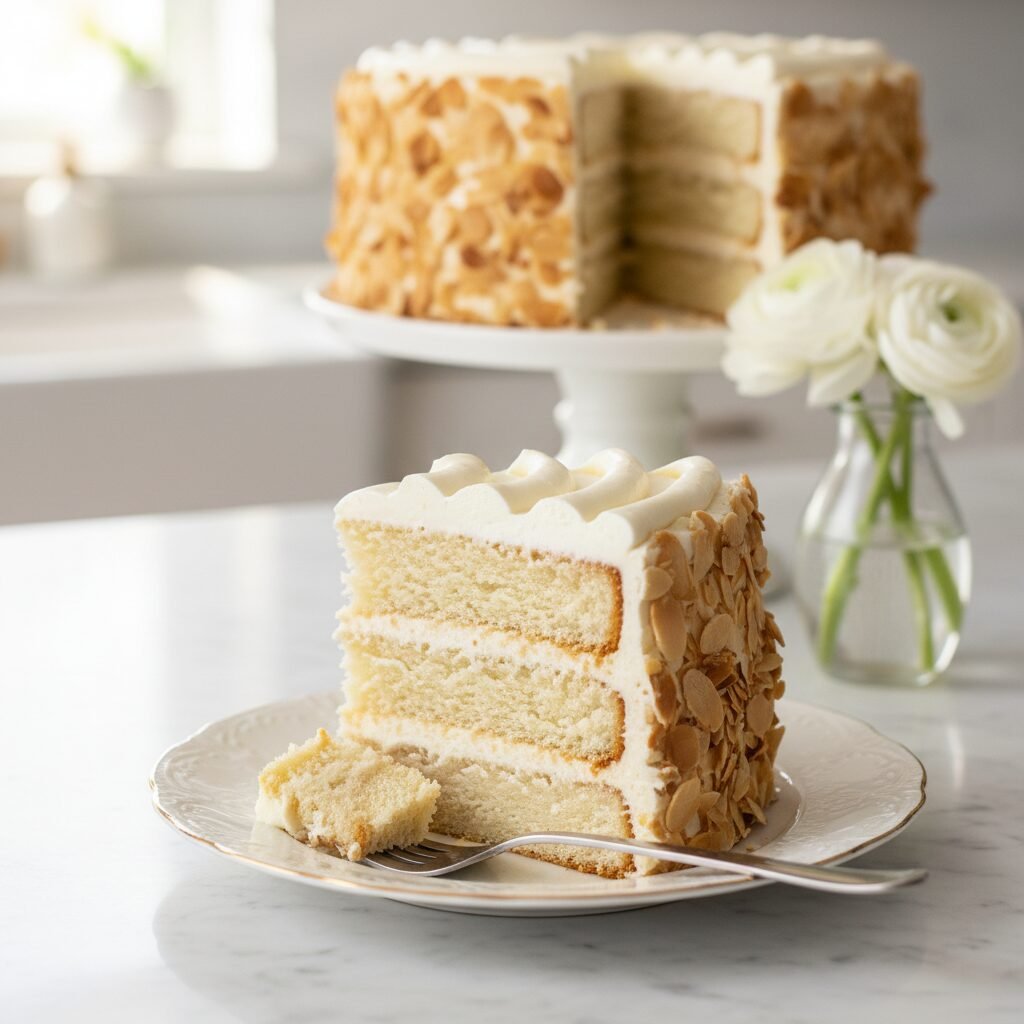
This exquisite Moist Almond Layer Cake features tender, nutty crumb layers infused with pure almond extract and almond flour, frosted with a silky Amaretto buttercream. It captures the nostalgic elegance of a classic wedding cake but is easy enough to bake at home for any celebration.
45 minutes
35 minutes
2 hours
12-14 servings
Dessert
Baking
American / European Fusion
Vegetarian
There is something undeniably sophisticated about the flavor of almond. Unlike the loud sweetness of chocolate or the ubiquity of vanilla, almond offers a floral, nutty, and slightly cherry-like aroma that feels instantly upscale. For many, this flavor profile triggers a deep sense of nostalgia, reminiscent of high-end wedding cakes or the delicate pastries found in European bakeries. This Moist Almond Layer Cake is my love letter to that specific, elegant flavor profile, designed to banish the dryness often associated with nut-based cakes.
Creating the perfect almond cake is a balancing act. If you rely solely on almond extract, the flavor can become artificial and chemical-tasting. However, if you use only ground nuts, the cake can become heavy, dense, and oily. This recipe strikes the perfect equilibrium by utilizing both superfine almond flour for texture and moisture, and a high-quality pure almond extract for that signature aromatic punch. The result is a crumb that is incredibly soft, plush, and tender, with a tightness that allows it to be sliced thinly without crumbling.
To elevate this cake from a simple tea loaf to a show-stopping centerpiece, we pair it with a Swiss Meringue-style American buttercream spiked with a hint of Amaretto liqueur. The slight bitterness of the liqueur cuts through the sweetness of the frosting, mirroring the natural complexity of the almonds. Whether you are baking for a birthday, an anniversary, or simply because you crave a slice of luxury on a Tuesday afternoon, this recipe promises a bakery-quality result right from your home oven.
History & Origins
The use of almonds in desserts traces back thousands of years, originating in the Middle East where almond trees first flourished. Traders on the Silk Road carried these precious nuts to the Mediterranean, where they became a staple in cuisines ranging from Italy to Spain. In Medieval Europe, almonds were a status symbol; they were ground into milk for fasting days or processed into marzipan and frangipane, pastes that remain essential in pastry arts today. The concept of the ‘nut cake’ or ‘torte’—often flourless or low-flour cakes relying on ground nuts for structure—became particularly popular in Central Europe, exemplified by the Austrian Esterházy torte or the Swedish Mandeltårta.
However, the specific iteration of the fluffy, high-rising Almond Layer Cake is a more modern, distinctly American evolution. The development of chemical leaveners like baking powder in the mid-19th century allowed home bakers to move away from dense, yeast-leavened cakes or sponge cakes that relied solely on whipped eggs. As American ‘cake culture’ exploded in the 20th century, the ‘White Cake’ became a standard base for weddings. Bakers began incorporating almond emulsion to differentiate wedding cakes from standard vanilla birthday cakes, creating a flavor association that remains strong in the American palate today. This recipe marries that fluffy American texture with the European tradition of using real ground nuts, creating a hybrid that honors the history of the ingredient while embracing modern textural preferences.
Why This Recipe Works
This recipe succeeds where many others fail because it meticulously addresses the two biggest enemies of almond cake: dryness and density. Almond flour is hygroscopic and high in fat, which generally contributes to moisture, but it lacks gluten. If you simply swap wheat flour for almond flour, the cake will crumble. To counter this, we use a precise blend of cake flour (which has a lower protein content than all-purpose flour) and superfine blanched almond flour. The cake flour provides just enough structure to hold the layers up, while the almond flour disrupts the gluten network slightly, resulting in a ‘melt-in-your-mouth’ tenderness.
Furthermore, moisture is guaranteed through the ‘fat-plus-acid’ method. We incorporate full-fat sour cream into the batter. The acidity in the sour cream tenderizes the gluten strands, while the extra fat content ensures the crumb remains moist for days after baking. We also use the ‘creaming method’—beating butter and sugar until pale and airy—to mechanically trap air bubbles, which expand during baking to lift the heavy almond flour. Finally, the dual-flavor approach—using both vanilla bean paste and almond extract—creates a rounded flavor profile. The vanilla rounds out the sharp, high notes of the almond extract, preventing the medicinal taste that can occur when almond extract is used in isolation.
Why You’ll Love This Recipe
- ✓Incredibly moist crumb thanks to sour cream and almond flour.
- ✓Authentic nutty flavor without being heavy or dense.
- ✓Stable buttercream that pipes beautifully and holds up at room temperature.
- ✓Perfect for stacking; the layers are sturdy yet tender.
- ✓Keeps fresh for days, making it ideal for making ahead.
- ✓Elegant white-on-white aesthetic perfect for formal occasions.
Equipment You’ll Need
- ✓Stand mixer with paddle attachment
- ✓3 x 8-inch round cake pans (or 2 x 9-inch)
- ✓Digital kitchen scale
- ✓Sifter or fine-mesh sieve
- ✓Rubber spatula
- ✓Offset spatula
- ✓Wire cooling racks
- ✓Parchment paper
Ingredients
- ✓2 1/2 cups (300g) cake flour, sifted
- ✓3/4 cup (75g) superfine blanched almond flour
- ✓1 tablespoon baking powder
- ✓1/2 teaspoon salt
- ✓1 cup (226g) unsalted butter, room temperature
- ✓1 3/4 cups (350g) granulated sugar
- ✓4 large eggs, room temperature
- ✓1 teaspoon pure vanilla extract
- ✓1 1/2 teaspoons pure almond extract
- ✓1 cup (240ml) whole milk, room temperature
- ✓1/2 cup (120g) full-fat sour cream, room temperature
- ✓FOR THE FROSTING: 1 1/2 cups (340g) unsalted butter, slightly softened
- ✓5-6 cups (600g-720g) powdered sugar, sifted
- ✓2 tablespoons heavy cream
- ✓1 tablespoon Amaretto liqueur (or 1 tsp almond extract)
- ✓Pinch of salt
Instructions
- Preheat your oven to 350°F (175°C). Grease three 8-inch round cake pans with butter, line the bottoms with parchment paper, and grease the parchment. Dust with flour and tap out the excess.
- In a medium bowl, whisk together the sifted cake flour, almond flour, baking powder, and salt until well combined. Ensure there are no lumps of almond flour.
- In the bowl of a stand mixer fitted with the paddle attachment, beat the room temperature butter and granulated sugar on medium-high speed for about 3-5 minutes. The mixture should look pale, creamy, and fluffy.
- Reduce the mixer speed to medium-low. Add the eggs one at a time, mixing well after each addition and scraping down the sides of the bowl as needed. Stir in the vanilla extract and almond extract.
- In a small bowl or jug, whisk together the milk and sour cream until smooth.
- With the mixer on low speed, add the dry ingredients in three parts, alternating with the wet ingredients in two parts (Dry, Wet, Dry, Wet, Dry). Mix only until the flour streaks disappear. Do not overmix.
- Give the batter a final fold by hand with a rubber spatula to ensure the bottom of the bowl is incorporated.
- Divide the batter evenly among the prepared pans (use a kitchen scale for accuracy). Smooth the tops with an offset spatula.
- Bake for 30-35 minutes, or until a toothpick inserted into the center comes out clean or with just a few moist crumbs. The cakes should spring back when lightly touched.
- Allow the cakes to cool in the pans for 10 minutes, then invert them onto a wire rack to cool completely before frosting.
- To make the frosting: Beat the butter on medium-high speed for 5 minutes until incredibly pale and creamy. Gradually add the powdered sugar, one cup at a time, mixing on low.
- Add the heavy cream, Amaretto (or almond extract), and salt. Increase speed to high and whip for another 3-4 minutes until light and airy.
- Assemble the cake by spreading a generous layer of frosting between the cooled cake layers. Coat the outside with a thin crumb coat, chill for 20 minutes, then apply the final layer of frosting.
Expert Cooking Tips
- ✓Use superfine almond flour: Coarse almond meal will make the cake gritty and heavy. Look for ‘superfine’ or ‘blanched’ on the label.
- ✓Room temperature ingredients are non-negotiable: Cold eggs or dairy will cause the butter batter to curdle, resulting in an uneven bake.
- ✓Weigh your flour: The most common mistake is packing too much flour into the cup. Using a digital scale ensures the perfect texture.
- ✓Don’t skip the sour cream: This provides the necessary acidity to tenderize the crumb.
- ✓Toast the almond flour (optional): For a deeper flavor, lightly toast the almond flour in a dry pan for 2-3 minutes before mixing it with the dry ingredients. Let it cool completely first.
- ✓Chill the layers: Chilled cake layers are much easier to frost and less likely to break.
- ✓Watch the oven time: Almond flour browns faster than wheat flour. If the tops are browning too quickly, tent lightly with foil.
Substitutions and Variations
If you cannot find cake flour, you can make a DIY version by measuring 1 cup of all-purpose flour, removing 2 tablespoons, and replacing them with 2 tablespoons of cornstarch. Sift this mixture twice before using. For the almond flour, there is no direct 1:1 substitution that maintains the exact texture, but you can grind blanched slivered almonds in a food processor with a tablespoon of the sugar until fine (be careful not to make nut butter). If you need to avoid alcohol, simply replace the Amaretto in the frosting with an extra teaspoon of vanilla extract or a 1/2 teaspoon of almond extract. Full-fat Greek yogurt can be substituted for sour cream in equal amounts. For a dairy-free version, use high-quality plant-based butter blocks and a thick dairy-free yogurt, though the texture may be slightly less plush.
Common Mistakes to Avoid
The most frequent mistake with this cake is overmixing the batter after adding the flour. Overmixing develops gluten, which fights against the tenderness we want from the almond flour, leading to a tough, rubbery cake. Another common issue is using ‘almond meal’ (which includes the skins) instead of ‘blanched almond flour’. The skins add bitterness and a speckled appearance that detracts from the cake’s elegance. Additionally, ensure your baking powder is fresh; almond flour is heavy, and the cake needs active leavening to rise properly. Finally, do not frost the cake while it is even slightly warm, or the butter-based frosting will melt and slide right off the layers.
Serving Suggestions
This cake is stunning when served simply with the Amaretto buttercream and a garnish of toasted slivered almonds pressed into the sides. For a fruity element, serve slices with fresh raspberries or macerated strawberries; the tartness of the berries cuts through the rich, nutty sweetness beautifully. It also pairs exceptionally well with a dollop of apricot preserves between the layers, mimicking the flavors of a traditional wedding cake. Beverage-wise, serve this with a hot cup of Earl Grey tea, an espresso, or a glass of sparkling wine or Prosecco for a celebratory touch.
Storage and Reheating Tips
Store the frosted cake at room temperature in an airtight cake carrier for up to 3 days; the sugar and fat content keep it safe and moist. If your kitchen is very hot, store it in the refrigerator, but allow it to come to room temperature for at least an hour before serving to soften the buttercream. For longer storage, you can freeze individual slices wrapped tightly in plastic wrap and foil for up to 2 months. Unfrosted cake layers can be wrapped in plastic wrap and frozen for up to 3 months; thaw them in the fridge overnight before assembling.
Nutrition Facts (Estimated)
| Serving Size | 1 slice |
| Calories | 580 |
| Fat | 34g |
| Saturated Fat | 18g |
| Unsaturated Fat | 14g |
| Trans Fat | 0.5g |
| Cholesterol | 95mg |
| Sodium | 210mg |
| Carbohydrates | 62g |
| Fiber | 2g |
| Sugar | 42g |
| Protein | 8g |
Frequently Asked Questions
Can I make this cake gluten-free?
Yes, you can replace the cake flour with a high-quality 1:1 gluten-free baking flour blend that contains xanthan gum. Since the recipe already contains almond flour, the texture adapts relatively well to gluten-free blends.
Why did my cake sink in the middle?
Sinking usually happens if the oven door was opened too early during baking, causing a temperature drop, or if the cake was underbaked. It can also result from over-creaming the butter and sugar, incorporating too much air that collapses later.
Can I use almond milk instead of cow’s milk?
Yes, you can use unsweetened almond milk to amplify the nutty flavor. However, because almond milk has less fat than whole milk, the cake might be slightly less rich.
Is almond paste the same as almond flour?
No! Almond paste is a sweet mixture of almonds and sugar with a clay-like texture. Almond flour is simply ground dry almonds. They are not interchangeable in this recipe.
Can I bake this in a 9×13 pan?
Yes, this batter fits a 9×13 inch rectangular pan. You will likely need to increase the baking time to 40-50 minutes. Check for doneness with a toothpick.
How do I get the frosting so white?
To get very white buttercream, beat the butter alone for at least 5 minutes before adding sugar. You can also add a tiny drop of purple food coloring to counteract the yellow tone of the butter.
Can I make the cake layers ahead of time?
Absolutely. Bake the layers, let them cool completely, wrap them tightly in plastic wrap, and freeze them. Frosting frozen layers is actually easier and reduces crumbs.
The almond flavor is too strong/weak, what did I do wrong?
Almond extracts vary significantly in potency. Always taste your batter (if safe) or frosting. If it’s too strong, adding more vanilla helps mellow it out. If too weak, you likely used an imitation extract; pure almond extract is recommended.
Conclusion
This Moist Almond Layer Cake is more than just a dessert; it is a centerpiece that brings a sense of occasion to any table. With its plush, tender crumb and the sophisticated interplay of sweet cream and aromatic almond, it is bound to become a requested favorite for birthdays, holidays, and quiet weekends alike. The effort of separating eggs or sifting flour pays off tenfold in the luxurious texture of the final slice. I hope this recipe brings a touch of elegance to your kitchen. Don’t forget to snap a picture of your beautiful creation and tag us on social media—we love seeing your baking triumphs!