Moist Lime Bundt Cake Recipe
Experience the perfect balance of tangy and sweet with this incredibly moist Lime Bundt Cake. Infused with fresh lime zest and topped with a silky glaze, it’s the ultimate refreshing dessert for any occasion.
20 minutes
55 minutes
1 hour 15 minutes
12-16 servings
Dessert
Baking
American
Vegetarian
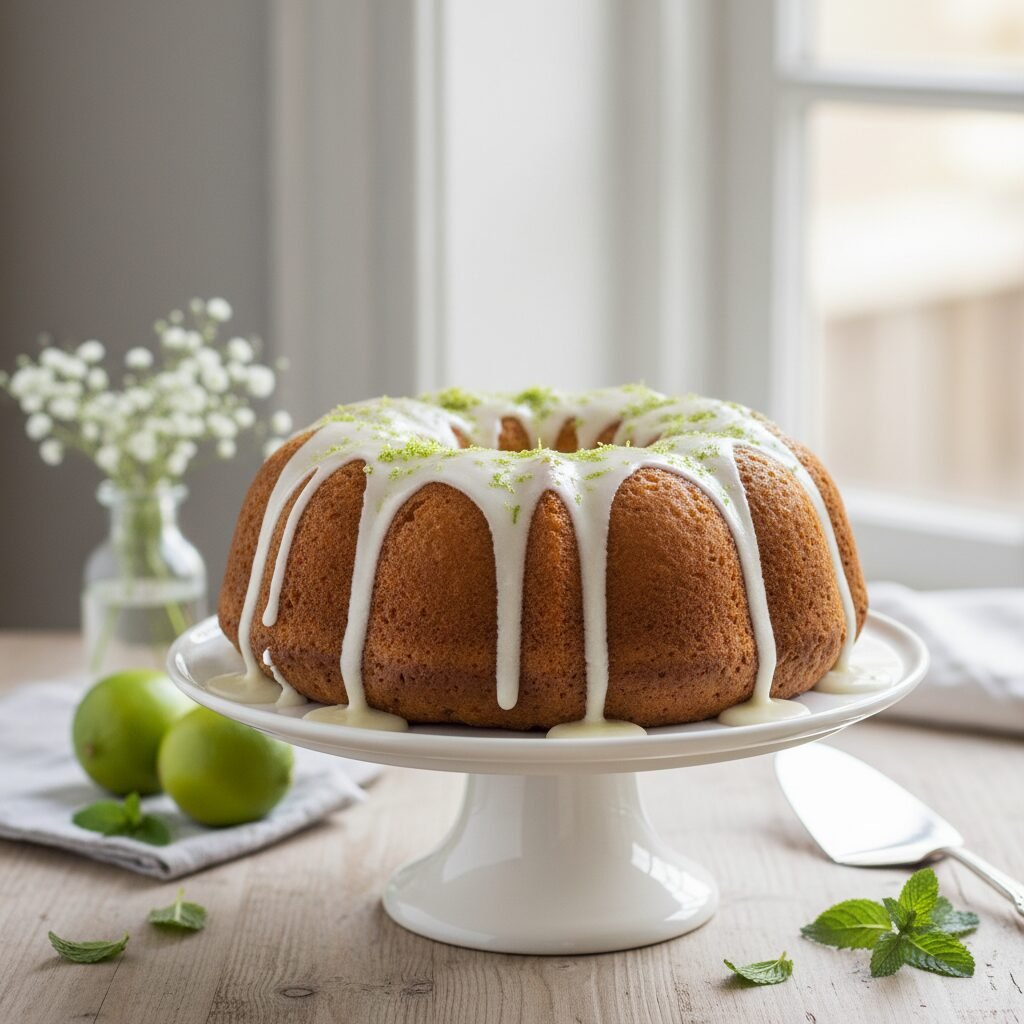
If you are searching for a dessert that screams sunshine and happiness, look no further than this Ultimate Moist Lime Bundt Cake. There is something undeniably cheerful about citrus desserts; they possess a brightness that cuts through the richness of butter and sugar, creating a palate-cleansing finish that leaves you wanting just one more slice. This particular recipe is the result of years of tweaking and testing to achieve that elusive ‘perfect crumb’—dense enough to hold its shape in a Bundt pan, yet tender and melt-in-your-mouth soft. Unlike many pound cakes that can veer towards dryness, this lime cake relies on a secret weapon—full-fat Greek yogurt (or sour cream)—to ensure it stays moist for days. The flavor profile is a sophisticated dance between the floral notes of fresh lime zest and the sharp kick of lime juice, mellowed out by vanilla and high-quality butter. It is not just a cake; it is a centerpiece. Whether you are hosting a summer garden party, a bridal shower, or simply craving a slice of comfort with your afternoon tea, this cake delivers on all fronts. The glaze, a simple mixture of powdered sugar and fresh lime juice, cascades down the ridges of the Bundt, creating a beautiful, snow-capped presentation that looks like it came straight from a professional bakery. Get ready to fill your kitchen with the intoxicating aroma of fresh citrus and warm vanilla.
History & Origins
The Bundt cake, with its distinctive ring shape and fluted sides, is an iconic piece of American baking history, though its roots go much deeper. The style of the cake is derived from a European fruit cake known as Gugelhupf, which was popular in Germany, Austria, and Poland for centuries. However, the Bundt pan as we know it today was popularized in the United States in the 1950s and 60s by H. David Dalquist, the founder of Nordic Ware. He created the cast aluminum pan at the request of a group of Jewish women in Minneapolis who wanted a modern vessel for their traditional kugel. Initially, the pan was a slow seller, but when a Bundt cake recipe won the Pillsbury Bake-Off in 1966, sales skyrocketed, and the pan became a staple in American kitchens. Lime, on the other hand, has a history that spans the globe. Originally cultivated in Southeast Asia, limes were spread by Arab traders to the Middle East and North Africa, eventually making their way to Europe and the Americas via explorers like Columbus. In the culinary world, lime has often played second fiddle to lemon in the realm of baked goods, frequently reserved for pies (like the famous Key Lime Pie) or cocktails. However, in recent decades, the unique, slightly bitter, and highly aromatic profile of lime has gained prominence in cakes and cookies. This Lime Bundt Cake marries the mid-century American tradition of sturdy, decorative cakes with the timeless, zesty appeal of tropical citrus.
Why This Recipe Works
This recipe succeeds where others fail because of the precise balance of fat, acid, and sugar. First, the inclusion of acidic ingredients like lime juice and Greek yogurt (or sour cream) does double duty: it tenderizes the gluten strands in the flour, resulting in a softer crumb, and it reacts with the baking soda to provide lift. Without this acidity, a cake this dense might turn out heavy or rubbery. Second, we use the ‘rubbing in’ method for the zest. By massaging the lime zest directly into the granulated sugar before creaming it with the butter, we release the essential oils trapped in the zest. This infuses the entire cake with a deep, floral lime flavor that simply adding zest at the end cannot achieve. Third, the structure of a Bundt cake requires a batter that is sturdy enough to rise without collapsing, yet moist enough to be palatable. We use a combination of butter for flavor and oil (optional in some variations, but here we rely on the high fat content of butter and yogurt) to ensure richness. The glaze is applied while the cake is slightly warm or completely cool depending on preference, but applying a syrup soak (optional) while warm ensures the lime flavor penetrates deep into the crumb.
Why You’ll Love This Recipe
- ✓Incredibly moist texture thanks to Greek yogurt
- ✓Intense lime flavor from zest-infused sugar
- ✓Beautiful presentation with minimal effort
- ✓Perfect balance of sweet and tangy
- ✓Freezes beautifully for make-ahead desserts
- ✓No fancy decorating skills required
Equipment You’ll Need
- ✓10-12 cup Bundt pan
- ✓Stand mixer or electric hand mixer
- ✓Microplane or zester
- ✓Large mixing bowl
- ✓Whisk
- ✓Rubber spatula
- ✓Cooling rack
- ✓Measuring cups and spoons
Ingredients
- ✓3 cups All-Purpose Flour
- ✓1/2 teaspoon Baking Powder
- ✓1/2 teaspoon Baking Soda
- ✓1 teaspoon Salt
- ✓1 cup Unsalted Butter, softened to room temperature
- ✓2 cups Granulated Sugar
- ✓4 large Eggs, room temperature
- ✓1 tablespoon Fresh Lime Zest (approx. 3-4 limes)
- ✓1/4 cup Fresh Lime Juice
- ✓1 cup Full-Fat Greek Yogurt or Sour Cream
- ✓1 teaspoon Pure Vanilla Extract
- ✓FOR THE GLAZE: 2 cups Powdered Sugar, sifted
- ✓FOR THE GLAZE: 3-4 tablespoons Fresh Lime Juice
- ✓FOR THE GLAZE: 1 teaspoon Lime Zest for garnish
Instructions
- Preheat your oven to 350°F (175°C). Thoroughly grease your Bundt pan with baking spray (the kind with flour in it) or butter and dust with flour, ensuring every crevice is coated. Shake out excess flour.
- In a medium bowl, whisk together the flour, baking powder, baking soda, and salt. Set aside.
- In the bowl of a stand mixer, combine the granulated sugar and fresh lime zest. Rub the zest into the sugar with your fingertips until the sugar is fragrant and looks like wet sand. This releases the lime oils.
- Add the softened butter to the sugar mixture. Beat on medium-high speed for about 4-5 minutes until the mixture is pale, light, and fluffy. Scrape down the sides of the bowl as needed.
- Add the eggs one at a time, beating well after each addition. Mix in the vanilla extract and the 1/4 cup fresh lime juice. The mixture might look slightly curdled due to the acid; this is normal.
- Reduce the mixer speed to low. Add one-third of the flour mixture, followed by half of the Greek yogurt. Repeat, ending with the flour mixture. Mix just until combined—do not overmix.
- Pour the batter into the prepared Bundt pan and smooth the top with a spatula. Tap the pan gently on the counter to release any large air bubbles.
- Bake for 50-60 minutes, or until a toothpick inserted into the thickest part of the cake comes out clean or with just a few moist crumbs attached.
- Remove from the oven and let the cake cool in the pan for exactly 10 minutes. Then, invert the cake onto a wire cooling rack to cool completely.
- While the cake cools, make the glaze. Whisk together the powdered sugar and lime juice until smooth. Adjust consistency by adding more juice (thinner) or sugar (thicker).
- Drizzle the glaze over the completely cooled cake and sprinkle with additional lime zest.
Expert Cooking Tips
- ✓Room temperature ingredients are crucial for a smooth, emulsified batter.
- ✓Don’t skimp on greasing the pan; Bundt pans are notorious for sticking.
- ✓Rubbing the zest into the sugar is a game-changer for flavor intensity.
- ✓Measure flour correctly by spooning it into the cup and leveling it off, rather than scooping directly.
- ✓Let the cake cool in the pan for 10 minutes—no more, no less—to prevent breaking or sticking.
- ✓Use fresh lime juice, not bottled, for the best zesty flavor.
Substitutions and Variations
This recipe is quite versatile. If you do not have Greek yogurt, full-fat sour cream is the perfect 1:1 substitute and provides excellent richness. In a pinch, you can also use buttermilk, though the batter will be slightly thinner. For the citrus, while this is a lime cake, you can easily swap in lemons for a Lemon Bundt Cake, or oranges for a milder flavor. If you want to use Key Limes, remember they are smaller and more tart, so you will need many more of them to get the required zest and juice. For a gluten-free version, use a high-quality 1:1 gluten-free baking flour blend that contains xanthan gum; the texture will be slightly different but still delicious. Dairy-free butter and a dairy-free yogurt alternative (like coconut yogurt) can be used, but ensure they have a high fat content to maintain moisture.
Common Mistakes to Avoid
The most common mistake with Bundt cakes is improper pan preparation. Even non-stick pans need to be greased and floured or sprayed with baking spray containing flour. If you miss a spot, the intricate design of the cake will tear upon release. Another error is over-mixing the batter once the flour is added. Over-mixing develops too much gluten, leading to a tough, rubbery cake rather than a tender one. Additionally, baking time can vary by oven. If you bake it too long, it will be dry; if you underbake it, the dense center will be raw. Always use a skewer to test. Finally, trying to glaze a warm cake will result in the glaze melting and sliding right off—patience is key!
Serving Suggestions
This cake is a stunner on its own, but you can elevate it for special occasions. Serve thick slices with a dollop of lightly sweetened whipped cream or a scoop of vanilla bean ice cream. Fresh berries, particularly raspberries or blackberries, offer a nice color contrast and tartness that complements the lime. For a brunch setting, pair it with hot Earl Grey tea or a mimosa. If you want to get fancy, garnish the plate with thin lime twists or edible flowers like pansies or nasturtiums.
Storage and Reheating Tips
To keep your Lime Bundt Cake moist, store it in an airtight cake carrier or wrap it tightly in plastic wrap at room temperature for up to 3 days. The glaze actually helps seal in the moisture. For longer storage, keep it in the refrigerator for up to 1 week, though it is best served at room temperature. This cake freezes exceptionally well. You can freeze the whole cake (unglazed is best for freezing) or individual slices. Wrap tightly in plastic wrap and then foil. Thaw on the counter for a few hours before serving.
Nutrition Facts (Estimated)
| Serving Size | 1 slice |
| Calories | 380 |
| Fat | 18g |
| Saturated Fat | 11g |
| Unsaturated Fat | 6g |
| Trans Fat | 0g |
| Cholesterol | 85mg |
| Sodium | 180mg |
| Carbohydrates | 52g |
| Fiber | 1g |
| Sugar | 28g |
| Protein | 5g |
Frequently Asked Questions
Can I use bottled lime juice?
While you technically can, it is highly discouraged. Bottled lime juice lacks the floral aromatic compounds of fresh juice and often has a harsher, more acidic taste. For a recipe where lime is the star, fresh is always best.
Why did my cake stick to the pan?
Sticking usually happens due to under-greasing or letting the cake cool in the pan for too long. Sugar in the crust can caramelize and act like glue as it cools. Stick to the 10-minute cooling rule.
Can I make this cake in a standard loaf pan?
Yes, but you will likely need two loaf pans as this makes a large volume of batter. Adjust baking time to 45-55 minutes and watch closely.
Why is my cake dense?
Bundt cakes are naturally denser than sponge cakes, but if it’s heavy like a brick, you may have over-creamed the butter and sugar (collapsing air bubbles) or over-mixed the flour.
Can I add poppy seeds to this recipe?
Absolutely! Add 2-3 tablespoons of poppy seeds with the dry ingredients for a classic Lime Poppy Seed variation.
Do I have to use a Bundt pan?
A Bundt pan is ideal for heat distribution in such a dense batter. If you use a round cake pan, the center may not cook before the edges dry out.
My glaze is too runny, how do I fix it?
Simply whisk in more powdered sugar, a tablespoon at a time, until it reaches your desired thickness.
Can I use Key Limes?
Yes, Key Limes are delicious and more aromatic. You will just need to zest and juice about 15-20 of them to get the required amount.
Conclusion
There you have it—the secret to making the most refreshing, moist, and crowd-pleasing Lime Bundt Cake. It is a recipe that looks incredibly impressive with its fluted edges and snowy glaze, yet requires nothing more than standard pantry staples and a bit of mixing. Whether you are a seasoned baker or a novice, this cake is forgiving and rewarding. The burst of citrus flavor is sure to brighten up even the gloomiest of days. So grab your zester, preheat that oven, and get ready to bake a masterpiece that your friends and family will be asking for again and again. Happy baking!