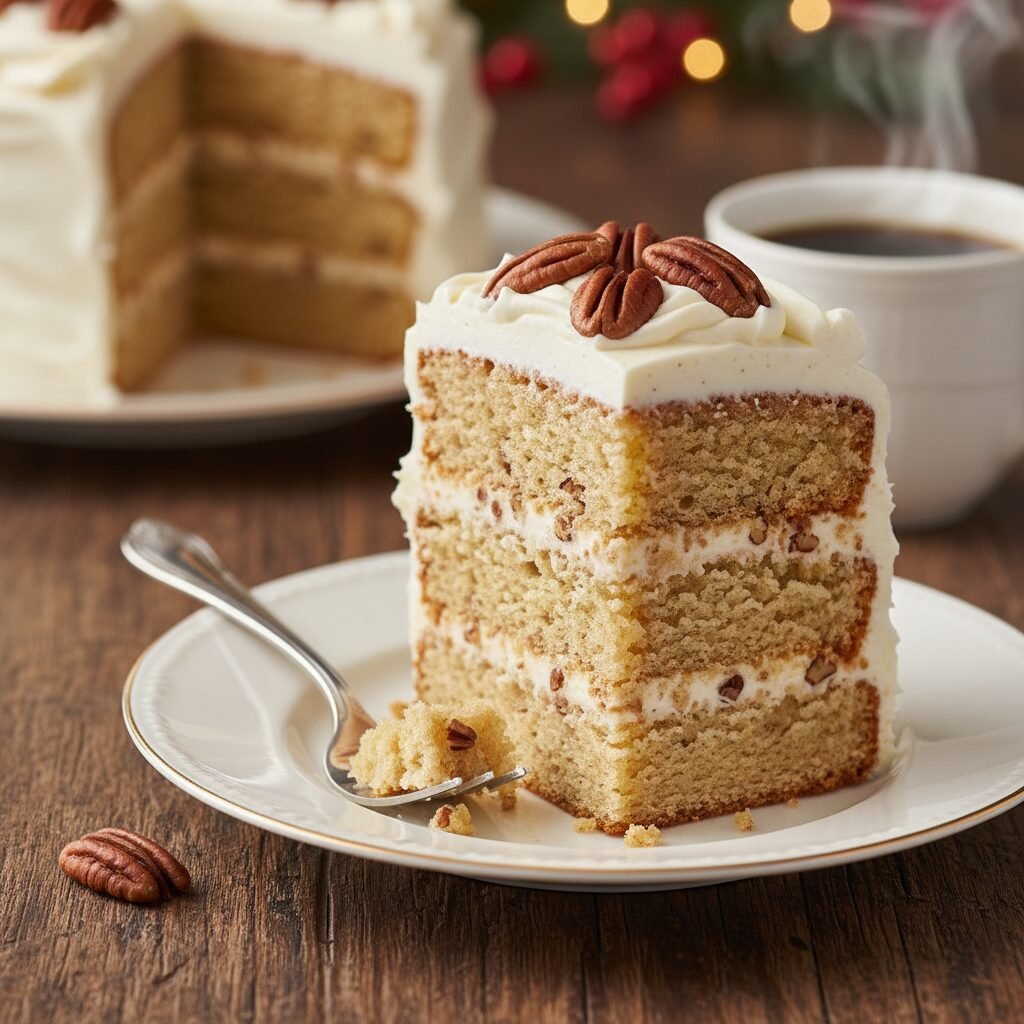
Moist Pecan Layer Cake Recipe
Experience the ultimate comfort with this incredibly moist Pecan Layer Cake. Featuring buttery, toasted pecan cake layers enveloped in a tangy, velvety cream cheese frosting, this Southern classic is the perfect centerpiece for holidays and special celebrations.
30 minutes
35 minutes
2 hours 30 minutes (includes cooling)
12-14 servings
Dessert
Baking
American (Southern)
Vegetarian
There are few desserts that evoke the feeling of Southern hospitality quite like a homemade Pecan Layer Cake. This isn’t just a cake; it is a celebration of texture and flavor, a masterpiece of baking that balances the deep, nutty aroma of toasted pecans with the sweet, buttery richness of a tender crumb. If you have ever been disappointed by dry nut cakes in the past, prepare to have your expectations completely shattered. This recipe has been meticulously developed to ensure that every single bite is exceptionally moist, fluffy, and bursting with flavor.
The secret lies in the harmony of ingredients. We use a combination of brown and white sugars to create a depth of caramel-like sweetness, while buttermilk ensures the gluten remains tender, resulting in a melt-in-your-mouth texture. But the true star of the show is the pecan itself. By toasting the nuts before incorporating them into the batter, we release their natural oils and intensify their flavor profile, preventing them from getting lost against the sugar and butter.
To finish, the cake is cloaked in a luxurious, silky cream cheese frosting that offers just the right amount of tang to cut through the sweetness of the cake layers. Whether you are baking for Thanksgiving, Christmas, a birthday, or simply because you crave something truly decadent, this Moist Pecan Layer Cake is guaranteed to impress. It is the kind of recipe that gets passed down through generations, scribbled on recipe cards, and cherished as a family secret. Get your coffee brewing, because you are about to bake the best cake of your life.
History & Origins
The history of the pecan cake is deeply rooted in the agricultural and culinary heritage of the American South. The pecan tree (*Carya illinoinensis*) is the only major tree nut that is indigenous to North America. Before European settlers arrived, Native American tribes across the central and southern United States relied on pecans as a staple food source, valuing them for their high energy content and durability through the winter. The word ‘pecan’ itself is derived from the Algonquian word ‘paccan,’ meaning a nut too hard to crack by hand.
As French and Spanish colonists settled in areas like New Orleans and along the Mississippi River, they adopted the local ingredients, integrating pecans into their baking traditions. However, the concept of the modern layer cake didn’t truly take shape until the mid-19th century. Before the invention of chemical leavening agents like baking powder and baking soda, cakes were dense, yeast-leavened, or relied solely on whipped eggs for lift. With the industrial revolution and the availability of refined flour and baking powder in the late 1800s, the tall, fluffy American layer cake was born.
Pecan cakes specifically gained prominence as the commercial pecan industry grew in Georgia, Texas, and Alabama during the early 20th century. Recipes for ‘Nut Cakes’ began appearing in community cookbooks and church potluck guides, often varying between dense, fruitcake-like textures and lighter, sponge-like variations. The addition of cream cheese frosting is a more modern evolution, likely popularized in the mid-20th century as cream cheese became a household staple. Today, the Pecan Layer Cake stands as a culinary icon of the South, representing the region’s rich history of agriculture and the timeless tradition of home baking.
Why This Recipe Works
This recipe succeeds where many others fail—specifically in the department of moisture retention and flavor intensity. Nut cakes are notorious for becoming dry because nuts absorb moisture from the batter, and their heavy weight can collapse a delicate crumb. We solve these issues through a few key scientific principles. First, we use a specific ratio of brown sugar to granulated sugar. Brown sugar contains molasses, which is hygroscopic, meaning it attracts and holds water molecules, keeping the cake soft for days after baking.
Secondly, the inclusion of buttermilk is non-negotiable. The acidity in the buttermilk reacts with the baking soda to create carbon dioxide, providing a superior lift that counteracts the heaviness of the pecans. Furthermore, the acid breaks down long strands of gluten, ensuring the cake remains tender rather than tough.
Thirdly, we employ the ‘toasting’ technique. Raw nuts in a cake often taste bland and have a waxy texture. By pre-toasting the pecans, we trigger the Maillard reaction, unlocking complex, savory, and nutty flavor compounds that permeate the entire cake. Finally, the fat ratio is optimized using unsalted butter for flavor and whole eggs for structure and richness. We chop the pecans finely for the batter to ensure even distribution, so you get the perfect crunch in every bite without weighing down the slice. The result is a cake that is structurally sound enough to stack but delicate enough to melt on your tongue.
Why You’ll Love This Recipe
- ✓Incredibly moist crumb thanks to buttermilk and brown sugar.
- ✓Deep, roasted flavor from pre-toasted pecans.
- ✓Tangy cream cheese frosting balances the sweetness perfectly.
- ✓Sturdy enough for layer stacking but soft to eat.
- ✓Ideally suited for make-ahead preparation as flavors meld over time.
- ✓A stunning presentation with minimal decorating skills required.
Equipment You’ll Need
- ✓3 9-inch round cake pans
- ✓Stand mixer or electric hand mixer
- ✓Large mixing bowls
- ✓Parchment paper
- ✓Wire cooling rack
- ✓Baking sheet (for toasting nuts)
- ✓Rubber spatula
- ✓Offset spatula (for frosting)
- ✓Food processor or sharp knife
Ingredients
- ✓2 1/2 cups chopped pecans (divided)
- ✓1 cup (2 sticks) unsalted butter, softened to room temperature
- ✓1/2 cup vegetable oil
- ✓1 1/2 cups granulated sugar
- ✓1/2 cup light brown sugar, packed
- ✓5 large eggs, room temperature
- ✓1 tablespoon pure vanilla extract
- ✓3 cups all-purpose flour
- ✓2 teaspoons baking powder
- ✓1/2 teaspoon baking soda
- ✓1/2 teaspoon salt
- ✓1 1/4 cups buttermilk, room temperature
- ✓16 oz full-fat cream cheese, softened (for frosting)
- ✓1 cup unsalted butter, softened (for frosting)
- ✓5-6 cups powdered sugar (for frosting)
- ✓2 teaspoons vanilla extract (for frosting)
- ✓Pinch of salt (for frosting)
Instructions
- 1. Preheat your oven to 350°F (175°C). Spread the pecans on a baking sheet and toast them in the oven for 7-8 minutes until fragrant. Watch closely so they do not burn. Remove and let cool completely. Finely chop 2 cups for the batter and leave 1/2 cup coarser for decoration.
- 2. Grease three 9-inch round cake pans with butter or baking spray and line the bottoms with parchment paper. Dust the sides with flour and tap out the excess.
- 3. In a medium bowl, whisk together the flour, baking powder, baking soda, and salt. Set aside.
- 4. In the bowl of a stand mixer fitted with the paddle attachment, beat the softened butter, vegetable oil, granulated sugar, and brown sugar on medium-high speed for about 3-5 minutes until light, fluffy, and pale in color.
- 5. Add the eggs one at a time, beating well after each addition. Scrape down the sides and bottom of the bowl as needed. Stir in the vanilla extract.
- 6. Reduce the mixer speed to low. Add the flour mixture in three parts, alternating with the buttermilk in two parts, starting and ending with the flour. Mix only until just combined; do not overmix.
- 7. Gently fold in the 2 cups of finely chopped, cooled pecans using a rubber spatula.
- 8. Divide the batter evenly among the three prepared cake pans. Smooth the tops with a spatula.
- 9. Bake for 30-35 minutes, or until a toothpick inserted into the center comes out clean or with just a few moist crumbs. Avoid opening the oven door too early to prevent sinking.
- 10. Remove cakes from the oven and allow them to cool in the pans for 10 minutes. Then, turn them out onto a wire rack to cool completely before frosting.
- 11. To make the frosting: In a large bowl, beat the cream cheese and butter together on medium-high speed until smooth and creamy (about 3 minutes).
- 12. Gradually add the powdered sugar, one cup at a time, mixing on low speed until incorporated. Add vanilla and a pinch of salt. Increase speed to high and whip for 2-3 minutes until fluffy.
- 13. Assemble the cake: Place one cake layer on your serving plate. Spread a generous layer of frosting over the top. Repeat with the second and third layers. Use the remaining frosting to coat the top and sides of the cake.
- 14. Decorate the top or sides with the remaining 1/2 cup of toasted pecans. Slice and serve.
Expert Cooking Tips
- ✓Ensure all cold ingredients (eggs, butter, buttermilk, cream cheese) are at room temperature to prevent the batter from curdling.
- ✓Do not skip toasting the pecans; it brings out the essential oils and keeps the nuts crunchy within the soft cake.
- ✓Measure your flour correctly by spooning it into the measuring cup and leveling it off, or use a kitchen scale (approx. 120g per cup) to avoid a dense cake.
- ✓If you don’t have buttermilk, make a substitute by adding 1 tablespoon of lemon juice or vinegar to a cup of whole milk and letting it sit for 5 minutes.
- ✓Cool the cake layers completely before frosting. Even a slightly warm cake will melt the butter in the cream cheese frosting, causing it to slide off.
- ✓Toss the chopped pecans in a tablespoon of the flour mixture before folding them in; this helps prevent them from sinking to the bottom of the pans.
- ✓For ultra-smooth frosting, sift the powdered sugar before mixing to remove any lumps.
Substitutions and Variations
This recipe is quite versatile if you need to make adjustments based on dietary needs or pantry availability. If you do not have pecans, walnuts are the best direct substitute, offering a similar texture and slightly more bitter, earthy flavor that pairs beautifully with the sweet frosting. For a nut-free version, you can omit the nuts entirely and add a teaspoon of cinnamon for a spice cake variation. If you prefer a gluten-free cake, use a high-quality 1:1 gluten-free all-purpose baking flour that contains xanthan gum; almond flour alone will not provide enough structure. Regarding the dairy, while buttermilk is preferred for its acidity, you can use sour cream or plain Greek yogurt thinned with a little milk as a substitute. For the frosting, mascarpone cheese can be used in place of cream cheese for a less tangy, more Italian-style topping, though it is softer and may require more sugar to stiffen.
Common Mistakes to Avoid
The most common mistake with this cake is over-mixing the batter once the flour is added. Over-mixing develops the gluten too much, resulting in a tough, rubbery texture rather than a tender crumb. Stop mixing as soon as the white streaks of flour disappear. Another pitfall is using pecans that are too large. If the nuts are not chopped finely enough, they can make the cake difficult to slice neatly and may cause the cake layers to crumble. Additionally, ensure your baking powder is fresh; expired leavening agents are a primary cause of dense, flat cakes. Finally, be patient with the cooling process. Rushing to frost a warm cake is a disaster waiting to happen—the frosting will weep and the layers may slide apart. If your kitchen is very warm, chill the cake layers in the fridge for 20 minutes before assembling.
Serving Suggestions
This Moist Pecan Layer Cake is a statement piece that deserves to be served with flair. It pairs exceptionally well with a hot cup of dark roast coffee or an espresso, as the bitterness of the coffee cuts through the sweetness of the frosting. For a holiday touch, serve each slice with a drizzle of warm salted caramel sauce or a dollop of lightly sweetened whipped cream. If you are serving this in the summer or spring, a side of fresh berries—particularly raspberries or blackberries—adds a nice acidic contrast. The cake is rich, so thin slices are often sufficient, making it perfect for feeding a large crowd at gatherings.
Storage and Reheating Tips
Because of the cream cheese frosting, this cake should be stored in the refrigerator. It can be left out at cool room temperature for 2-3 hours during a party, but for long-term storage, cover it with a cake dome or plastic wrap and keep it chilled. It will stay fresh for up to 5 days in the fridge. In fact, the flavor often improves on the second day as the moisture redistributes. For freezing, you can freeze individual slices wrapped tightly in plastic wrap and then foil for up to 3 months. Alternatively, you can freeze the unfrosted cake layers wrapped in plastic wrap for up to 2 months; thaw them in the refrigerator overnight before frosting and serving.
Nutrition Facts (Estimated)
| Serving Size | 1 slice |
| Calories | 680 |
| Fat | 42g |
| Saturated Fat | 18g |
| Unsaturated Fat | 22g |
| Trans Fat | 0.5g |
| Cholesterol | 95mg |
| Sodium | 310mg |
| Carbohydrates | 74g |
| Fiber | 3g |
| Sugar | 52g |
| Protein | 7g |
Frequently Asked Questions
Can I make this cake ahead of time?
Yes, absolutely. The cake layers can be baked, cooled, wrapped tightly in plastic wrap, and stored at room temperature for 1 day or frozen for up to 2 months. The assembled cake keeps well in the fridge for up to 5 days.
Why did my pecans sink to the bottom?
This happens if the batter is too thin or the nut pieces are too heavy. To prevent this, chop the nuts finely and toss them in a small amount of flour before folding them into the batter. This gives them ‘grip’ within the rising cake.
Can I use salted butter instead of unsalted?
Yes, you can. However, if you use salted butter, you should reduce the added salt in the recipe by half to ensure the cake doesn’t taste too salty.
How do I know when the cake is perfectly done?
Insert a wooden toothpick into the center of the cake. It should come out clean or with a few moist crumbs attached. If there is wet batter on the toothpick, it needs more time. Also, the cake should gently spring back when lightly pressed with a finger.
Can I bake this in a 9×13 pan instead of layers?
Yes, this recipe fits a 9×13 inch rectangular pan. You will need to increase the baking time to approximately 40-50 minutes. Check for doneness starting at the 40-minute mark.
My frosting is too runny, how can I fix it?
If the frosting is too soft, try refrigerating it for 15-20 minutes to let the butter firm up. If it’s still too runny, add more powdered sugar, 1/4 cup at a time, until it reaches the desired consistency.
Do I have to use a stand mixer?
No, a hand-held electric mixer works perfectly fine. You can even mix it by hand if you have strong arm muscles for creaming the butter and sugar, though an electric mixer yields the fluffiest results.
Can I cut the sugar in this recipe?
Sugar provides moisture and structure, not just sweetness. Reducing it significantly will alter the texture, making the cake drier and denser. We recommend sticking to the recipe for the best structural results.
Conclusion
This Moist Pecan Layer Cake is more than just a sweet treat; it is a labor of love that brings warmth and comfort to any table. The combination of the nutty, buttery sponge with the tangy richness of the cream cheese frosting creates a symphony of flavors that is hard to beat. Whether you are an experienced baker or a novice looking to try your hand at a layer cake, this recipe is forgiving, reliable, and utterly delicious. Don’t forget to pin this recipe to your favorite dessert board on Pinterest so you can easily find it for your next special occasion. Happy baking!