
Moist Vanilla Birthday Cake For Beginners Recipe
Discover the secret to the perfect birthday celebration with this foolproof vanilla cake recipe. It combines the buttery richness of a classic bakery cake with an impossibly moist crumb that stays fresh for days, making it the ultimate beginner-friendly bake.
25 minutes
30 minutes
55 minutes
12-14 servings (Two 8-inch round cakes)
Dessert
Baking
American
Vegetarian
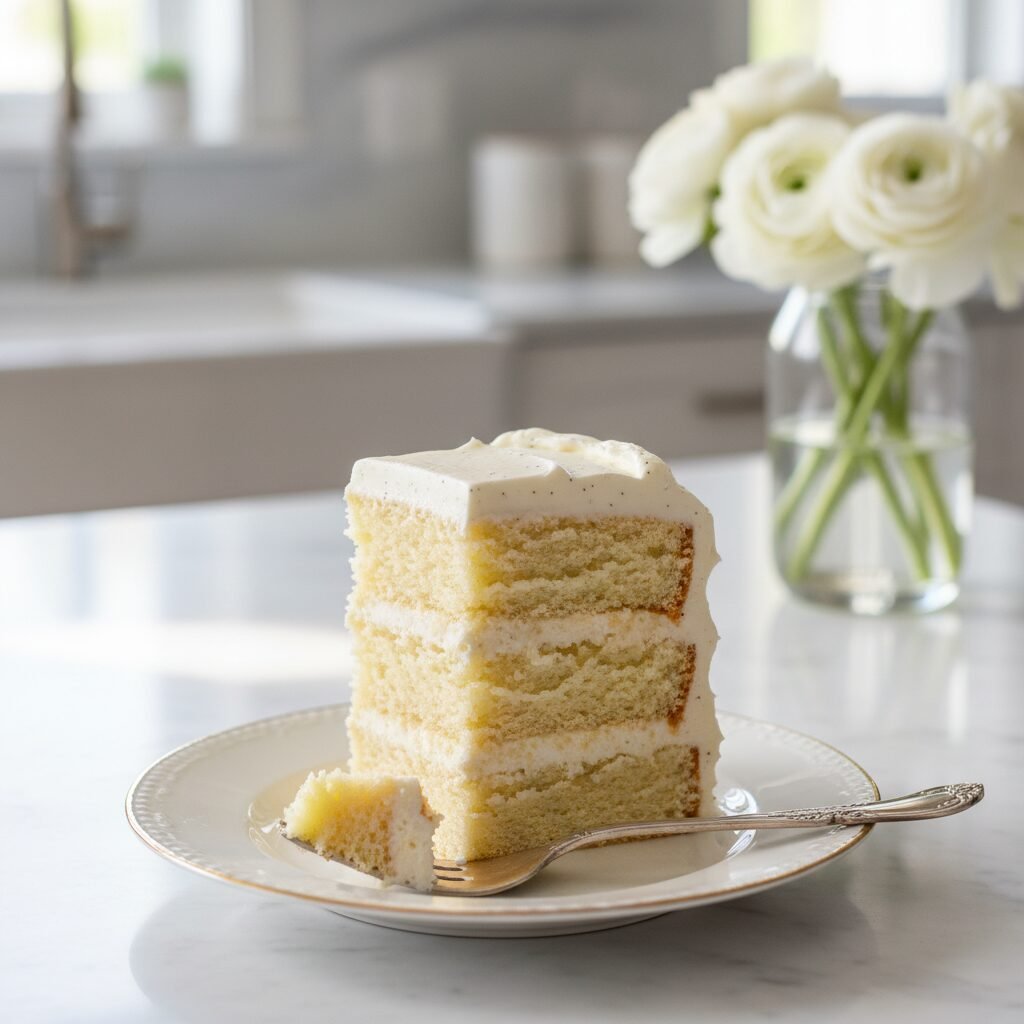
There is something undeniably magical about a classic vanilla birthday cake. It is the centerpiece of our most cherished childhood memories, the sweet finale to a celebration, and a symbol of joy that transcends generations. However, for many home bakers, finding the ‘perfect’ vanilla cake recipe is a journey fraught with disappointment. We have all been there: the cake looks beautiful in the oven, but once sliced, it is dry, crumbly, or lacks that profound vanilla flavor we crave. This recipe is the answer to those baking woes. Designed specifically for beginners but delicious enough for a professional bakery, this Moist Vanilla Birthday Cake strikes the perfect balance between density and fluffiness.
Unlike standard recipes that rely solely on butter, which can lead to a dry texture once the cake cools, this recipe utilizes a ‘power couple’ of fats: butter for that nostalgic, creamy flavor, and vegetable oil to ensure the crumb remains tender and moist for days. We also incorporate buttermilk, which not only adds a subtle tang to cut through the sweetness but also works chemically to tenderize the gluten strands, resulting in a melt-in-your-mouth texture. Whether you are baking for a first birthday, a golden anniversary, or just a Tuesday night craving, this cake is a blank canvas waiting for your creativity. It pairs beautifully with rich chocolate fudge frosting, fresh berry compote, or the classic sprinkles-laden vanilla buttercream included here. Get ready to retire every other vanilla cake recipe in your binder—this is the only one you will ever need.
History & Origins
The concept of the birthday cake has a rich and surprisingly ancient history that dates back centuries, evolving significantly to become the sugary staple we know today. The origins can be traced back to the ancient Greeks, who would make round cakes or breads sweetened with honey to honor Artemis, the goddess of the moon. They would place lit candles on top to represent the glow of the moon, and the smoke from the blown-out candles was believed to carry prayers and wishes up to the gods—a tradition that persists in our modern ‘make a wish’ ritual.
However, the modern birthday cake as we recognize it began to take shape in Germany during the Middle Ages with the celebration of ‘Kinderfest,’ a birthday celebration for children. These cakes were originally more like bread—coarse and not particularly sweet. It wasn’t until the 17th century in Europe that cakes began to resemble contemporary versions, thanks to advances in baking technology and ingredient availability. During this time, the ‘icing’ was often a boiled sugar mixture that formed a hard shell.
The true revolution for home bakers came in the mid-19th century with the invention of baking powder. Before this chemical leavener, cakes relied on yeast or purely on whipped eggs for lift, making them labor-intensive and temperamental. Baking powder, along with the mass production of refined white flour and sugar, democratized cake baking, allowing home cooks to produce light, fluffy, and sweet sponges without hours of labor. Vanilla, once a rare and exotic orchid derivative from Mexico, became more accessible in the late 19th and early 20th centuries, cementing its place as the standard ‘plain’ flavor, though there is nothing plain about its complex floral and aromatic profile. Today, the vanilla birthday cake stands as a culinary icon of American culture, representing celebration, love, and the simple pleasure of sharing food.
Why This Recipe Works
This recipe succeeds where many others fail because it is built on a solid foundation of food science, specifically targeting moisture retention and structural integrity. The primary reason this cake works so well is the hybrid fat method. Butter is essential for flavor; it provides those milk solids that brown and create a rich, nutty undertone that oil simply cannot replicate. However, butter is solid at room temperature, which can make a cake feel dry or dense. Vegetable oil, on the other hand, remains liquid at room temperature. By using a carefully calculated ratio of both, we achieve a cake that tastes like butter but retains the sensation of moisture provided by the oil.
Furthermore, the use of cake flour instead of all-purpose flour is a game-changer. Cake flour has a lower protein content (usually around 7-9% compared to 10-12% in all-purpose). Less protein means less gluten formation during mixing. This results in a finer, softer crumb that is tender rather than chewy. We also employ buttermilk as the liquid component. The acidity in buttermilk reacts with the baking soda (and baking powder) to create carbon dioxide bubbles, giving the cake a superior lift. Additionally, that acid breaks down long gluten strands, further tenderizing the cake. Finally, the ‘creaming method’—beating the sugar and fats together before adding eggs—incorporates mechanical air into the batter, which expands in the oven to create a light, fluffy texture that doesn’t feel heavy on the palate.
Why You’ll Love This Recipe
- ✓Uses a mix of butter and oil for maximum flavor and moisture retention.
- ✓Beginner-friendly method that requires standard kitchen tools.
- ✓Stays soft and fresh for up to 4 days at room temperature.
- ✓Versatile base that pairs with any frosting or filling.
- ✓Perfect structural integrity for stacking or carving.
Equipment You’ll Need
- ✓Two 8-inch round cake pans
- ✓Stand mixer or electric hand mixer
- ✓Large mixing bowl
- ✓Medium mixing bowl
- ✓Sifter or fine-mesh sieve
- ✓Rubber spatula
- ✓Measuring cups and spoons
- ✓Wire cooling rack
- ✓Parchment paper
Ingredients
- ✓2 ½ cups (300g) Cake flour, spooned and leveled
- ✓2 cups (400g) Granulated white sugar
- ✓1 tbsp Baking powder
- ✓½ tsp Baking soda
- ✓½ tsp Fine sea salt
- ✓¾ cup (170g) Unsalted butter, softened to room temperature
- ✓¼ cup (60ml) Vegetable oil or canola oil
- ✓4 Large eggs, room temperature
- ✓1 tbsp Pure vanilla extract
- ✓1 cup (240ml) Buttermilk, room temperature
- ✓For the Frosting: 1 ½ cups (340g) Unsalted butter, softened
- ✓For the Frosting: 5-6 cups (600-720g) Powdered sugar
- ✓For the Frosting: ¼ cup (60ml) Heavy cream
- ✓For the Frosting: 2 tsp Pure vanilla extract
- ✓For the Frosting: Pinch of salt
Instructions
- 1. Preheat your oven to 350°F (175°C). Grease two 8-inch round cake pans with butter or cooking spray. Line the bottoms with parchment paper rounds and grease the parchment. This guarantees your cakes won’t stick.
- 2. In a medium bowl, sift together the cake flour, baking powder, baking soda, and salt. Whisk briefly to ensure everything is evenly distributed. Set aside.
- 3. In the bowl of a stand mixer fitted with the paddle attachment (or a large bowl with a hand mixer), combine the softened butter, vegetable oil, and granulated sugar. Beat on medium-high speed for about 3-4 minutes until the mixture is pale, light, and fluffy. Scrape down the sides of the bowl as needed.
- 4. Reduce the mixer speed to medium. Add the eggs one at a time, beating well after each addition to ensure they are fully incorporated before adding the next. Stir in the vanilla extract.
- 5. Reduce the mixer speed to low. Add the flour mixture in three parts, alternating with the buttermilk in two parts, starting and ending with the flour (Flour -> Buttermilk -> Flour -> Buttermilk -> Flour). Mix only until just combined; do not overmix or the cake will be tough.
- 6. Use a rubber spatula to give the batter one final gentle stir by hand, scraping the bottom of the bowl to ensure no pockets of flour remain.
- 7. Divide the batter evenly between the prepared cake pans. You can use a kitchen scale to be precise. Smooth the tops with an offset spatula or the back of a spoon.
- 8. Bake for 28-32 minutes, or until a toothpick inserted into the center comes out clean or with just a few moist crumbs attached. The tops should be golden and spring back when lightly pressed.
- 9. Remove the cakes from the oven and let them cool in the pans for 10-15 minutes. Then, carefully invert them onto a wire rack to cool completely before frosting.
- 10. To make the frosting: Beat the softened butter on medium-high speed for 5 minutes until creamy and white. Gradually add the powdered sugar, one cup at a time, mixing on low. Add the heavy cream, vanilla, and salt. Whip on high speed for 3-4 minutes until fluffy. Frost the cooled cakes.
Expert Cooking Tips
- ✓Room temperature ingredients are non-negotiable. Cold eggs or buttermilk can curdle the batter and inhibit the rise.
- ✓Measure flour correctly. Spoon the flour into the measuring cup and level it off with a knife. Scooping directly from the bag packs the flour and leads to a dry cake.
- ✓Don’t peek! Opening the oven door too early can cause the temperature to drop and the center of the cake to collapse.
- ✓Use parchment paper circles. It is the only 100% guarantee that your cake layers will release perfectly from the pans.
- ✓Do not overmix the batter once the flour is added. Stop mixing as soon as the white streaks of flour disappear.
- ✓Tap the pans on the counter before baking to release large air bubbles, ensuring an even, bakery-style crumb.
Substitutions and Variations
If you do not have cake flour, you can make a DIY version: measure 1 cup of all-purpose flour, remove 2 tablespoons, and replace them with 2 tablespoons of cornstarch. Sift this mixture twice before using. If you don’t have buttermilk, you can make a ‘sour milk’ substitute by adding 1 tablespoon of white vinegar or lemon juice to a measuring cup and filling it to the 1-cup line with whole milk; let it sit for 5 minutes until slightly curdled. You can substitute the vegetable oil with melted coconut oil, though this may impart a slight coconut flavor. For a dairy-free version, use a high-quality plant-based butter stick and almond milk mixed with vinegar instead of buttermilk.
Common Mistakes to Avoid
The most common mistake beginners make is overmixing the batter. Once the flour hits the liquid, gluten begins to develop. While some gluten is necessary for structure, too much creates a rubbery, dense cake. Always mix on low speed at the end and stop immediately when combined. Another frequent error is baking at the wrong temperature. Oven thermostats are often inaccurate; use an external oven thermometer to ensure your oven is actually at 350°F. Lastly, frosting a warm cake is a recipe for disaster. The butter in the frosting will melt, causing the layers to slide and the icing to become a greasy puddle. Ensure the cakes are cool to the touch—even chilled in the fridge for 20 minutes—before assembling.
Serving Suggestions
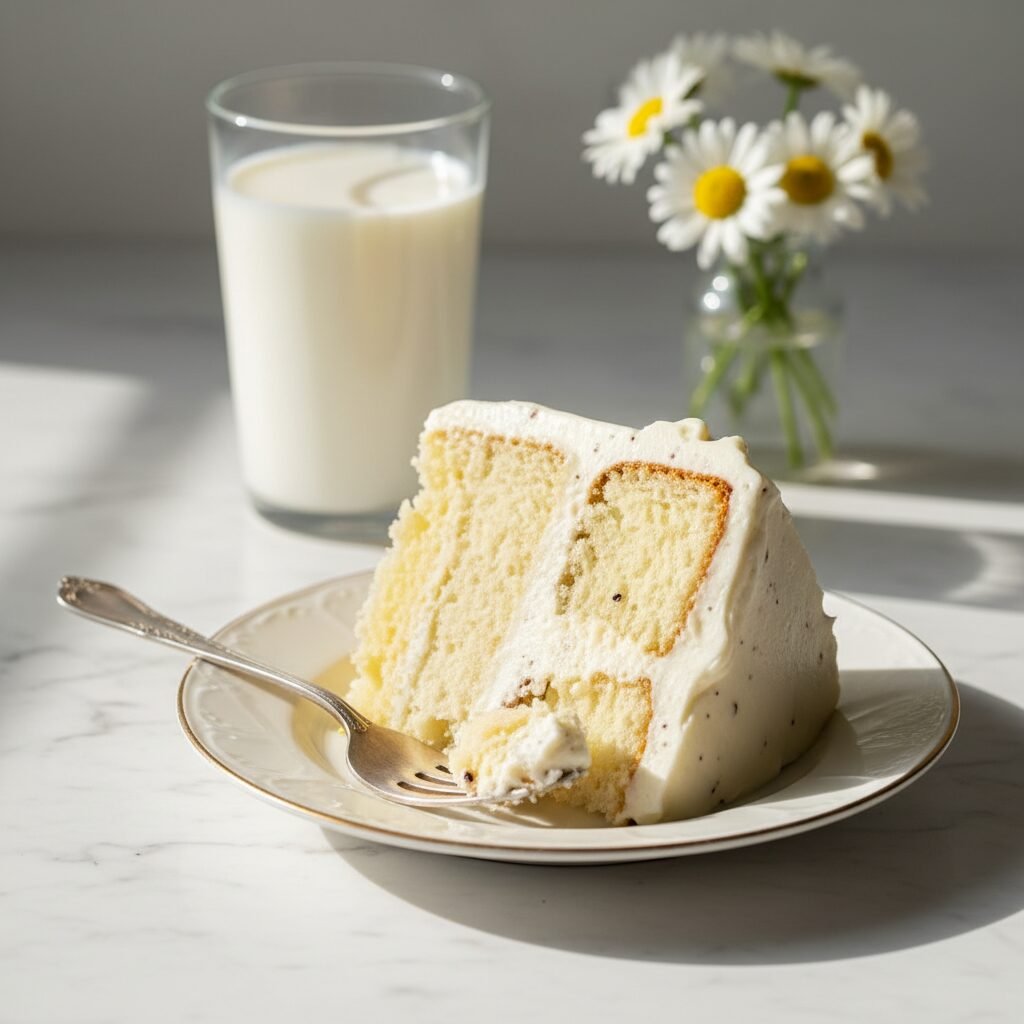
This classic vanilla cake is incredibly versatile. For a traditional birthday vibe, serve it with the vanilla buttercream and plenty of rainbow sprinkles. To elevate it for a dinner party, serve slices with a dollop of lightly sweetened whipped cream and fresh strawberries or raspberries. It also pairs wonderfully with a scoop of dark chocolate gelato or a drizzle of warm salted caramel sauce. For beverages, a cold glass of milk is the nostalgic choice, but it also goes beautifully with a hot cup of Earl Grey tea or a glass of prosecco for adult celebrations.
Storage and Reheating Tips
This cake stores exceptionally well thanks to the oil content. A fully frosted cake can be kept at room temperature under a cake dome for up to 3 days. If you live in a very hot or humid climate, store it in the refrigerator for up to 5 days, but bring it to room temperature before serving for the best texture and flavor. Unfrosted cake layers can be wrapped tightly in plastic wrap and then aluminum foil and frozen for up to 3 months. Thaw the frozen layers in the refrigerator overnight before unwrapping and decorating. Leftover slices can be placed in an airtight container in the fridge for 4-5 days.
Nutrition Facts (Estimated)
| Serving Size | 1 slice (with frosting) |
| Calories | 580 |
| Fat | 28g |
| Saturated Fat | 12g |
| Unsaturated Fat | 14g |
| Trans Fat | 0g |
| Cholesterol | 85mg |
| Sodium | 320mg |
| Carbohydrates | 78g |
| Fiber | 1g |
| Sugar | 45g |
| Protein | 5g |
Frequently Asked Questions
Can I use all-purpose flour instead of cake flour?
Yes, but the texture will be slightly denser and more bread-like. Cake flour is milled finer and has less protein, which creates that velvety, melt-in-your-mouth texture. If you must use all-purpose, use the cornstarch substitution method mentioned in the substitutions section.
Why did my cake sink in the middle?
Cakes usually sink because they were underbaked (the center structure wasn’t set), the oven door was opened too early, or there was too much leavening (baking powder/soda) which caused it to rise too fast and then collapse.
Can I make this recipe into cupcakes?
Absolutely! This recipe yields about 24 standard cupcakes. Bake them at 350°F for 18-22 minutes. Check for doneness with a toothpick.
Why is my cake dry?
Dry cake is usually the result of over-baking or measuring flour incorrectly (packing it down). Check the cake a few minutes before the timer goes off. Also, ensure you used the oil as written, as it provides lasting moisture.
Can I reduce the sugar in this recipe?
It is not recommended to reduce the sugar significantly. Sugar is not just for sweetness; it is a ‘wet’ ingredient that holds moisture and tenderizes the crumb. Reducing it can lead to a dry, tough, and pale cake.
How do I get flat cake layers?
You can use ‘cake strips’ soaked in water wrapped around the outside of the pan to insulate the edges, helping the cake bake evenly. Alternatively, simply use a serrated knife to level the domed tops after the cakes have cooled.
Do I have to use unsalted butter?
We recommend unsalted butter so you can control the sodium level. If you only have salted butter, omit the ½ tsp of added salt in the recipe.
Can I add sprinkles to the batter?
Yes, you can make this a ‘Funfetti’ style cake! Fold in about ½ cup of ‘jimmies’ (cylindrical sprinkles) at the very end. Do not use nonpareils (the tiny balls) as they tend to bleed color into the batter.
How far in advance can I make the cake layers?
You can bake the layers up to 2 days in advance if stored in the fridge wrapped in plastic, or up to 3 months in advance if frozen.
Conclusion
Mastering a simple, moist vanilla birthday cake is a rite of passage for any home baker, and with this recipe, you have a guaranteed winner in your repertoire. The combination of ease, reliability, and incredible flavor makes this cake a standout choice for any celebration. No longer will you need to rely on boxed mixes to get that soft texture; this homemade version offers the best of both worlds—the convenience of a straightforward method and the unmatched taste of real butter and vanilla. Whether you cover it in sprinkles, smother it in chocolate, or eat it plain with a cup of coffee, this cake is sure to bring smiles to the faces of everyone who takes a bite. Happy baking!