
Moist Vanilla Layer Cake With Strawberry Frosting Recipe
Experience the perfect marriage of fluffy, tender vanilla crumb and vibrantly fresh strawberry frosting. This recipe uses a special combination of butter and oil to ensure moistness that lasts for days, paired with a natural strawberry reduction buttercream that bursts with summer flavor.
45 minutes
30 minutes
1 hour 30 minutes
12-14 servings
Dessert
Baking
American
Vegetarian
There is something undeniably classic and comforting about a vanilla layer cake. It is the quintessential celebration dessert, appearing at birthdays, weddings, and anniversaries for generations. However, finding the “perfect” vanilla cake recipe is often a lifelong quest for many home bakers. We have all suffered through dry, crumbly sponges that rely entirely on syrup for moisture, or dense, heavy cakes that feel more like muffins than delicate patisserie. This recipe ends that search once and for all.
This Moist Vanilla Layer Cake is engineered to be the gold standard. It strikes the elusive balance between a light, airy structure and a rich, velvety crumb. The secret lies in the dual-fat method—using high-quality butter for that unmistakable flavor and a neutral oil to lock in moisture, ensuring the cake stays soft even after days in the refrigerator. But a vanilla cake is only as good as its frosting. Forget artificial extracts and neon pink food coloring. We are crowning this masterpiece with a Fresh Strawberry Buttercream made from a concentrated strawberry reduction. This technique boils down fresh berries into a jam-like consistency, removing excess water that would otherwise ruin the buttercream’s texture, while intensifying the tart, sweet strawberry profile.
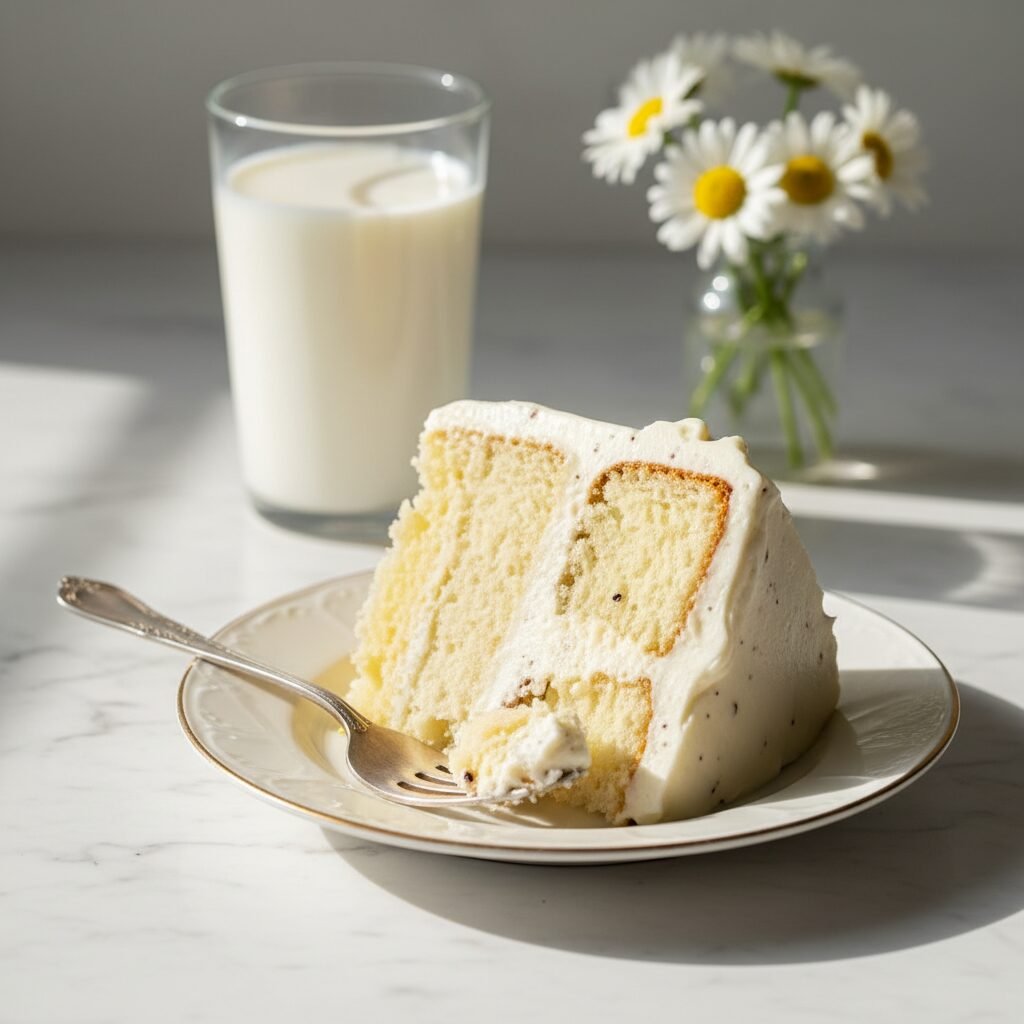
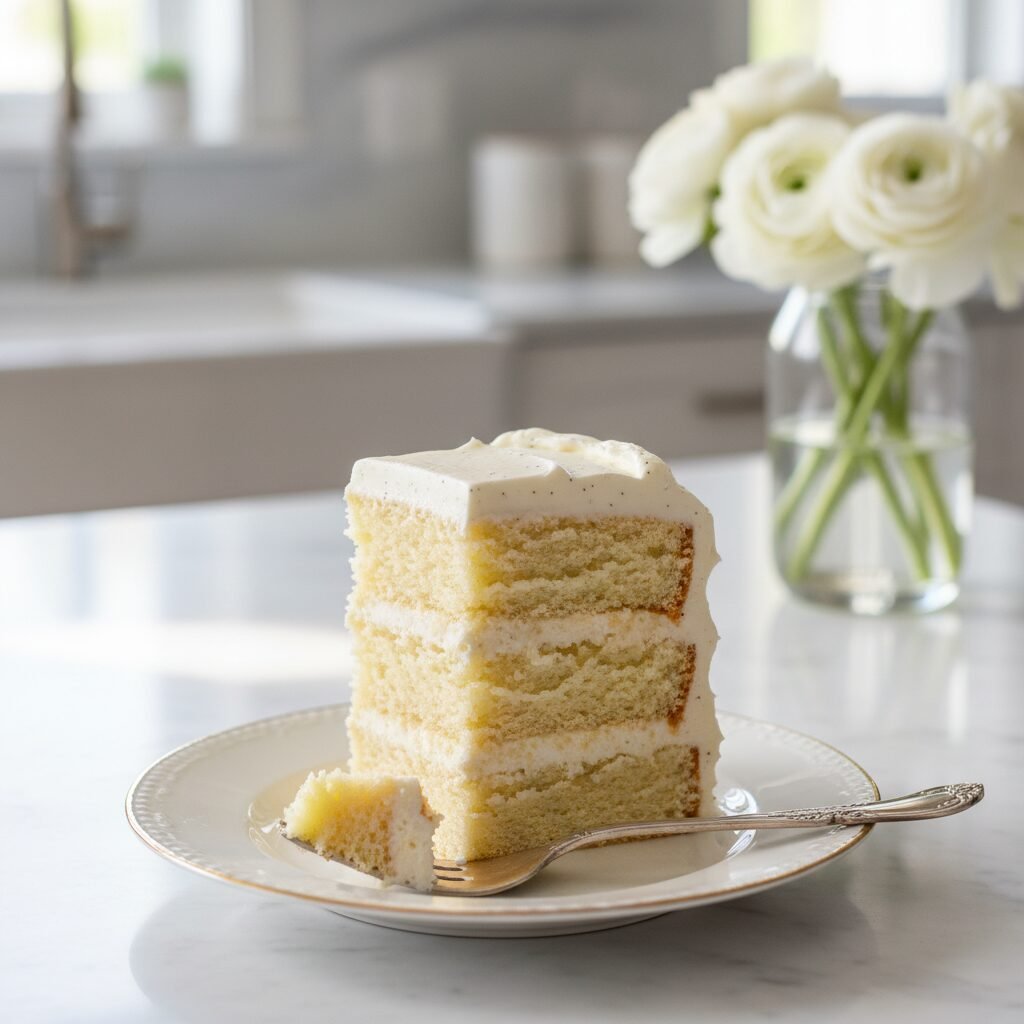
The result is a visually stunning dessert: pale, golden-white layers stacked high, enveloped in a rustic, speckled pink frosting that tastes like pure strawberries and cream. Whether you are a seasoned baker or a novice looking to impress, this cake promises a bakery-quality result right in your own kitchen. It is sweet, but not cloying; rich, but not heavy. It is, quite simply, a slice of happiness.
History & Origins
The history of the vanilla cake is deeply intertwined with the history of vanilla itself and the evolution of chemical leavening agents. Vanilla, derived from the orchid of the genus Vanilla, is native to Mexico. The Totonac people are believed to be the first to cultivate it, but it was the Aztecs who introduced it to the Spanish conquistador Hernán Cortés in the early 16th century. For centuries, vanilla was an exclusive luxury in Europe, primarily used to flavor chocolate drinks for the aristocracy. It wasn’t until the mid-19th century, with the invention of artificial pollination techniques by Edmond Albius, that vanilla became more accessible to the masses.
Simultaneously, the concept of “cake” was evolving. Early European cakes were essentially sweetened breads raised with yeast. The modern “layer cake” as we know it is a distinctly American innovation, born out of the development of baking powder in the 1840s and 1850s. This chemical leavener allowed for a lighter, fluffier texture that didn’t require hours of rising time or the intense labor of beating eggs to foam. By the late 19th century, the multi-layered cake filled with jams or jellies became a staple of American culinary culture.
The pairing of vanilla cake with fruit frostings gained popularity in the mid-20th century as refrigeration became standard and buttercream frostings replaced the older boiled icings. Strawberry frosting, specifically, often utilized seasonal berries or, later, strawberry gelatin powder. However, the return to artisanal baking in the 21st century has revived the use of fresh fruit reductions, honoring the natural flavor profile that defined early fruit preserves.
Why This Recipe Works
This recipe succeeds where others fail due to a precise understanding of baking chemistry. First, let’s talk about the fat. Butter is essential for flavor and structure—it helps aerate the batter during the creaming process, creating lift. However, butter is about 15-20% water and solidifies at room temperature, which can lead to a dry mouthfeel if the cake is cold. By substituting a portion of the butter with neutral oil (which remains liquid at room temperature and is 100% fat), we guarantee a cake that remains sensationally moist and tender, regardless of storage temperature.
Secondly, the use of cake flour instead of all-purpose flour is non-negotiable for that bakery-style texture. Cake flour has a lower protein content (around 7-8%), which inhibits gluten formation. Less gluten means a softer, more velvety crumb that melts in your mouth. We also incorporate sour cream into the batter. The acidity in the sour cream tenderizes the gluten strands further and reacts with the baking soda to provide additional lift, while its high fat content adds richness.
Finally, the strawberry buttercream uses a reduction technique. Fresh strawberries contain a lot of water. If you simply puree them and add them to butter and sugar, the emulsion will break, and the frosting will be runny. By simmering the puree until it reduces by half or more, we evaporate the water while concentrating the flavor and color. This creates a potent strawberry paste that blends seamlessly into the buttercream without compromising its structural integrity.
Why You’ll Love This Recipe
- ✓Stays moist for up to 4 days due to the oil-butter blend.
- ✓Intense, natural strawberry flavor using a fruit reduction.
- ✓No artificial food coloring or flavorings needed.
- ✓Velvety, soft crumb texture from cake flour and sour cream.
- ✓Stable buttercream that pipes beautifully.
- ✓Perfect balance of sweet and tart.
Equipment You’ll Need
- ✓Three 8-inch round cake pans
- ✓Stand mixer with paddle attachment
- ✓Medium saucepan
- ✓Food processor or blender
- ✓Kitchen scale
- ✓Wire cooling racks
- ✓Offset spatula
- ✓Parchment paper
- ✓Sifter
Ingredients
- ✓3 cups (345g) cake flour, sifted
- ✓1 tbsp baking powder
- ✓1/2 tsp baking soda
- ✓1 tsp salt
- ✓1 cup (226g) unsalted butter, room temperature
- ✓1/4 cup (60ml) vegetable or canola oil
- ✓1 3/4 cups (350g) granulated sugar
- ✓4 large eggs, room temperature
- ✓1 tbsp pure vanilla extract
- ✓1/2 cup (120g) sour cream, room temperature
- ✓1 cup (240ml) whole milk, room temperature
- ✓— For the Strawberry Frosting —
- ✓1 1/2 cups (225g) fresh strawberries, hulled and chopped
- ✓1 1/2 cups (340g) unsalted butter, slightly cool room temperature
- ✓5 cups (600g) powdered sugar, sifted
- ✓1 tsp vanilla extract
- ✓Pinch of salt
- ✓1-2 tbsp heavy cream (optional, for consistency)
Instructions
- 1. Prepare the Strawberry Reduction: Place the chopped strawberries in a food processor and puree until smooth. Transfer the puree to a small saucepan over medium heat. Simmer, stirring occasionally, until the mixture reduces to about 1/3 to 1/2 cup of thick, jam-like paste (approx. 15-20 minutes). Remove from heat and let it cool completely to room temperature. This is crucial.
- 2. Prep Oven and Pans: Preheat your oven to 350°F (175°C). Grease three 8-inch round cake pans with butter, line the bottoms with parchment paper, and grease the paper. Dust with flour and tap out the excess.
- 3. Mix Dry Ingredients: In a medium bowl, sift together the cake flour, baking powder, baking soda, and salt. Whisk to combine and set aside.
- 4. Cream Butter and Sugar: In the bowl of a stand mixer fitted with the paddle attachment, beat the softened butter, oil, and granulated sugar on medium-high speed for about 3-5 minutes. The mixture should look pale, fluffy, and aerated.
- 5. Add Eggs: Reduce speed to medium. Add the eggs one at a time, beating well after each addition and scraping down the sides of the bowl. Stir in the vanilla extract and sour cream until combined.
- 6. Combine: Reduce the mixer speed to low. Add the dry ingredients in three additions, alternating with the milk (begin and end with the dry ingredients). Mix only until just combined and no streaks of flour remain. Do not overmix.
- 7. Bake: Divide the batter evenly among the three prepared pans (use a kitchen scale for precision). Bake for 25-30 minutes, or until a toothpick inserted into the center comes out clean or with a few moist crumbs. The cakes should spring back lightly when touched.
- 8. Cool: Remove cakes from the oven and let them cool in the pans for 10 minutes. Then, gently invert them onto a wire rack to cool completely before frosting.
- 9. Make the Frosting: Clean the mixer bowl. Beat the 1 1/2 cups of butter on medium-high speed until creamy and pale (about 5 minutes). Gradually add the powdered sugar, one cup at a time, mixing on low. Once incorporated, increase speed to high and whip for 2 minutes.
- 10. Add Strawberry Reduction: Add the cooled strawberry reduction, vanilla extract, and a pinch of salt. Mix on medium speed until fully combined and fluffy. If the frosting is too stiff, add 1 tablespoon of heavy cream at a time until desired consistency is reached.
- 11. Assemble: Level the tops of the cooled cakes if necessary. Place one layer on a cake stand. Spread a generous layer of frosting on top. Repeat with the second and third layers. Frost the outside of the cake with the remaining buttercream. Garnish with fresh strawberries if desired.
Expert Cooking Tips
- ✓Room Temperature Ingredients: Ensure your butter, eggs, milk, and sour cream are all at room temperature. This creates a proper emulsion, trapping air for a fluffier cake.
- ✓Weigh Your Flour: Using a kitchen scale is far more accurate than measuring cups. Too much flour is the #1 cause of dry cake.
- ✓Cool the Reduction: Do not add warm strawberry puree to your buttercream, or the butter will melt and the frosting will become a soupy mess.
- ✓Don’t Overmix: Once the flour hits the liquid, gluten begins to form. Mix on low speed and stop as soon as the flour disappears to keep the cake tender.
- ✓Scrape the Bowl: Frequently scrape the bottom and sides of your mixer bowl to ensure all ingredients are incorporated evenly.
Substitutions and Variations
If you cannot find cake flour, you can make a DIY version: measure 1 cup of all-purpose flour, remove 2 tablespoons, and replace them with 2 tablespoons of cornstarch. Sift 3-4 times to combine. For a dairy-free version, substitute the butter with high-quality vegan butter blocks (not tub margarine) and use unsweetened almond or oat milk instead of cow’s milk; replace sour cream with a dairy-free yogurt. If you prefer not to use fresh strawberries, you can use freeze-dried strawberries. Pulverize about 1-1.5 cups of freeze-dried strawberries into a fine powder and whisk it into the buttercream along with the powdered sugar. This yields a very intense flavor and avoids the need for cooking a reduction. Canola oil can be swapped for any neutral oil like vegetable, grapeseed, or avocado oil.
Common Mistakes to Avoid
The most common mistake is over-baking the layers. Check the cakes 2-3 minutes before the recipe states; ovens vary greatly. Another issue is a split buttercream. This usually happens if the strawberry reduction was too wet or the butter was too cold. Ensure the reduction is thick (like tomato paste texture) and the butter is soft. If the batter looks curdled after adding the eggs, don’t panic; it will smooth out once the flour is added. Lastly, never try to frost a warm cake. The residual heat will melt the butter in the frosting, causing the layers to slide off one another.
Serving Suggestions
This cake is best served at room temperature. If the cake has been refrigerated, let it sit on the counter for at least 1-2 hours before serving to allow the butter in the cake and frosting to soften. Serve with a side of fresh berries, a sprig of mint, or a scoop of vanilla bean ice cream. For a beverage pairing, a glass of cold milk, a flute of champagne, or a cup of Earl Grey tea complements the floral vanilla and tart strawberry flavors perfectly.
Storage and Reheating Tips
Store the frosted cake at room temperature in a cake keeper for up to 2 days (unless your kitchen is very hot, then refrigerate). For longer storage, keep it in the refrigerator for up to 5 days; cover any cut sections with plastic wrap to prevent drying. The cake layers can be baked ahead of time, wrapped tightly in plastic wrap, and frozen for up to 3 months. Thaw frozen layers in the refrigerator overnight before frosting. The strawberry buttercream can also be frozen for up to 3 months; thaw and rewhip before using.
Nutrition Facts (Estimated)
| Serving Size | 1 slice |
| Calories | 680 |
| Fat | 38g |
| Saturated Fat | 22g |
| Unsaturated Fat | 14g |
| Trans Fat | 0.5g |
| Cholesterol | 115mg |
| Sodium | 320mg |
| Carbohydrates | 82g |
| Fiber | 1g |
| Sugar | 52g |
| Protein | 6g |
Frequently Asked Questions
Can I make this recipe as cupcakes?
Yes! This batter works perfectly for cupcakes. It will yield approximately 24-28 cupcakes. Bake them at 350°F for 18-22 minutes.
Why did my cake sink in the middle?
Sinking is usually caused by opening the oven door too early (releasing heat), under-baking the center, or using too much leavening (baking powder/soda).
Can I use frozen strawberries for the frosting?
Absolutely. Thaw them first, puree, and then reduce them on the stove exactly as you would with fresh berries. You might need to simmer slightly longer to evaporate the extra ice water.
My frosting is too soft, what do I do?
If the frosting is too runny, try chilling it in the fridge for 20 minutes and then whipping it again. If it’s still too soft, add more sifted powdered sugar, 1/4 cup at a time.
Can I use salted butter instead of unsalted?
Yes, but reduce the added salt in the recipe. For the cake, reduce salt to 1/2 tsp. For the frosting, omit the pinch of salt entirely.
How do I get flat cake layers?
You can use ‘cake strips’ wrapped around the pans to insulate the edges, preventing them from cooking faster than the center. Alternatively, simply trim the domes off with a serrated knife after cooling.
Is the strawberry reduction necessary?
Yes, for this specific buttercream recipe. Adding raw puree adds too much liquid, which will break the emulsion of the butter and sugar. The reduction concentrates flavor and removes moisture.
Can I make the cake layers in advance?
Yes, wrapping the warm layers in plastic wrap and freezing them immediately actually helps lock in moisture. You can bake them days or weeks in advance.
What if I don’t have a stand mixer?
A hand mixer works well too. You may need to beat the butter and sugar a bit longer to achieve the same fluffiness.
Conclusion
Baking this Moist Vanilla Layer Cake with Strawberry Frosting is a labor of love that pays off in every delicious bite. It transforms simple pantry staples into a centerpiece worthy of your most special occasions. The contrast between the creamy, speckled pink frosting and the tender golden crumb is not just a treat for the palate, but a feast for the eyes. Whether you are celebrating a milestone or just need a sweet pick-me-up, this recipe will never let you down. So, preheat your oven, hull those strawberries, and get ready to bake the best vanilla cake of your life. Happy baking!