Moist Vanilla Layer Cake With Vanilla Buttercream Recipe
This isn’t just another vanilla cake; it is the gold standard for what a celebration cake should be. Featuring a plush, tender crumb that stays moist for days and paired with a silky, whipped vanilla bean buttercream, this recipe delivers professional bakery-quality results right from your home kitchen.
45 minutes
30 minutes
1 hour 15 minutes
12-14 servings
Dessert
Baking
American
Vegetarian
In the world of baking, vanilla is often unfairly maligned as ‘plain’ or ‘boring,’ but a truly spectacular vanilla cake is anything but. It is a complex symphony of floral aromatics, buttery richness, and a texture that should be soft enough to melt in your mouth yet sturdy enough to hold towering layers of frosting. For years, home bakers have searched for the ‘Holy Grail’ of vanilla cakes—one that doesn’t taste like cornbread, isn’t dry as a bone, and doesn’t rely on a box mix. This recipe is the answer to that search.
What sets this specific cake apart is the careful engineering of the batter. We move beyond the standard creaming method by incorporating both high-quality butter and vegetable oil. The butter provides that classic, nostalgic flavor that we associate with birthday parties and weddings, while the oil ensures the crumb remains incredibly moist and tender, even days after baking. Furthermore, the addition of sour cream introduces a slight tang that cuts through the sweetness and an acidity that tenderizes the gluten strands, resulting in a velvety texture that feels luxurious on the palate.
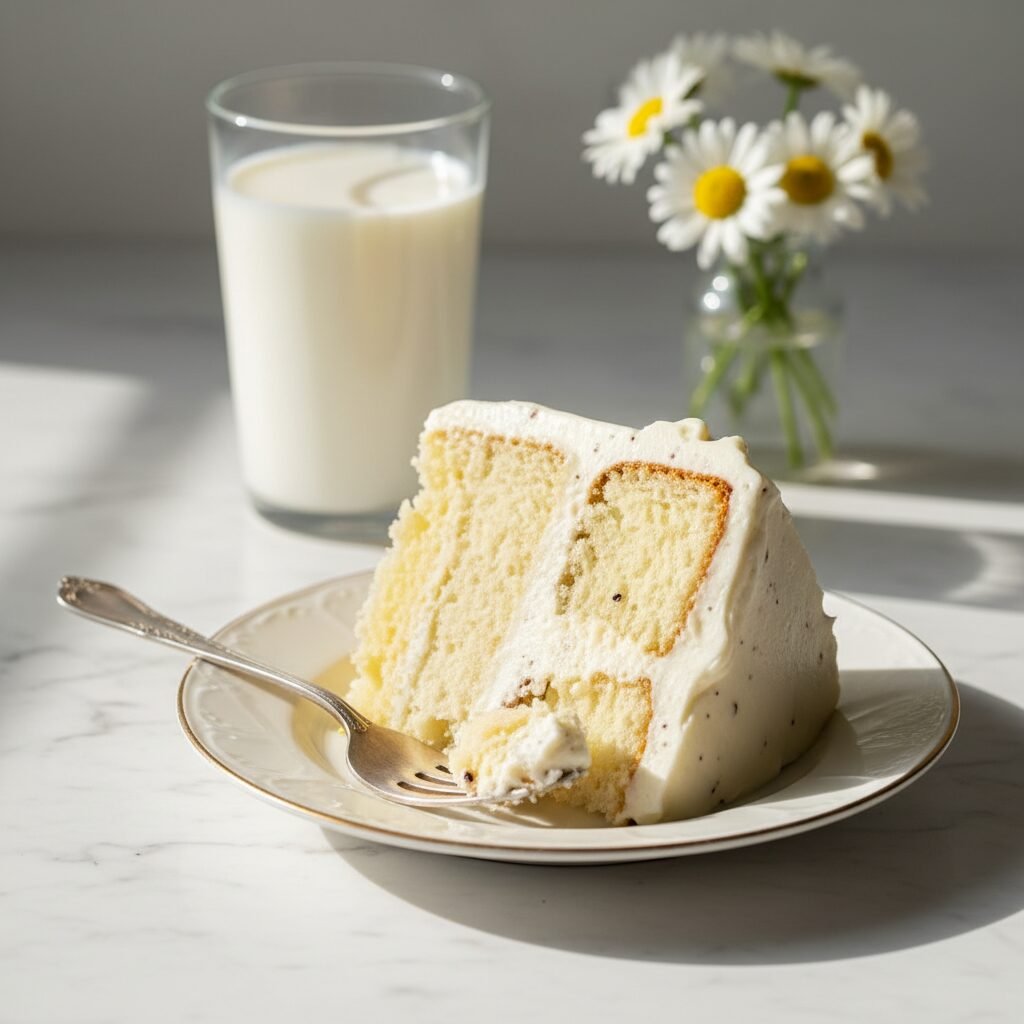
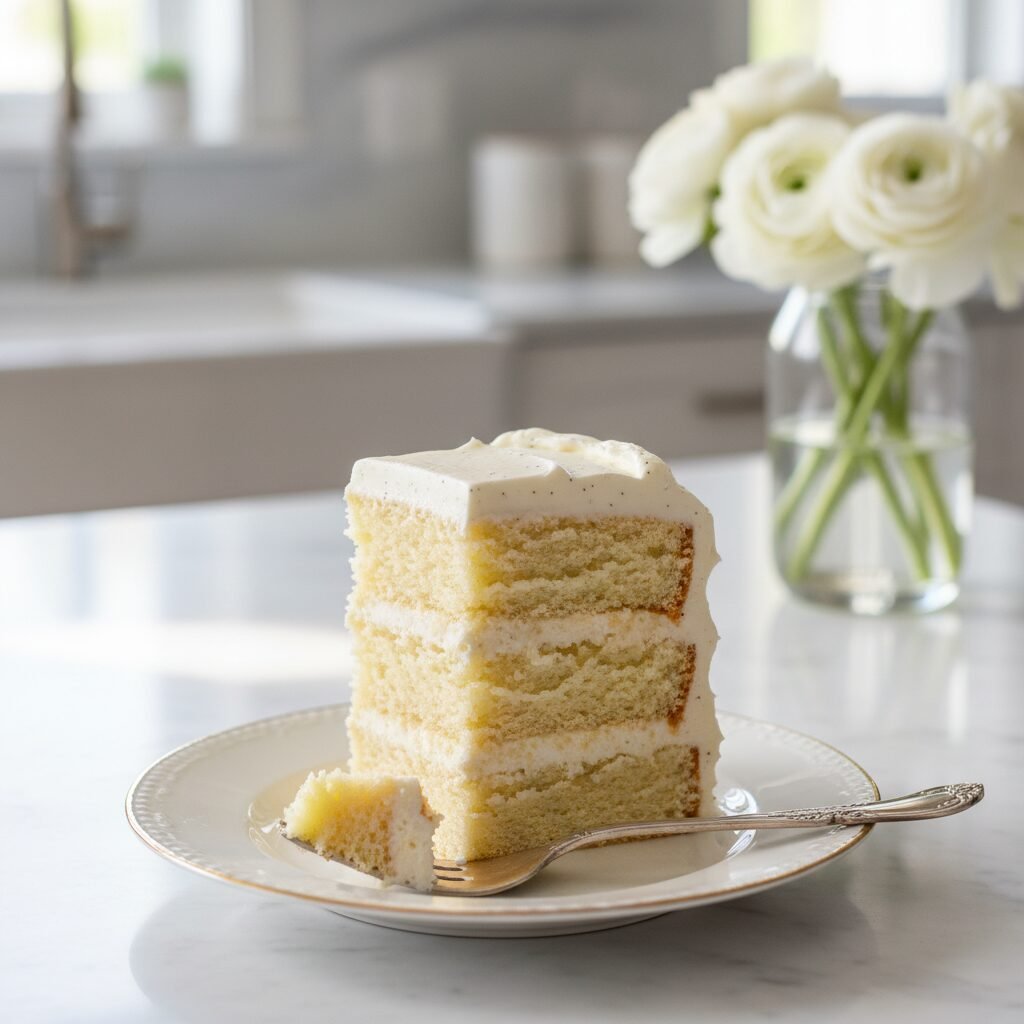
To top it all off, we pair the layers with a classic American Vanilla Buttercream that is whipped for an extended period to remove the gritty texture often associated with powdered sugar frostings. We use vanilla bean paste to introduce gorgeous little black specks that signal real, high-quality flavor. Whether you are baking for a birthday, a bridal shower, or simply because you crave a slice of comfort, this Moist Vanilla Layer Cake is a showstopper that proves vanilla is, in fact, the most delicious flavor of all.
History & Origins
The concept of the ‘cake’ has evolved drastically over millennia, but the modern vanilla layer cake is a relatively recent innovation in culinary history. The word ‘cake’ is of Viking origin, from the Old Norse word ‘kaka,’ but early cakes were essentially sweetened breads raised with yeast. It wasn’t until the mid-19th century, with the Industrial Revolution and the invention of chemical leavening agents like baking soda and baking powder, that the light, fluffy, sponge-like cakes we know today became possible. This shifted baking from a lengthy, labor-intensive process involving yeast fermentation to a quicker, more reliable chemical reaction.
Vanilla itself has a storied past. Native to Mexico and cultivated by the Totonacs and later the Aztecs, the vanilla orchid was brought to Europe by Spanish conquistadors. For centuries, it was an incredibly expensive luxury spice, reserved only for royalty and the ultra-wealthy. It wasn’t until the mid-19th century, when a 12-year-old enslaved boy named Edmond Albius on the island of Réunion discovered how to hand-pollinate the orchids, that vanilla became more accessible to the wider world.
The ‘layer cake’ is distinctly American. While European tortes often featured thin layers of sponge with jam or liqueur, the American style focused on thicker, tender cakes stacked high with generous amounts of frosting. By the early 20th century, with the mass production of refined white flour and sugar, the ‘white cake’ or ‘yellow cake’ became a staple of American domestic life. The classic Vanilla Layer Cake became the centerpiece of celebration culture in the United States, symbolizing joy, community, and the sweetness of life’s milestones. This recipe honors that tradition while utilizing modern food science to perfect the texture.
Why This Recipe Works
This recipe succeeds where many others fail due to a specific balance of fat, flour, and acidity. Many vanilla cakes rely solely on butter. While butter is king for flavor, it is 80% fat and 20% water; when it cools, it solidifies, which can lead to a dense or dry cake if not eaten at room temperature. By substituting a portion of the butter with neutral vegetable oil, which remains liquid at room temperature, we guarantee a cake that stays soft and moist for a significantly longer period.
The second pillar of success here is the use of cake flour instead of all-purpose flour. Cake flour has a lower protein content (usually around 7-9%) compared to all-purpose flour (10-12%). Less protein means less gluten formation during the mixing process. This results in a finer, tighter crumb structure that feels like velvet rather than bread.
Finally, the inclusion of sour cream is chemically vital. The acidity in the sour cream reacts with the baking soda (if used) and helps to break down gluten strands, tenderizing the cake further. It also adds a thickness to the batter that helps suspend the air bubbles created during the creaming of the butter and sugar, ensuring the cake rises evenly and doesn’t collapse. The result is a cake that is structurally sound for stacking but incredibly delicate to eat.
Why You’ll Love This Recipe
- ✓Stays moist for up to 4 days thanks to the oil-butter blend.
- ✓Uses cake flour for a professional, bakery-style fine crumb.
- ✓Sturdy enough for fondant or heavy decorations but soft to eat.
- ✓Infused with double vanilla flavor in both the sponge and frosting.
- ✓Freezes beautifully for make-ahead convenience.
Equipment You’ll Need
- ✓3 x 8-inch round cake pans
- ✓Stand mixer with paddle attachment
- ✓Large mixing bowls
- ✓Kitchen scale
- ✓Parchment paper
- ✓Wire cooling rack
- ✓Offset spatula
- ✓Piping bag and tips (optional)
- ✓Cake turntable (optional)
Ingredients
- ✓3 2/3 cups (420g) Cake flour, sifted
- ✓1 tsp Salt
- ✓1 tbsp Baking powder
- ✓1/2 tsp Baking soda
- ✓1 cup (226g) Unsalted butter, softened to room temperature
- ✓2 cups (400g) Granulated white sugar
- ✓1/2 cup (120ml) Vegetable oil (or canola oil)
- ✓1 tbsp Pure vanilla extract
- ✓4 large Eggs, room temperature
- ✓2 large Egg whites, room temperature
- ✓1 cup (240g) Sour cream, room temperature
- ✓1 cup (240ml) Whole milk, room temperature
- ✓FOR THE BUTTERCREAM:
- ✓2 cups (452g) Unsalted butter, softened slightly cool
- ✓7-8 cups (850g-950g) Powdered sugar, sifted
- ✓1 tbsp Vanilla bean paste (or pure extract)
- ✓1/4 cup (60ml) Heavy whipping cream
- ✓1/4 tsp Fine sea salt
Instructions
- 1. Preheat your oven to 350°F (175°C). Grease three 8-inch cake pans with butter or baking spray, line the bottoms with parchment paper circles, and grease the parchment. Dust with a little flour and tap out the excess.
- 2. In a medium bowl, whisk together the sifted cake flour, baking powder, baking soda, and salt. Set this dry mixture aside.
- 3. In the bowl of a stand mixer fitted with the paddle attachment, beat the softened butter on high speed for 2 minutes until creamy. Add the granulated sugar and vegetable oil.
- 4. Beat the butter, sugar, and oil mixture on medium-high speed for 3-4 minutes. The mixture should look white, fluffy, and aerated. Scrape down the sides and bottom of the bowl.
- 5. Turn the mixer to low-medium speed. Add the eggs and egg whites one at a time, mixing just until the yolk disappears before adding the next. Add the vanilla extract and mix to combine. Scrape the bowl again.
- 6. In a small bowl or jug, whisk together the room-temperature sour cream and whole milk until smooth.
- 7. With the mixer on low speed, add the dry ingredients in three additions and the wet ingredients (milk/sour cream) in two additions, starting and ending with the dry ingredients (Dry – Wet – Dry – Wet – Dry).
- 8. Mix until just combined and no streaks of flour remain. Do not overmix. Use a silicone spatula to give it one final fold by hand to ensure nothing is stuck at the bottom.
- 9. Divide the batter evenly among the three prepared pans (use a kitchen scale for precision, approx 550g per pan). Smooth the tops with an offset spatula.
- 10. Bake for 28-32 minutes, or until a toothpick inserted into the center comes out clean or with just a few moist crumbs. The cakes should spring back when gently pressed.
- 11. Remove from the oven and let the cakes cool in the pans for 20 minutes. Then, carefully invert them onto a wire rack to cool completely before frosting.
- 12. TO MAKE THE BUTTERCREAM: In a clean mixer bowl, beat the butter on medium-high speed for 5 minutes until it is very pale and creamy.
- 13. Reduce speed to low and gradually add the powdered sugar, about one cup at a time. Once all sugar is added, increase speed to high and beat for 3 minutes.
- 14. Add the vanilla bean paste, salt, and heavy cream. Beat on medium-high for another 2-3 minutes until the frosting is light, airy, and creamy. If it’s too stiff, add more cream 1 tsp at a time.
- 15. ASSEMBLE: If cake layers are domed, use a serrated knife to level them. Place one layer on a cake stand, spread a generous layer of buttercream, top with the next cake layer, and repeat. Cover the outside with a thin crumb coat, chill for 20 minutes, then apply the final layer of frosting.
Expert Cooking Tips
- ✓Room Temperature is Non-Negotiable: Your butter, eggs, milk, and sour cream MUST be at room temperature. Cold ingredients will cause the batter to curdle and result in a dense, uneven bake.
- ✓Weigh Your Flour: If you don’t have a scale, spoon the flour into the measuring cup and level it off. Scooping directly packs the flour and dries out the cake.
- ✓Don’t Overmix: Once you add the flour, mix only until combined. Overmixing develops gluten, making the cake tough instead of tender.
- ✓Calibrate Your Oven: Use an oven thermometer to ensure your oven is actually at 350°F. Many ovens run hot or cold, affecting bake time.
- ✓Cool Completely: Never try to frost a warm cake. The butter in the frosting will melt, and your layers will slide off.
- ✓Beat the Frosting: Beating the buttercream for several minutes is the secret to getting rid of the ‘powdery’ taste and achieving a silky texture.
- ✓Use Vanilla Bean Paste: For the frosting, paste adds visible black specks which look elegant and provide a stronger flavor punch than extract.
Substitutions and Variations
If you cannot find **cake flour**, you can make a DIY version: for every cup of all-purpose flour, remove 2 tablespoons of flour and replace them with 2 tablespoons of cornstarch, then sift 3 times. However, real cake flour yields the best results.
**Sour cream** can be substituted with full-fat plain Greek yogurt or room-temperature buttermilk. If using buttermilk, the batter will be slightly thinner, which is fine.
**Vegetable oil** can be swapped for canola oil, grapeseed oil, or melted coconut oil (though coconut oil may impart a slight flavor).
For the **milk**, whole milk is best for fat content, but 2% can work in a pinch. Avoid skim milk as it lacks the necessary richness.
If you prefer a **less sweet frosting**, you can try a Swiss Meringue Buttercream instead of the American Buttercream listed here, though it requires a different method involving heating egg whites and sugar.
Common Mistakes to Avoid
The most common mistake is **using cold ingredients**. When cold eggs hit creamed butter, the butter seizes up, breaking the emulsion. The batter will look curdled, and the cake won’t rise properly.
Another major error is **opening the oven door too early**. This releases heat and can cause the cake to collapse in the center before the structure has set. Wait until at least 25 minutes have passed before peeking.
**Over-baking** is the enemy of moisture. Check the cake a few minutes before the timer goes off. If the toothpick has wet batter, it needs time; if it has a few moist crumbs, it’s done. If the toothpick is bone dry, the cake might be slightly overdone.
Finally, **skipping the sifting** of the powdered sugar for the frosting often leads to lumpy, gritty buttercream that is unpleasant to eat.
Serving Suggestions
This cake is a versatile canvas. Serve it simply with the vanilla buttercream for a classic look. For birthdays, top with rainbow sprinkles or a chocolate drip ganache. It pairs beautifully with fresh berries—strawberries, raspberries, or blackberries cut through the sweetness of the frosting perfectly. For an elegant dinner party, serve thin slices with a dollop of tart lemon curd or a side of espresso to balance the sugar. If serving in summer, a scoop of strawberry ice cream on the side is delightful.
Storage and Reheating Tips
This cake stores exceptionally well thanks to the oil content.
**Room Temperature:** The frosted cake can stay at room temperature in a cake keeper or covered with a glass dome for up to 3 days. The sugar in the frosting acts as a preservative.
**Refrigerator:** If you live in a hot climate or want to keep it longer, store it in the fridge for up to 6 days. However, always let the cake come to room temperature for at least 1-2 hours before serving, as cold butter makes the cake feel dense and the frosting hard.
**Freezing:** You can freeze the baked, unfrosted layers wrapped tightly in plastic wrap for up to 3 months. You can also freeze slices of the fully frosted cake. Place slices on a baking sheet to freeze the frosting solid, then wrap them individually in plastic wrap and foil.
Nutrition Facts (Estimated)
| Serving Size | 1 slice |
| Calories | 680 |
| Fat | 34g |
| Saturated Fat | 18g |
| Unsaturated Fat | 14g |
| Trans Fat | 0g |
| Cholesterol | 95mg |
| Sodium | 310mg |
| Carbohydrates | 88g |
| Fiber | 1g |
| Sugar | 55g |
| Protein | 6g |
Frequently Asked Questions
Can I make this recipe into cupcakes?
Yes! This batter makes fantastic cupcakes. Fill liners 2/3 full and bake at 350°F for 18-22 minutes. It should yield about 24-30 cupcakes.
Why did my cake sink in the middle?
Sinking usually happens because the cake was underbaked (the center structure wasn’t set), the oven door was opened too early, or there was too much leavening (baking powder/soda) which caused it to rise too fast and then collapse.
Can I use salted butter instead of unsalted?
You can, but you lose control over the saltiness. If you only have salted butter, reduce the added salt in the recipe to 1/4 teaspoon.
How do I get flat cake tops?
You can use ‘cake strips’ (damp fabric strips wrapped around the pan) to insulate the edges, ensuring the cake rises evenly. Alternatively, simply slice the domes off with a serrated knife after baking for a chef’s snack!
Is this a ‘White Cake’ or a ‘Vanilla Cake’?
Technically, this is a Vanilla Cake (or Yellow Cake) because it uses whole eggs. A true ‘White Cake’ uses only egg whites to keep the crumb stark white. The yolks here add richness and tenderness.
Why is my buttercream gritty?
Gritty buttercream comes from powdered sugar that wasn’t dissolved or mixed enough. Sifting the sugar is crucial. Also, adding a tablespoon or two more cream and beating for longer helps dissolve the sugar crystals.
Can I use a hand mixer?
Yes, but it will take longer. Be prepared to beat the butter and sugar for at least 5-6 minutes to get the right aeration, and your arm might get a workout!
Can I bake this in 9-inch pans?
Yes, you can use two 9-inch pans instead of three 8-inch pans. Increase the baking time slightly, checking around the 30-35 minute mark.
How do I make the frosting less sweet?
American Buttercream is naturally sweet. Adding a pinch of salt cuts the sweetness. You can also add a little lemon juice to balance it, or switch to Swiss Meringue Buttercream which is much less sweet.
Can I make the cake layers ahead of time?
Absolutely. In fact, cake layers are easier to frost when they have been chilled. Bake them the day before, wrap in plastic, and keep in the fridge or freezer until you are ready to assemble.
Conclusion
Mastering the perfect Moist Vanilla Layer Cake is a milestone for any home baker. It transforms a simple gathering into a celebration and brings a sense of pride that a box mix simply cannot replicate. The combination of the tender, velvety crumb and the rich, vanilla-bean-flecked buttercream creates a dessert that is timeless, comforting, and undeniably delicious. Don’t be intimidated by the steps; baking is a science, and if you follow the measurements and temperature guides, you are guaranteed success. So, preheat that oven, let your butter soften, and get ready to bake the best vanilla cake of your life.