Moist Yellow Layer Cake With Strawberry Frosting Recipe
This classic yellow layer cake features a tender, buttery crumb that stays incredibly moist for days, paired with a vibrant, natural strawberry buttercream made from fresh fruit reduction. It is the quintessential celebration cake that tastes like the best version of your childhood memories.
45 minutes
30 minutes
2 hours 15 minutes (includes cooling)
12-14 Servings
Dessert
Baking
American
Vegetarian
There is something undeniably cheerful about a classic yellow cake. Unlike its delicate white cake cousin, which relies solely on egg whites for a cloud-like lift, or the dense richness of a chocolate mud cake, the yellow cake sits in a category all its own. It is the gold standard of American birthdays, potlucks, and Sunday family dinners. However, finding the perfect recipe that balances a sturdy structure with a melt-in-your-mouth texture can be surprisingly difficult. Too often, homemade yellow cakes turn out dry, cornbread-like, or lacking in that distinct buttery vanilla flavor we crave.
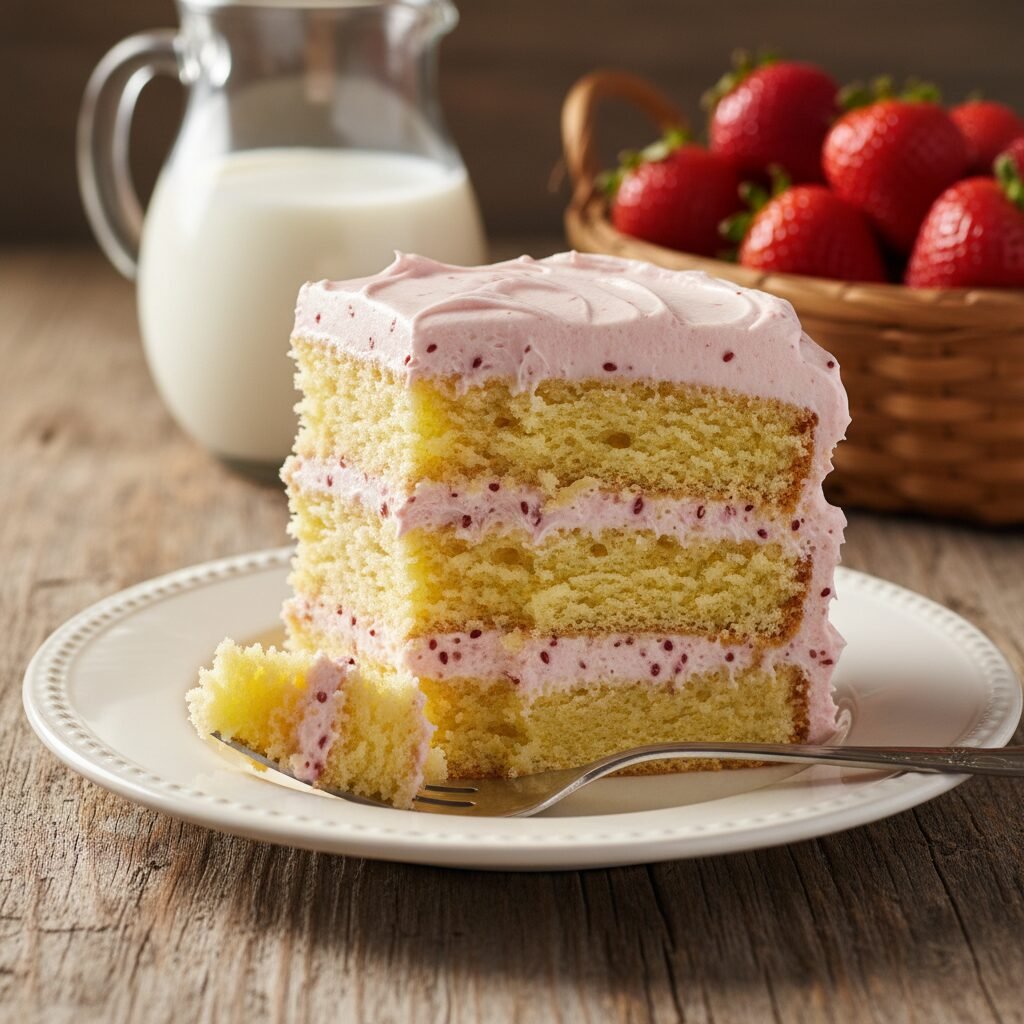
This recipe changes everything. We have ditched the standard creaming method for a ‘reverse creaming’ technique that guarantees a velvety, plush crumb every single time. But the cake layers are only half the story. The crowning jewel of this dessert is the fresh strawberry buttercream. We aren’t using artificial extracts or pink food coloring here. Instead, we cook down pounds of fresh strawberries into a concentrated jam-like reduction. This packs an explosion of authentic berry flavor into the frosting without compromising its stability. When you slice into this cake, the contrast between the golden, vanilla-scented sponge and the speckled, pastel-pink frosting is visually stunning and palate-pleasing. It’s sweet, but balanced by the tang of buttermilk and the acidity of the fruit. Whether you are celebrating a milestone or just need a slice of comfort, this Moist Yellow Layer Cake with Strawberry Frosting is destined to become your new family heirloom recipe.
History & Origins
The concept of the ‘layer cake’ is a relatively modern invention in the grand timeline of culinary history. For centuries, cakes were more akin to sweetened breads, raised with yeast and often studded with dried fruits. It wasn’t until the mid-19th century, with the invention of chemical leaveners like baking soda and baking powder, that the modern butter cake began to take shape. These new agents allowed home bakers to produce lighter, higher-rising cakes without the laborious process of beating eggs for hours or relying on finicky yeast cultures.
The specific distinction of the ‘Yellow Cake’ emerged as recipes began to diverge based on the use of eggs. ‘Silver’ or ‘White’ cakes utilized only egg whites to achieve a pristine, pale crumb, often reserved for weddings or high-society tea parties. Conversely, ‘Gold’ or ‘Yellow’ cakes utilized the whole egg, or sometimes extra yolks, resulting in a richer flavor and that signature golden hue. This style of cake became the workhouse of the American kitchen—dependable, sturdy, and flavorful.
During the post-WWII era, the introduction of boxed cake mixes solidified the ‘Yellow Cake with Chocolate Frosting’ or ‘Yellow Cake with Fruit Frosting’ as an icon of American suburbia. General Mills and Pillsbury marketed the yellow cake as the ultimate convenience. While these mixes defined the flavor profile for a generation—often characterized by an artificial vanilla and distinct chemical tenderness—they lacked the depth of a scratch-made cake. Today, we are seeing a renaissance of heritage baking, where the goal is to recreate that nostalgic ‘box mix’ texture using pure, high-quality ingredients like European butter, cake flour, and real vanilla bean paste.
Why This Recipe Works
This recipe succeeds where many others fail due to three critical scientific principles: the reverse creaming method, the fat blend, and the fruit reduction technique.
First, the **Reverse Creaming Method**: Instead of creaming butter and sugar first, we mix the butter into the dry ingredients until it resembles coarse sand. This coats the flour particles in fat, which inhibits gluten formation when the liquid is added. Less gluten development means a significantly more tender, velvety crumb that melts in your mouth, rather than a chewy or bready texture.
Second, the **Fat Blend**: We use a combination of butter and vegetable oil. Butter provides that undeniable flavor and structure, while oil—which remains liquid at room temperature—ensures the cake stays moist for days. A cake made with 100% butter can often dry out or become hard when cool; the addition of oil keeps the texture soft and springy.
Finally, the **Strawberry Reduction**: Adding fresh pureed fruit directly to buttercream is usually a disaster because the high water content causes the frosting to curdle or separate. By simmering the strawberry puree on the stovetop until it reduces by half or more, we evaporate the water while concentrating the flavor and acidity. This results in a potent strawberry ‘jam’ that flavors the buttercream intensely without breaking the emulsion, giving you a stable, pipeable frosting with a natural pink color.
Why You’ll Love This Recipe
- ✓Uses the reverse creaming method for an ultra-tender, plush crumb.
- ✓Combines butter and oil for superior moisture and flavor.
- ✓Frosting is flavored with real fruit reduction, not artificial extracts.
- ✓Sturdy enough for stacking but soft enough to melt in your mouth.
- ✓No artificial food coloring required; the strawberries provide a natural pink hue.
Equipment You’ll Need
- ✓Three 8-inch round cake pans or two 9-inch pans
- ✓Stand mixer with paddle attachment
- ✓Small saucepan (for strawberry reduction)
- ✓Food processor or blender
- ✓Kitchen scale
- ✓Parchment paper
- ✓Wire cooling rack
- ✓Offset spatula
Ingredients
- ✓FOR THE STRAWBERRY REDUCTION:
- ✓1 1/2 cups fresh or frozen strawberries, hulled and chopped
- ✓FOR THE YELLOW CAKE:
- ✓2 1/2 cups (300g) cake flour (sifted)
- ✓1 1/2 cups (300g) granulated sugar
- ✓1 1/2 tsp baking powder
- ✓1/2 tsp baking soda
- ✓1 tsp fine sea salt
- ✓3/4 cup (170g) unsalted butter, room temperature, cut into cubes
- ✓1/3 cup (80ml) neutral vegetable oil (canola or grapeseed)
- ✓2 large eggs, room temperature
- ✓2 large egg yolks, room temperature
- ✓1 tbsp pure vanilla extract
- ✓1 cup (240ml) buttermilk, room temperature
- ✓FOR THE STRAWBERRY BUTTERCREAM:
- ✓1 1/2 cups (340g) unsalted butter, slightly cool room temperature
- ✓4 to 5 cups (480g-600g) powdered sugar, sifted
- ✓Pinch of salt
- ✓1 tsp vanilla extract
- ✓Reduced strawberry puree (from step 1)
Instructions
- 1. Make the Strawberry Reduction: Place the strawberries in a food processor and puree until smooth. Pour into a small saucepan over medium-low heat. Simmer, stirring occasionally, until the mixture has reduced to about 1/3 cup. It should be thick like tomato paste. Remove from heat and let it cool completely. This can be done a day in advance.
- 2. Prep the Oven and Pans: Preheat oven to 350°F (175°C). Grease three 8-inch round cake pans (or two 9-inch pans), line the bottoms with parchment paper, and grease the parchment. Dust with flour and tap out excess.
- 3. Mix Dry Ingredients & Butter: In the bowl of a stand mixer fitted with the paddle attachment, combine cake flour, sugar, baking powder, baking soda, and salt. Mix on low speed for 30 seconds. Add the cubed butter and mix on low speed until the mixture resembles coarse sand or breadcrumbs. There should be no large chunks of butter left.
- 4. Add Wet Ingredients: In a separate jug or bowl, whisk together the eggs, egg yolks, oil, buttermilk, and vanilla extract. With the mixer on low speed, slowly pour about half of the liquid mixture into the dry ingredients. Increase speed to medium-high and beat for 2 minutes to build structure.
- 5. Finish Batter: Scrape down the sides and bottom of the bowl. Reduce speed to low and add the remaining liquid mixture in two batches, mixing just until combined after each addition. Do not overmix.
- 6. Bake: Divide the batter evenly between the prepared pans (use a kitchen scale for accuracy). Bake for 25-30 minutes, or until a toothpick inserted into the center comes out clean or with just a few moist crumbs. The cakes should spring back when gently pressed.
- 7. Cool: Let the cakes cool in the pans for 10 minutes, then turn them out onto a wire rack to cool completely before frosting.
- 8. Make the Frosting: In a clean mixer bowl with the paddle attachment, beat the butter on medium-high speed for about 5-7 minutes until it is very pale and creamy. Lower the speed and gradually add the powdered sugar, one cup at a time. Add the salt and vanilla.
- 9. Add Strawberry Reduction: Once the buttercream is fluffy, add the cooled strawberry reduction. Mix on medium speed until fully incorporated and airy. If the frosting is too soft, add a little more sugar; if too stiff, add a teaspoon of milk.
- 10. Assemble: Place one cake layer on your serving plate. Spread a generous layer of frosting over the top. Repeat with remaining layers. Cover the top and sides of the cake with the remaining frosting. Garnish with fresh strawberries if desired.
Expert Cooking Tips
- ✓Room Temperature Ingredients: It is non-negotiable that your butter, eggs, and buttermilk are at room temperature. Cold ingredients will not emulsify properly, leading to a dense or greasy cake.
- ✓Weigh Your Flour: For the most accurate results, use a kitchen scale. If you don’t have one, spoon the flour into the measuring cup and level it off—never scoop directly from the bag, which packs the flour down.
- ✓Cool the Reduction: Do not add warm strawberry puree to your butter; it will melt the butter and turn your frosting into soup. The reduction must be completely cool.
- ✓Don’t Overmix: Once the final liquid is added, mix only until combined. Overmixing develops gluten and makes the cake tough.
- ✓Scrape the Bowl: Stand mixers often leave a pocket of dry ingredients at the very bottom. Stop and scrape deeply with a spatula during the mixing process.
Substitutions and Variations
If you cannot find **cake flour**, you can make a substitute by measuring 1 cup of all-purpose flour, removing 2 tablespoons, and replacing them with 2 tablespoons of cornstarch. Sift this mixture twice before using. For the **buttermilk**, you can make a quick alternative by adding 1 tablespoon of white vinegar or lemon juice to a cup of whole milk and letting it sit for 5 minutes until thickened. If you prefer a **dairy-free** cake, use a high-quality plant-based butter block (not tub margarine) and almond milk mixed with vinegar for the buttermilk. For the oil, any neutral oil like canola, vegetable, or grapeseed works; melted coconut oil can be used but may impart a slight coconut flavor. If fresh strawberries are out of season, **frozen strawberries** work perfectly for the reduction since they are being cooked down anyway.
Common Mistakes to Avoid
The most common mistake with yellow cake is **over-baking**. Because yellow cake has a golden color naturally, it can be hard to tell when it’s done by sight alone. Rely on the toothpick test and the ‘spring back’ method. Another major pitfall is **improper creaming** (or in this case, reverse creaming). Ensure the butter is fully worked into the flour before adding liquids; if large chunks of butter remain, you will get holes in your cake. Regarding the frosting, a common error is **not reducing the puree enough**. If the puree is watery, the frosting will separate. It needs to be a thick paste. Lastly, frosting the cake while it is still slightly warm is a disaster recipe; the butter in the frosting will slide right off. Patience is key.
Serving Suggestions
This cake is a stunner on its own, but it looks particularly beautiful when garnished with fresh, whole strawberries (leaves on for color contrast) or edible flowers like pansies or nasturtiums. Serve it at room temperature, not cold from the fridge, to allow the butter in the cake and frosting to soften for the best texture and flavor release. A glass of cold milk or a flute of champagne pairs perfectly with the sweet berry notes. For a summer twist, serve with a side of macerated berries.
Storage and Reheating Tips
The high sugar and fat content act as preservatives, keeping this cake fresh. It can be stored at room temperature in an airtight cake carrier for up to 3 days. If your kitchen is very hot (above 75°F), store the cake in the refrigerator to prevent the buttercream from melting, but allow it to come to room temperature for an hour before serving. For long-term storage, you can freeze the baked, unfrosted layers wrapped tightly in plastic wrap for up to 2 months. You can also freeze individual slices of the finished cake; place them on a baking sheet to freeze the frosting solid, then wrap tightly in plastic wrap and foil.
Nutrition Facts (Estimated)
| Serving Size | 1 slice |
| Calories | 650 |
| Fat | 34g |
| Saturated Fat | 18g |
| Unsaturated Fat | 14g |
| Trans Fat | 0g |
| Cholesterol | 95mg |
| Sodium | 320mg |
| Carbohydrates | 82g |
| Fiber | 1g |
| Sugar | 48g |
| Protein | 6g |
Frequently Asked Questions
Can I make this recipe as cupcakes?
Yes! This recipe translates beautifully to cupcakes. It will yield approximately 24-28 cupcakes. Bake them at 350°F for 18-22 minutes. Watch them closely as they bake faster than whole cakes.
Why is my cake dense instead of fluffy?
Dense cake is usually caused by over-mixing the batter (developing too much gluten) or using expired leavening agents (baking powder/soda). It can also happen if your ingredients were cold, preventing proper emulsification.
Can I use freeze-dried strawberries instead of fresh?
Absolutely. In fact, freeze-dried strawberries are an excellent shortcut. Grind about 1 cup of freeze-dried strawberries into a fine powder and whisk it into the buttercream. You get intense flavor without adding any liquid.
Do I have to use cake flour?
For the specific texture promised in this recipe—tender and velvety—cake flour is highly recommended because it has a lower protein content. All-purpose flour will result in a slightly tougher, more bread-like crumb.
Why do you use both butter and oil?
Butter provides the classic yellow cake flavor, while oil ensures the cake stays moist. Butter is solid at room temperature, which can make cakes feel dry; oil stays liquid, keeping the crumb soft.
Can I prepare the cake layers in advance?
Yes. Bake the layers, let them cool completely, wrap them individually in plastic wrap, and store them at room temperature overnight or freeze them for up to a month. Freezing layers actually makes them easier to frost.
My frosting looks curdled after adding the strawberry puree. What do I do?
This happens if the temperature difference is too great or the puree was too watery. Keep whipping on high speed; it often comes back together. If not, warm the bowl slightly (wrap a warm towel around it) and whip again to help the fats emulsify.
Is the strawberry reduction necessary?
If you want fresh strawberry flavor, yes. Simply adding pureed berries adds too much water. The reduction concentrates the flavor and removes the water so your frosting stays stable.
Can I use salted butter?
We recommend unsalted butter so you can control the sodium level. If you only have salted butter, omit the additional salt listed in the ingredients.
Conclusion
There are few things in life as satisfying as mastering a classic yellow cake. It is a testament to the magic of baking—how simple ingredients like flour, butter, and eggs can transform into something that evokes such joy and nostalgia. The burst of real strawberry flavor in the frosting elevates this from a standard birthday cake to a gourmet experience. Whether you are an experienced baker or trying your first layer cake, this recipe is designed to guide you to success. So, preheat your oven, hull those strawberries, and get ready to bake the best cake of your life. We can’t wait to hear how it turns out!